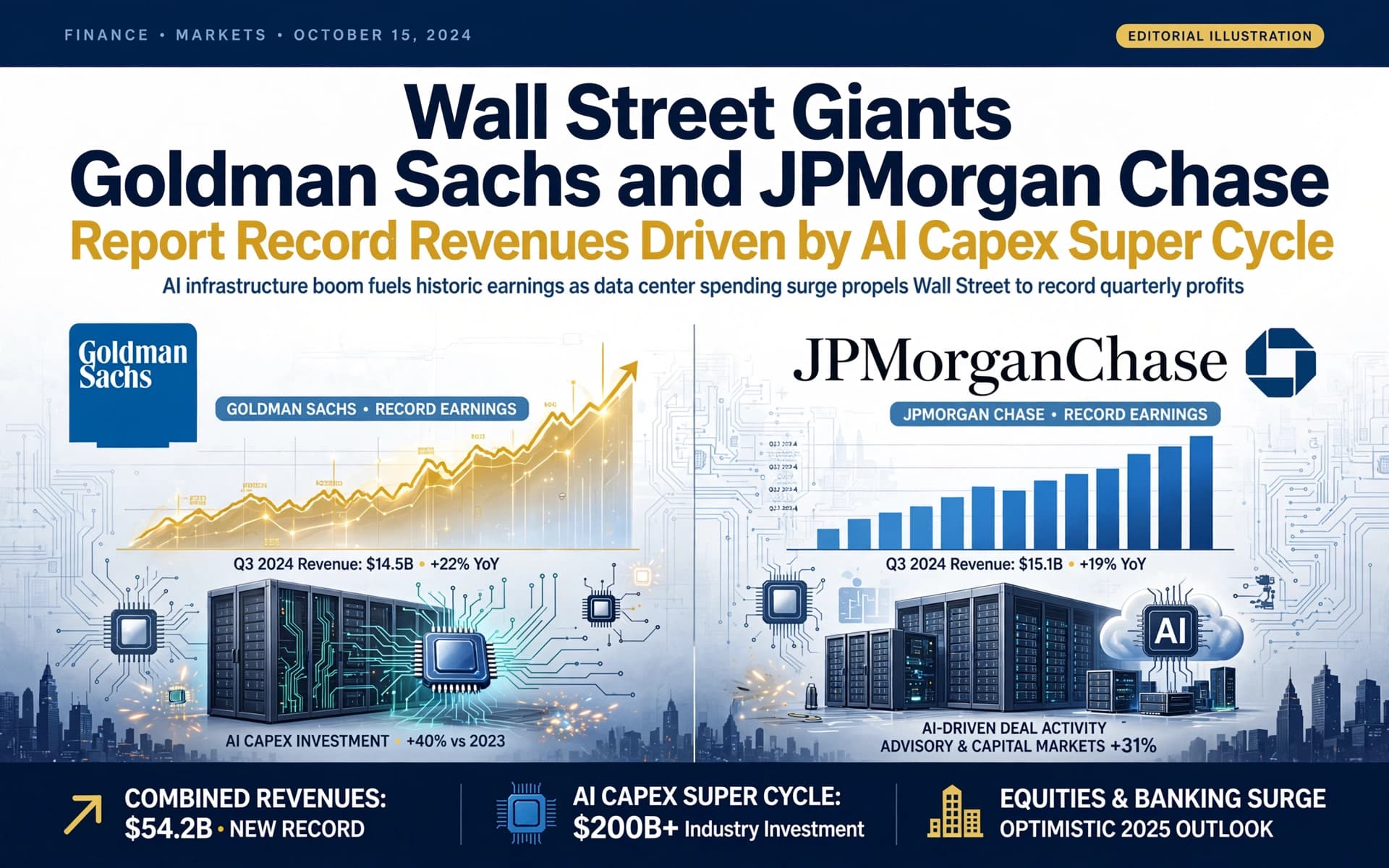
The financial architecture of Wall Street is undergoing a fundamental shift as the capital expenditure cycle surrounding AI begins to manifest in the balance sheets of the world's largest investment banks. The second quarter of 2026 has signaled a definitive turning point, moving beyond speculative hype into a phase of realized, high-volume transaction activity.
As corporations pivot capital allocation strategies toward massive infrastructure builds, the institutions facilitating these flows are seeing significant surges in both trading volumes and advisory fees. This surge is not localized to a single sector but is instead a systemic response to the scale of capital being deployed into the AI ecosystem.
From equity issuances to complex mergers and acquisitions, the financial machinery required to fund the next generation of computing power is operating at maximum capacity.
Record-Breaking Quarterly Performance
The latest fiscal data reveals a significant acceleration in revenue generation across the primary tier of global banking institutions.
| Institution | Reported Quarterly Revenue | Percentage Increase |
|---|---|---|
| Goldman Sachs | $20.3 Billion | 39% |
| JPMorgan Chase | $58.0 Billion | 27% |
| Bank of America | N/A | N/A |
These figures represent an expansion in liquidity and transaction velocity, driven primarily by the intense demand for capital in the technology and energy sectors.
Drivers of the Capital Super Cycle
The current financial momentum is rooted in a fundamental realignment of corporate spending, specifically targeting the physical and digital infrastructure required for large-scale AI deployment.
- The AI investment cycle reached a critical point in the second quarter, transitioning from software experimentation to hardware and energy infrastructure builds.
- Massive equity issuances, such as Alphabet's $90 billion move, have provided the liquidity for tech giants to fund data center expansions.
- A surge in equities trading activity, fueled by high-frequency institutional rebalancing, has bolstered the non-interest income of major banks.
- Complex M&A activity, exemplified by the Dominion Energy and NextEra Energy transaction, highlights the intersection of energy needs and technological growth.
This convergence of technology and energy requirements has created a feedback loop that benefits both the advisory and trading arms of major investment banks.
Transactional Breakdown and Sector Specifics
The revenue growth is not uniform across all business lines, with equities and investment banking emerging as the primary engines of the current windfall.
| Business Segment | Goldman Sachs Revenue | JPMorgan Chase Revenue |
|---|---|---|
| Equities Trading | $7.42 Billion (+72%) | $6.0 Billion (+86%) |
| Investment Banking | $3.4 Billion (+55%) | $3.3 Billion (+30%) |
The dominance of equities trading is particularly notable, with JPMorgan Chase seeing an 86% increase, reflecting the volatility and volume inherent in the current market regime.
Broad Market Implications
The performance of these banking giants serves as a leading indicator for the broader health of the global economy and the sustainability of the current tech-driven expansion.
- The scale of recent deals, such as the SpaceX IPO, suggests that private-to-public transitions are accelerating as companies seek to capitalize on high valuations.
- Increased investment in energy infrastructure, such as the Dominion Energy sale to NextEra Energy, indicates that the AI boom is fundamentally an energy-security issue.
- The volume of capital being moved suggests a potential period of sustained high activity, though the exact duration remains a subject of debate.
While the current growth is robust, the market is closely watching for signs of whether this represents a temporary spike or a long-term structural shift in global capital flows.
Outlook
As we move into the second half of 2026, the financial sector remains heavily indexed to the continued expansion of the AI sector. The capital expenditures required for next-generation compute clusters are no longer a projection but a present-day reality reshaping the revenue models of firms like Goldman Sachs and JPMorgan Chase.
While the current momentum is evident, several variables remain unquantified. The market is currently awaiting further clarity on the specific details of the SpaceX IPO and the exact timeline for the three-to-five year investment cycle mentioned by Goldman Sachs leadership.
Furthermore, upcoming earnings reports from Morgan Stanley will be critical in determining if this trend is a broad-based industry phenomenon or a concentrated success for top-tier players. Ultimately, the intersection of equity issuances and the energy transition will dictate the next phase of Wall Street's evolution.
As companies like Alphabet and NextEra Energy continue to lead capital deployment, the banks facilitating these movements will remain the primary beneficiaries of this technological transition.