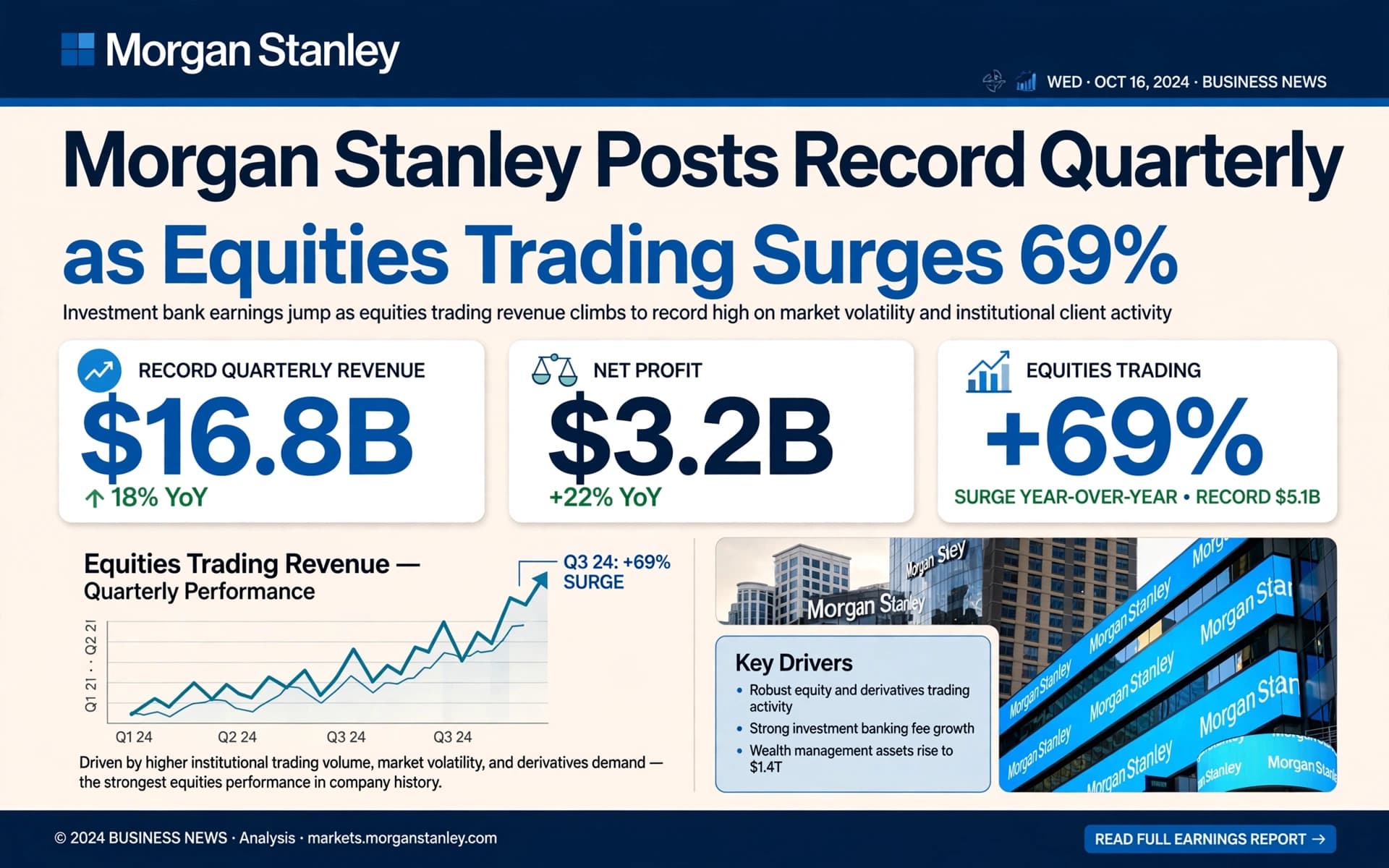
Morgan Stanley's quarterly earnings have shattered records, with the financial giant posting a 58% surge in profit to $5.58 billion. The bank's revenue also reached a new high, standing at $21.35 billion. This impressive performance is largely attributed to a 69% increase in equities trading revenue, which hit a record $6.3 billion. As the global economy continues to navigate uncertain waters, Morgan Stanley's robust earnings serve as a beacon of hope for investors.
These numbers are a testament to the bank's diversified business model, which has allowed it to weather the economic storm. The firm's wealth management division has shown remarkable resilience, with revenue climbing 14% to $8.86 billion. Investment banking revenue also surged 58% to $2.44 billion, while fixed income trading rose 13% to $2.46 billion. Even the firm's smallest division, investment management, managed to eke out a 6% increase in revenue to $1.65 billion.
Record-Breaking Earnings
| Key Highlights | Details |
|---|---|
| Revenue | $21.35 billion |
| Profit | $5.58 billion (58% increase) |
| Equities Trading Revenue | $6.3 billion (69% increase) |
| Investment Banking Revenue | $2.44 billion (58% increase) |
| Fixed Income Trading | $2.46 billion (13% increase) |
The bank's record-breaking earnings are a significant boost to its stock price, which is likely to see a surge in the coming days. Morgan Stanley's strong performance is also a reflection of its ability to adapt to changing market conditions. As the global economy continues to evolve, the bank's diversified business model will be crucial in navigating the challenges ahead.
Driving Factors Behind the Surge
Several factors have contributed to Morgan Stanley's impressive earnings. The bank's investment banking division has seen a significant increase in revenue, driven by a surge in deal activity. The firm's wealth management division has also performed well, with revenue climbing 14% to $8.86 billion. Additionally, the bank's fixed income trading business has seen a 13% increase in revenue, driven by a rise in interest rates.
- The bank's investment banking division has seen a significant increase in revenue, driven by a surge in deal activity.
- The firm's wealth management division has performed well, with revenue climbing 14% to $8.86 billion.
- The bank's fixed income trading business has seen a 13% increase in revenue, driven by a rise in interest rates.
Deal Structure and Key Features
| Key Features | Details |
|---|---|
| Investment Banking Revenue | $2.44 billion (58% increase) |
| Fixed Income Trading | $2.46 billion (13% increase) |
| Equities Trading Revenue | $6.3 billion (69% increase) |
Morgan Stanley's strong earnings are a reflection of its ability to adapt to changing market conditions. As the global economy continues to evolve, the bank's diversified business model will be crucial in navigating the challenges ahead.
Broader Market Impact
Morgan Stanley's earnings are likely to have a positive impact on the broader market. The bank's strong performance is a reflection of its ability to adapt to changing market conditions. As the global economy continues to evolve, Morgan Stanley's diversified business model will be crucial in navigating the challenges ahead.
- The bank's strong earnings are likely to boost investor confidence in the financial sector.
- The firm's diversified business model will be crucial in navigating the challenges ahead.
- The bank's performance is a reflection of its ability to adapt to changing market conditions.
Outlook
As the global economy continues to navigate uncertain waters, Morgan Stanley's robust earnings serve as a beacon of hope for investors. The bank's diversified business model has allowed it to weather the economic storm, and its strong performance is a reflection of its ability to adapt to changing market conditions. As the firm continues to navigate the challenges ahead, its ability to adapt and innovate will be crucial in driving future growth. With its strong earnings and diversified business model, Morgan Stanley is well-positioned to navigate the complexities of the global economy.