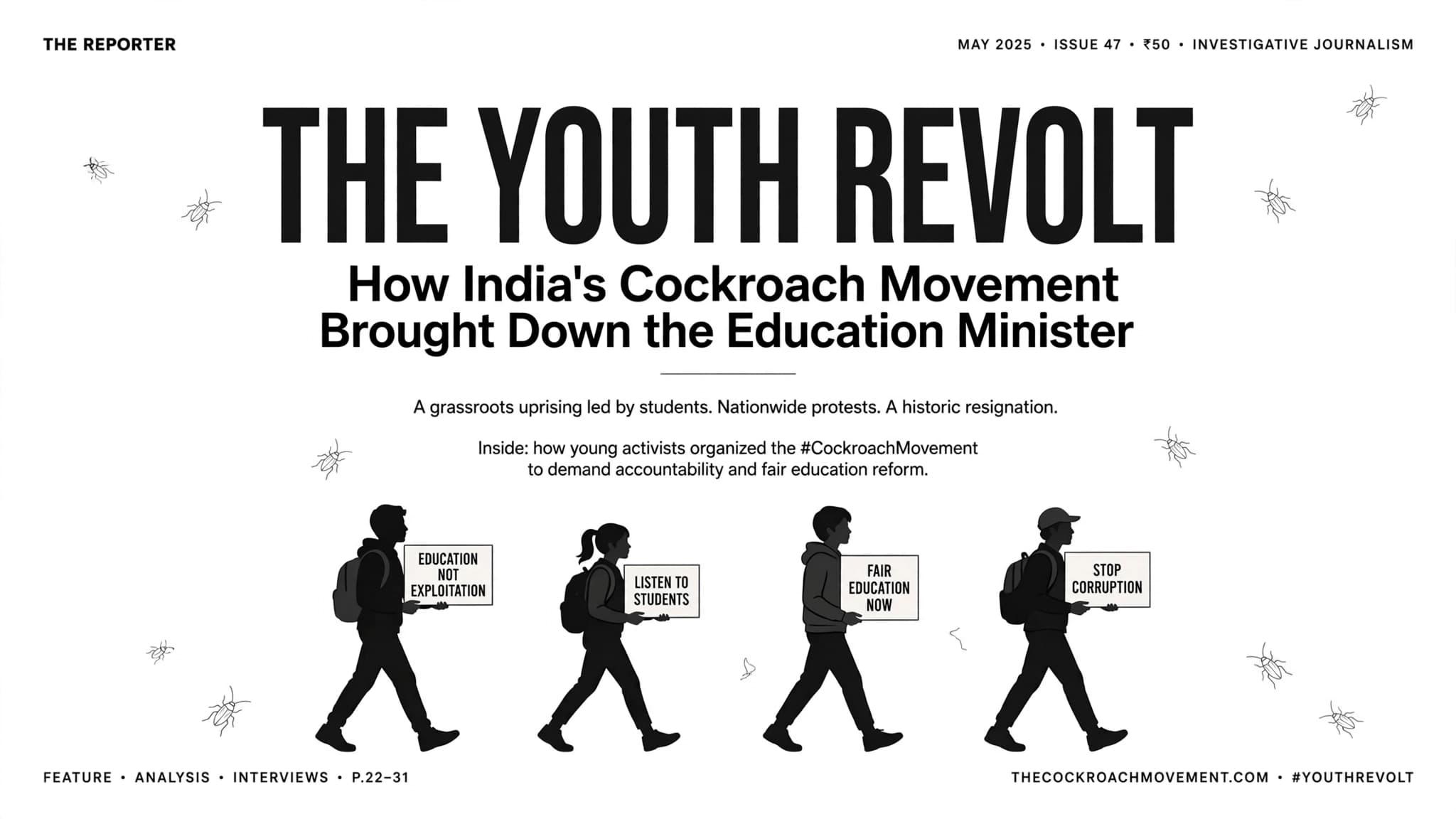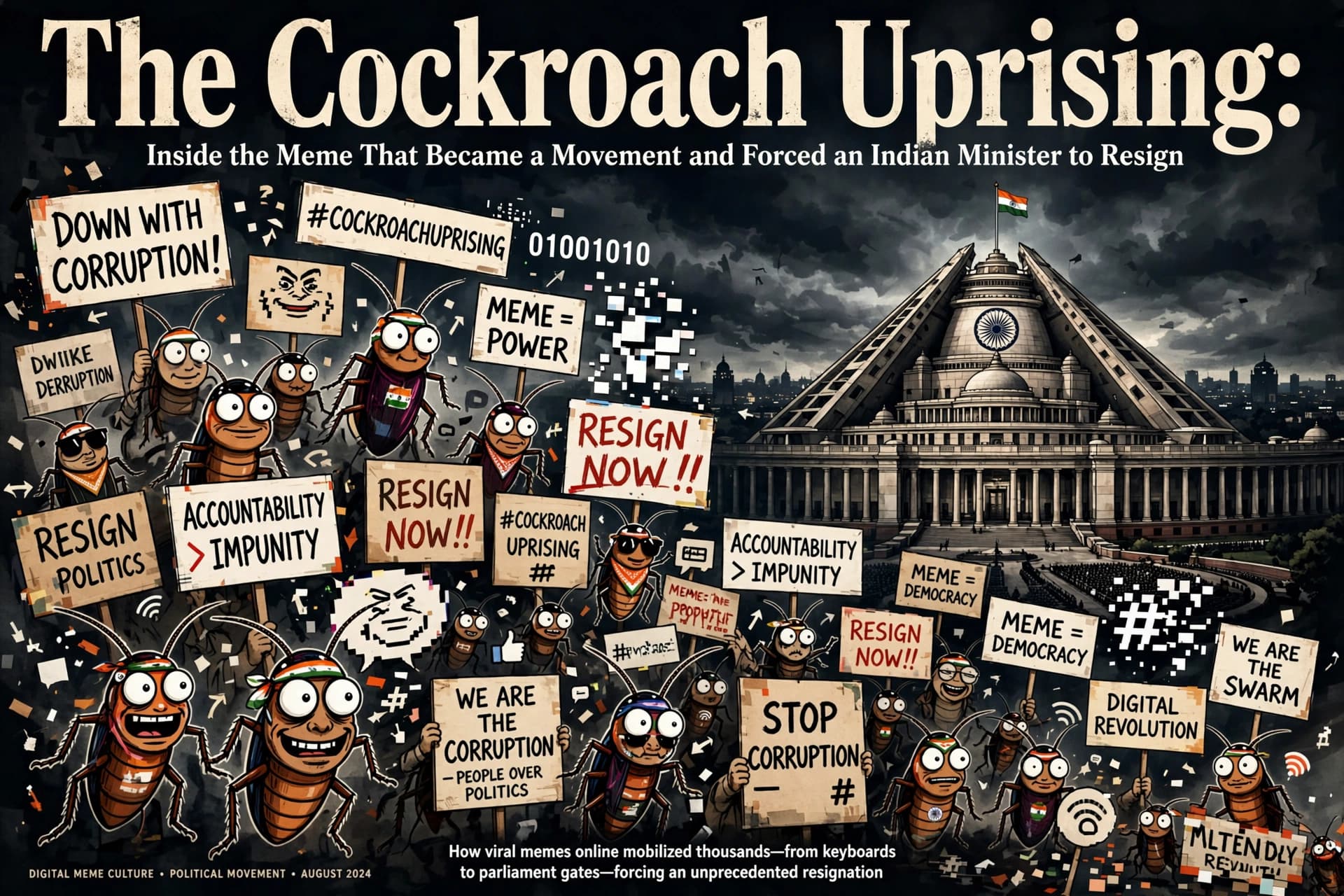
There is a particular kind of Delhi summer evening where the air over Jantar Mantar smells of tear gas, roasted corn, and phone chargers running low. For nearly two months in the middle of 2026, that smell became the backdrop to one of the most unusual political upheavals independent India has witnessed in a decade. It started, almost unbelievably, with a joke. A judge in the country's highest court compared unemployed young Indians to cockroaches. Within seventy two hours, a twenty something political communications graduate had turned that insult into a social media page. Within a week, that page had more followers than the ruling party of the world's largest democracy. Within two months, tens of thousands of students, engineers, doctors in waiting, out of work graduates and a soft spoken Ladakhi engineer with a history of hunger strikes had turned central Delhi into a running standoff with the state, and the sitting Union Education Minister had resigned.
This is the story of how it happened, as completely and as neutrally as the record allows: the courtroom line that lit the fuse, the young man who built a movement out of self mockery, the online explosion that outran the ruling party's own social media machine, the hunger strike that nearly ended in tragedy, the marches, the metro shutdowns, the baton charges, the ministers who tried to calm things down and the ones who mocked the protesters, the accusations of foreign funding that the government's own external affairs ministry could not confirm, the infiltrators who tried to hijack a peaceful sit in with stones and chaos, the memes that refused to stop coming even as tear gas filled the air, and finally, the resignation letter that landed on a Saturday afternoon in July.
Where It Began: A Line About Cockroaches
Every movement needs an origin story, and this one has an unusually specific one: a single sentence spoken inside a courtroom.
On 15 May 2026, the Chief Justice of India, Surya Kant, was hearing a matter connected to fake degrees and professional ethics when he made an off the cuff remark about a certain type of unemployed young Indian. According to multiple independent accounts of the hearing, the Chief Justice said there were young people "like cockroaches" who could not find employment or a place in any profession, and that some of them turned to journalism, social media activism or Right to Information campaigns, and "start attacking everyone." He is also reported to have used the word "parasites" in the same breath, describing people who attack the system without contributing to it.
The Chief Justice later clarified that his comments were directed at individuals holding spurious degrees, not at India's youth as a whole. But by the time that clarification arrived, the word had already escaped the courtroom and taken on a life nobody could have predicted. Legal commentary shows are a niche corner of Indian media, but this particular clip did not stay niche for long. Screenshots and short video clips of the remark spread across Instagram, X and WhatsApp groups with the speed that only genuinely aggrieved young people can generate. For a generation already frustrated by repeated examination scandals, a shrinking job market, and a sense that the country's institutions spoke about them more than they listened to them, the cockroach line landed as confirmation of something they already suspected: that the people running the system saw them as vermin.
Somewhere in Aurangabad, Maharashtra, officially renamed Chhatrapati Sambhajinagar, a thirty year old political communications strategist named Abhijeet Dipke read the remark and asked a simple, almost throwaway question on social media: what if all the cockroaches came together?
The Birth of the Cockroach Janta Party
Abhijeet Dipke was, by most accounts, an unremarkable candidate to lead a nationwide movement. Born in 1995 in Aurangabad to a middle class family, he studied journalism and public communication in Pune before moving to the United States, where he completed a Master of Science degree in Public Relations at Boston University's College of Communication. Before any of this made headlines, he had briefly worked as a social media volunteer for the Aam Aadmi Party, giving him a working knowledge of how a comparatively young political outfit could use digital platforms to compete with larger, better funded rivals. At the time the cockroach remark went viral, Dipke had recently finished his degree and was, by his own account, simply looking for a job.
What he built instead, within twenty four hours of the Chief Justice's remark, was the Cockroach Janta Party, styled CJP, a deliberate echo of the ruling Bharatiya Janata Party's own initials. He registered a website, designed a logo built around a smartphone with antennae, wrote a manifesto, and posted the first announcements from what would soon be one of the most talked about accounts in the country. The tagline he chose set the tone for everything that followed: "Voice of the Lazy and Unemployed." It was self deprecating, absurd, and completely disarming, and it worked precisely because it refused to dignify the insult with outrage. Instead of rejecting the cockroach label, the movement embraced it, weaponised it, and turned it into a badge.
The growth numbers that followed are, by any measure, extraordinary. The CJP's Instagram account reportedly crossed three million followers within seventy eight hours of launch. It passed ten million followers in under five days, a threshold at which it had already overtaken the official Instagram handle of the Bharatiya Janata Party, one of the best resourced political communications operations in the world. Within roughly a week, various counts placed the account beyond twenty million followers, eclipsing both the BJP and the Indian National Congress, India's two largest political parties, on the platform. The party's website claimed more than 350,000 registered "members" within the same window, though it is worth stressing, as most credible reporting on the CJP has, that this is not a party registered with the Election Commission of India. It is, by its own description and by its founder's own account, a satirical political movement, a caricature of a party rather than a functioning electoral outfit.
Understanding why the joke caught fire requires understanding the ground it fell on. India's young people, particularly the generation now often described as Gen Z, have spent the last several years absorbing a specific combination of grievances: chronic youth unemployment and underemployment, a seemingly endless run of examination leaks and administrative failures in competitive tests that are supposed to be the fairest route to upward mobility, and what many young Indians describe as a persistent elite condescension toward them, alternating between paternalistic advice and open suspicion of their motives. The cockroach remark did not create these frustrations. It simply gave them, for the first time, a single unifying, shareable, almost comic symbol.
From Meme to Movement: The First Street Protest
Digital anger has a way of staying digital in India, dissipating into the endless churn of the timeline. What made the CJP different was Dipke's decision, within weeks of the movement's launch, to physically return to India and take the protest to the street.
On 6 June 2026, the Cockroach Janta Party held its first physical demonstration at Jantar Mantar in New Delhi, a site with its own long history as India's designated protest ground, and one that had not seen a major sustained demonstration since the wrestlers' protest of 2023. Hundreds of supporters, most of them students and recent graduates, arrived wearing cockroach masks and carrying dog eared examination preparation books alongside the national flag, a visual combination that captured the movement's central argument: these were not anti national agitators, they were young Indians who had done everything asked of them and still felt failed by the system. Delhi Police granted permission for the protest until 5 pm, describing it at the time as a one time exception rather than an open ended arrangement, a distinction that would matter considerably in the weeks to come.
Dipke, addressing the crowd, framed the movement's central and, for a long time, singular demand: the resignation of Dharmendra Pradhan, the Union Minister of Education, over what protesters described as recurring examination leaks and grading errors under his watch.
The NEET Backdrop: Why Examinations Became the Flashpoint
To understand why an education minister became the lightning rod for this much anger, it helps to step back into the specific controversy that had been simmering for months before the CJP existed. The 2026 NEET UG paper leak, the latest in a long and painful history of leaks affecting India's National Eligibility cum Entrance Test for medical admissions, had already triggered student protests at Jantar Mantar as early as June 2024, when members of student groups including the All India Students Association and Delhi University's Krantikari Yuva Sangathan staged sit ins demanding the scrapping of the National Testing Agency and Pradhan's resignation. Those earlier protests ran for days, saw students detained for attempting to camp overnight in violation of the court ordered 5 pm curfew on Jantar Mantar demonstrations, and eventually petered out without securing their central demands.
By 2026, the grievance had compounded rather than resolved. Reports of irregularities extended beyond NEET to CBSE's On Screen Marking process, feeding a broader narrative that India's public examination architecture, the system millions of students depend on for a fair shot at higher education and employment, could not be trusted to function without leaks, errors or opacity. When results were voided and roughly two million students were forced to retake portions of the NEET examination, the frustration that had been building for years finally had, in the Cockroach Janta Party, an organisational vehicle it had never quite had before.
The Movement Spreads: Cities Beyond Delhi
Although Jantar Mantar became the symbolic and physical epicentre of the agitation, the CJP's reach was never confined to the capital. Solidarity protests and marches spread to Pune, Lucknow, Amritsar, Hyderabad, Bengaluru, Mumbai, Indore, Udaipur and other cities, with turnout ranging from a few hundred to several thousand depending on the city and the day. In Jaipur, at a rally at Shaheed Smarak, Dipke himself was physically assaulted by unidentified individuals in the crowd, an incident that, rather than deterring him, appeared to harden the movement's resolve. He addressed the crowd immediately after the assault and continued organising. In Nagpur, he led a gathering of more than two thousand students at Samvidhan Chowk demanding Pradhan's resignation. A Cockroach Students' Union of India also emerged as an affiliated body, positioning itself around student participation in politics, affordable education, transparency in recruitment examinations, mental health awareness and youth representation in governance, alongside a stated commitment to peaceful, democratic protest.
Along the way, the movement's founder became a target in ways that went beyond the political. Chhatrapati Sambhajinagar police deployed round the clock security at Dipke's family residence after crowds began gathering outside it. He received what have been described as graphic threats over WhatsApp, some demanding he shut the movement down, others demanding he join the very party his movement was mocking. Separate individuals, unconnected to Dipke, attempted to file trademark applications for the Cockroach Janta Party name in what was widely read as an effort to complicate or dilute the brand during the same period authorities were also scrutinising the movement. False rumours that Dipke had been expelled from Boston University also circulated and were later debunked. None of this is unusual in the life cycle of a movement that grows this fast, this publicly, and this suddenly, but it does illustrate how quickly the personal and the political fused around a single, previously obscure figure.
Sonam Wangchuk Joins: The Movement's Turning Point
If the first weeks of the CJP protest were defined by youthful energy, memes and viral growth, the movement entered a far more serious and far more consequential phase on 28 June 2026, when the Ladakhi engineer, innovator and climate activist Sonam Wangchuk arrived at Jantar Mantar and began an indefinite hunger strike, joined initially by six students from the All India Students Association.
Wangchuk was, by 2026, already one of the most recognisable civil society figures in India, known for his education reform work in Ladakh, his engineering innovations, and a long personal history of hunger strikes and padyatras in pursuit of Ladakh's demand for statehood and Sixth Schedule protection, a cause on which he had fasted before, including a prior stretch at Ladakh Bhawan after being denied permission to protest at Jantar Mantar itself. His decision to lend his considerable public credibility, and his body, to the CJP's cause transformed the protest's character almost overnight. What had been a youth led, internet native movement acquired the moral weight of a figure widely associated with Gandhian methods of civil disobedience. Wangchuk himself described feeling compelled to sit at the protest site, framing his participation as an act of solidarity rather than leadership, and called for the hunger strike to become a broader community exercise, encouraging supporters to observe at least a day long fast in sympathy rather than expecting everyone to match his own indefinite fast.
The CJP responded to Wangchuk's arrival by launching a nationwide campaign under the banner "Pradhan Go Back," and the protest's visibility rose sharply. Opposition parties, which had until this point offered cautious or partial support, began engaging more directly, and public sympathy for Wangchuk's fast grew visible across social media, television coverage and, eventually, celebrity endorsement, with figures including actor and activist Shabana Azmi and actor Prakash Raj visiting the protest site ahead of a planned march to Parliament, and singer Arijit Singh publicly backing the protesting students and criticising the police response to a later march.
Twenty One Days: Wangchuk's Hospitalisation
Wangchuk's fast continued for weeks, well past the point where doctors would ordinarily consider such prolonged fasting medically safe. By the third week of July, his health had visibly deteriorated. In the early hours of Saturday, 18 July 2026, on the twenty first day of his hunger strike, Delhi Police moved to remove him from the protest site and shifted him to Safdarjung Hospital.
The police account, delivered by Deputy Commissioner of Police (New Delhi) Sachin Sharma, was that the action was taken in compliance with a Delhi High Court order and on the basis of expert medical advice, given Wangchuk's deteriorating condition, and that he was moved for essential medical intervention. Some protesters at the site attempted to physically obstruct the removal, leading to a brief confrontation before he was taken away. Notably, the removal occurred just a day after a new Delhi Police Commissioner took charge, a detail that opposition figures and commentators seized on as evidence of a deliberately timed crackdown, though Delhi Police did not frame the timing as anything other than coincidental with the medical emergency.
The political reaction was immediate and sharp. Leader of the Opposition in the Lok Sabha, Rahul Gandhi, who had been comparatively quiet on the protest up to that point, broke his silence with a pointed statement on X, saying that the removal of Wangchuk while he was on a non violent hunger strike was "wrong," and alleging that the core tenets of the Narendra Modi government were "Asatya and Hinsa," falsehood and violence. He linked the incident to what he described as the broader crisis facing India's youth, citing paper leaks, the rising cost of education, and student suicides as critical issues, and posted the message under his ongoing political campaign hashtag "Chhatron Ki Goonj," or the echo of students. Congress president Mallikarjun Kharge, AAP's Arvind Kejriwal, Samajwadi Party's Akhilesh Yadav and other opposition leaders joined the criticism, with the Congress describing the action as a "blot" on India's democracy and Constitution, and Congress media chief Pawan Khera pointing out that the Delhi Police reports directly to the Union Home Ministry, which had appointed the new Commissioner only a day earlier.
Wangchuk was reported to have initially refused treatment at the hospital before ultimately, following the government's assurances on the students' demands, ending his twenty six day fast.
The March on Parliament: "Sansad Chalo"
If Wangchuk's hunger strike gave the movement moral gravity, the events of 20 July 2026 gave it a new and far more volatile physical dimension. The CJP called for a "Sansad Chalo," or March to Parliament, with thousands of supporters gathering at Jantar Mantar before attempting to march toward Parliament Street. Delhi Police, which had already declared the march illegal following Wangchuk's removal earlier that day, moved to stop the demonstrators, deploying baton charges and tear gas shells to prevent them from reaching the parliamentary complex.
The scenes that followed, captured extensively on video and shared widely online, showed protesters attempting to break through security cordons, commuters jumping over closed metro gates to get out of the area, and Delhi Police denying, even as the footage circulated, that there had been any "sporadic use of violence" and insisting the situation was being handled professionally. Several protesters and police personnel were injured in the clashes. Even as the confrontation unfolded, Dipke and three AISA students who had been fasting alongside Wangchuk chose to end their own fast that day, with CJP spokespersons Saurav Das and Ashutosh Ranka confirming they were on their way to meet Union Minister JP Nadda for talks, an early sign that even amid the chaos on the street, a parallel track of negotiation with the government had opened.
The clashes did not end with a single day. A second round of confrontations was reported past midnight the following Wednesday in Connaught Place, with reports of Rapid Action Force personnel being targeted by sections of the crowd and a police vehicle pelted with stones near Janpath. Internet services were suspended in parts of central Delhi on government instruction during some of these flare ups, a measure the authorities described as necessary for maintaining order and preventing the spread of rumours, and one that press freedom and civil liberties commentators criticised as disproportionate.
By the fourth day of the renewed unrest, fresh clashes near Sansad Marg saw CJP protesters described as having "turned unruly" outside Park Hotel, with stone pelting leading to tear gas deployment and five Delhi Police personnel, including two Assistant Commissioners of Police, injured. A policeman was reportedly chased and beaten by a section of the crowd. In response, both police using loudspeaker appeals and CJP's own volunteers urged the crowd to remain peaceful, with volunteers visibly removing stones from roads and traffic islands around Jantar Mantar to deny anyone the means to escalate further. Delhi Police went on to register ten separate FIRs after the stone pelting incidents at Connaught Place and Jantar Mantar.
Outside Elements and Bad Actors: A Movement Under Strain From Within
One of the more complicated threads running through the entire protest, and one that a neutral account cannot responsibly omit, is the repeated allegation, from multiple directions, that the demonstration was being infiltrated by people who did not share its stated aims.
Dipke himself, speaking to reporters at Jantar Mantar on what organisers marked as the thirty fourth day of the protest, alleged that outsiders were being deliberately sent to disrupt the movement and discredit its otherwise peaceful character. He went further, alleging in comments carried by multiple outlets that stone pelters had been sent by the ruling party and that police had brought "trucks of stones" to the site, an allegation Delhi Police did not substantiate publicly and which remains, like much of the finger pointing during the more chaotic nights of the protest, contested rather than conclusively established. Separately, Delhi Police reported that officers, including an Assistant Commissioner of Police in Connaught Place, were injured by stone pelting and bottle throwing attributed to what police described as miscreants operating on the margins of the otherwise organised sit in.
The scale of the crowd, drawing in supporters from across the country over more than a month, also raised concerns about who exactly was present at the site at any given time. Police reported identifying more than four hundred individuals with prior criminal records in and around the Jantar Mantar protest site over a five day stretch, a figure cited by law enforcement as justification for heightened security and screening measures, though the CJP's own leadership was careful to distinguish between its core body of student volunteers, who it said were actively working to keep the demonstration peaceful, removing stones and appealing for calm through loudspeakers, and a separate, harder to identify fringe that appeared intent on provoking confrontation.
The Bharatiya Janata Party, for its part, offered its own version of the "outside elements" narrative following Pradhan's eventual resignation, warning through an official statement that "opportunistic, power hungry political parties" were infiltrating the student protest and that students should be wary of being used by them, a framing that placed the blame not on shadowy foreign actors but on domestic opposition parties seeking to capitalise on youth anger for their own ends.
The Government's Response: Talks, Announcements and a Long Silence Broken
For the first several weeks of the physical protest, the Modi government's public posture was largely one of watchful restraint punctuated by security measures rather than direct engagement. That began to shift meaningfully in the last week of July, as the scale of disruption in the capital, combined with Wangchuk's hospitalisation and mounting opposition pressure, made continued silence politically costly.
CJP spokespersons Saurav Das and Ashutosh Ranka held a series of meetings with Union ministers, including JP Nadda and Jitendra Singh, at Vithalbhai Patel House in Delhi, described by the CJP as the third such meeting within a single week by late July. Following one two hour session, Das told reporters plainly that the demand for Pradhan's resignation remained "non negotiable," while Nadda, for the government's part, said only that the ministers had heard the students' demands and would revert. Further meetings were scheduled, including a session planned at Constitution Club, even as CJP representatives repeatedly declined government invitations to hold talks at ministers' offices or residences, insisting instead, in Das's words, that "the people's court is here," at Jantar Mantar itself, and that any minister wishing to talk should come to the protest site rather than the other way around.
Prime Minister Narendra Modi's own public silence on the protest, which had by then stretched for weeks even as it dominated headlines and disrupted central Delhi, finally broke on Thursday, 23 July 2026. In a statement posted on X, Modi announced that the government would establish fast track courts to ensure swift and stringent punishment for those found responsible for examination paper leaks, framing the announcement around the welfare of the country's youth. "Nothing is more important than the welfare and future of our youth," he wrote, adding that he had directed the relevant authorities and officials to take all necessary steps in this regard.
The reaction from the protest site to Modi's announcement was, notably, unimpressed. Dipke posted on X that the Prime Minister appeared "ready to shut down all of Delhi, but not sack Dharmendra Pradhan," a line that captured the movement's central grievance: that the government's response, however substantive on paper, sidestepped the one demand around which the entire agitation had organised itself. CJP spokesperson Ashutosh Ranka dismissed the fast track courts proposal as insufficient to address what the movement described as deeper, structural failures in how India conducts its public examinations.
Finance Minister Nirmala Sitharaman took a more combative line in Parliament during the same week, defending the government's overall handling of the NEET controversy and accusing the Congress party of changing its demands and pursuing "disruptive politics" despite what she described as the government's willingness to engage in a full debate on the floor of the House. "Congress party's intention is only disruption. They don't want solutions," she said, arguing that the government's response, including arrests of those responsible for the leak, a re examination conducted on schedule, and results announced without further delay, had already addressed the substance of the crisis, even as both Houses of Parliament saw repeated adjournments amid opposition sloganeering over the affair.
Parliament, Politics and Kangana Ranaut
The unrest inevitably spilled into the Monsoon Session of Parliament itself, which began on 20 July 2026, the same day as the Sansad Chalo march and the clashes that followed. BJP MP and actor Kangana Ranaut, addressing reporters outside Parliament on the opening day of the session, criticised what she described as opposition disruptions and argued that a democratically elected government held the sovereign right to run its own affairs without being "arm twisted" into deciding whom to sack and whom to retain. She characterised the purpose of the parliamentary session as constructive debate through which the government could be held accountable, contrasting that with what she called the chaos being created by the protest outside.
Two days later, addressing the events of the Sansad Chalo march more directly, Ranaut told reporters that all parliamentarians had remained inside Parliament during the march and had been genuinely frightened, saying, "We all were scared, thinking that the mob might attack us," while praising the Delhi Police for what she described as playing the role of a shield and preventing anyone from being harmed. Her remarks drew sharp criticism from several quarters, including from fellow actors and commentators who questioned whose account of the day, frightened parliamentarians or injured protesters, deserved greater weight, given that video from the same march showed baton charges and tear gas being used against demonstrators rather than any documented attack on Parliament itself.
The Foreign Funding Question
As with almost every large scale protest movement in contemporary India, allegations that the CJP agitation was being funded or directed by foreign interests began circulating within days of the protest gaining national attention, amplified in part by segments of television media and social media accounts alleging links to Pakistan and China. These allegations were never substantiated by any government agency or independent investigation made public during the course of the protest.
Asked directly about the allegations of foreign funding and a possible Pakistan connection during a routine press briefing, Ministry of External Affairs spokesperson Randhir Jaiswal offered a careful, noncommittal response: "I have no information to share with you on this issue." The statement, delivered without either confirming or denying any foreign involvement, effectively left the allegations hanging without official corroboration from the one government body positioned to speak authoritatively on cross border funding or foreign interference. In the absence of any subsequent finding that contradicted this position, the foreign funding narrative remained, through the life of the protest, an allegation rather than an established fact, one that critics of the government characterised as a familiar rhetorical move used against domestic protest movements in India, from farmers' agitations to earlier student demonstrations, and one that supporters of the claim insisted deserved further scrutiny given the scale and speed of the movement's growth.
Metro Shutdowns, Barricades and a Paralysed Capital
Whatever one's view of its causes or its politics, the CJP protest's practical impact on daily life in central Delhi was undeniable and, at points, severe. Beginning with the Sansad Chalo march on 20 July, the Delhi Metro Rail Corporation began closing stations across the network in response to security assessments tied to the protest, a measure that repeated itself on subsequent days as crowds continued to swell.
On one occasion, the DMRC closed sixteen metro stations from 7:30 am until further notice, listing Lok Kalyan Marg, Rajiv Chowk, Patel Chowk, Ramakrishna Ashram Marg, Barakhamba Road, Supreme Court, Seva Teerth, Janpath, Mandi House, Central Secretariat, ITO, Delhi Gate, Indraprastha, Khan Market, Jor Bagh and Shivaji Stadium among the affected stations, with interchange facilities preserved only at Rajiv Chowk, Mandi House and Central Secretariat. On other days the number of closed stations rose as high as seventeen or eighteen. For ordinary Delhi commuters, office workers, students unconnected to the protest, and visitors to the city, this meant repeated eight hour stretches of disruption, trains skipping entire clusters of stations, and thousands of people forced to travel well beyond their intended stops and return by road. Opposition leaders seized on the repeated closures as evidence that the government preferred managing the optics and mechanics of the protest over actually engaging with the students' underlying grievances, arguing that shutting down public transport was a poor substitute for dialogue.
Connaught Place, the commercial heart of the affected zone, saw its own share of disruption, from cordoned off roads and riot control vehicles stationed near Sansad Marg to, on the more volatile nights, temporary internet suspensions ordered by authorities in an effort to limit the organisation of further unrest and the spread of unverified claims. Security around the Prime Minister's residence at 7 Lok Kalyan Marg was also reported to have been reviewed and fortified after Rahul Gandhi and a group of Congress MPs staged a sit in protest outside it.
Police Conduct Under Scrutiny
The conduct of Delhi Police during the protest became a recurring flashpoint in its own right, distinct from the underlying dispute over Pradhan's resignation. Beyond the baton charges and tear gas deployment during the Sansad Chalo march, individual incidents drew particular attention, including video that circulated showing a senior Delhi Police officer slapping a woman protester, an officer who was subsequently reported to have been removed from duty at Jantar Mantar following the backlash the footage generated.
The Cockroach Janta Party pursued its grievances against police conduct through both public statements and, eventually, the courts. A petition was mentioned before the Supreme Court on 22 July 2026, seeking reforms to NEET, directions regarding alleged police excesses against protesting students, dissolution of the National Testing Agency, and other measures, supported by what the petitioner's counsel described as video evidence of police brutality. The Bench, led by Chief Justice Surya Kant himself, the same judge whose earlier remark had given the movement its name, declined to grant an urgent hearing, with the Chief Justice reportedly telling the counsel, "We are not interested in videos," when offered the footage, and asking the lawyers not to "waste our time." The episode added a layer of dramatic irony that was not lost on commentators or on the protesters themselves, given that the very courtroom exchange that had launched the movement was now the same body declining to expedite its grievances against the police.
Separately, opposition Members of Parliament alleged they were prevented from visiting Wangchuk at Medanta Hospital, with JMM MP Mahua Majhi claiming she and colleagues were stopped at the hospital gate despite there being no court order restricting visitors, and RJD MP Sanjay Yadav accusing the government of ignoring the concerns of the protesting students more broadly. CJP volunteers also alleged at various points that members had been detained by police, allegations the police denied, and that food and supplies meant for the protest site were being blocked from reaching demonstrators, adding a humanitarian dimension to the standoff even as talks continued in parallel.
The Culture of the Protest: Memes, Music and Gen Z Humour
For all its seriousness, tear gas, hospitalisations, FIRs and Parliament adjournments included, the CJP protest retained, throughout its life, an unmistakably online, unmistakably Gen Z character that older observers of Indian protest movements found genuinely novel. As demonstrators battled police batons on the ground, the same crowd, often within minutes, was turning the day's events into memes, reels and viral commentary online, blending political messaging with the reflexive irony and layered referentiality that defines much of contemporary internet culture.
Protesters were photographed and filmed cosplaying as Batman, Spider-Man, Superman and Iron Man alongside more traditionally Indian references, including figures dressed as Mahatma Gandhi and B.R. Ambedkar, and one dressed as Aamir Khan's alien character from the film PK, layering pop culture over protest iconography in ways that made the demonstration as visually distinctive as it was politically pointed. When one YouTuber asked a protester on camera why Pradhan had still not resigned despite weeks of pressure, the protester replied, without breaking a smile, that it was a "masterstroke" by the BJP led Centre and that its positive outcomes would become visible in the sequel to a recent Bollywood film widely seen as sympathetic to the government's messaging, a joke that spread rapidly precisely because of its deadpan delivery. Music became part of the protest's identity too, with reports that songs from Rang De Basanti and Swades, both films associated with youthful patriotic idealism and institutional critique, played at the site rather than more overtly commercial or nationalist soundtrack choices.
Even the emotional toll of the protest, exhaustion, tear gas exposure, homesickness, found its way into the movement's characteristic humour. "Aaj tear gas ke fog me unko yaad karke ro diya," one widely shared post read, translating roughly to crying while thinking of someone through the fog of tear gas, playing on the conventions of heartbreak posts common on Indian social media. Another read, "Itna ignore to usne bhi nahi kiya tha," a similarly wry line about being ignored, aimed at the government's slow response.
The government's own handling of the unrest, including the tear gas, baton charges and internet suspensions, became fodder for a second wave of memes rather than a deterrent, with commentary noting that "the Modi era just entered Gen Z's meme era," as demonstrators transformed confrontations with riot police into shareable digital content almost as quickly as the confrontations themselves unfolded. This dynamic, a government response met not with retreat but with satire, was, by most accounts of the protest's culture, one of the defining and most unusual features of the entire episode.
The Resignation
After nearly two months of escalating pressure, punctuated by Wangchuk's hospitalisation, repeated clashes, metro shutdowns and a fast track courts announcement that the movement's leadership dismissed as inadequate, the standoff reached its resolution on Saturday, 25 July 2026.
Union Education Minister Dharmendra Pradhan announced his resignation on X, posting a letter confirming that he had submitted his resignation to Prime Minister Narendra Modi. The announcement came just hours after opposition leaders had publicly rejected earlier reports suggesting the government was instead considering simply moving Pradhan to a different ministry rather than removing him from the Cabinet altogether, a compromise the CJP had already signalled it would not accept as satisfying its core demand.
At Jantar Mantar, as news of the resignation spread, CJP founder Abhijeet Dipke addressed the crowd and the cameras with visible satisfaction. "We have done it. Dharmendra Pradhan has resigned," he told reporters, in remarks captured on video and widely circulated. But Dipke was careful, even in that moment of apparent victory, not to declare total success. "We have two more demands, we will not go like that," he said, adding, in a line that leaned into the movement's founding metaphor even at its moment of triumph, "We are cockroaches, once it enters it does not leave." The remaining demands, as articulated earlier by CJP spokesperson Saurav Das, centred on compensation of one crore rupees for the families of students who had died by suicide connected to the NEET paper leak fallout, and the withdrawal of what the movement described as FIRs filed unnecessarily against peaceful protesters, alongside a broader, so far unmet, call for structural reform of the National Testing Agency.
The Bharatiya Janata Party's official response to the resignation combined an implicit acknowledgment of the outcome with a pointed warning to the students themselves, cautioning that "opportunistic, power hungry political parties" were also attempting to infiltrate the protest and that students should remain wary of being used by such actors, a framing that sought to preserve a distinction between the government's respect for the students' original grievance and its suspicion of the opposition parties that had gradually attached themselves to the cause as it grew.
Ripples Beyond Delhi
The resignation did not end the unrest immediately or everywhere. In Bihar, a statewide shutdown, a "Bihar Bandh," was called on the same day over the NEET paper leak issue and alleged police action against protesting students, with security personnel reported to have tried to evict protesters gathered at Ram Gulam Chowk in Patna even as the news from Delhi broke. In Pune, a separate student led march demanding Pradhan's resignation had drawn its own coverage in the days immediately preceding the resignation, illustrating that by late July the movement's demand had become a genuinely national one rather than a Delhi centric phenomenon confined to Jantar Mantar. Solidarity demonstrations by members of the Indian diaspora were also reported internationally, with rallies organised abroad in support of the CJP led protests, reflecting how thoroughly the movement's online reach had translated into a diaspora facing dimension well beyond India's own borders.
At the protest site itself, even after the resignation, supplies remained an issue, with CJP appeals for food assistance for those still camped at Jantar Mantar continuing to circulate even as attention shifted to what the government's next moves might be on the movement's two remaining demands.
A Note on What Remains Unsettled
A genuinely neutral accounting of this episode has to acknowledge what it does not resolve. The precise scale of "outside" involvement in the more violent nights of the protest, whether stone throwers were opportunistic criminals drawn to a large gathering, deliberately planted agitators as Dipke alleged, or some combination the record cannot cleanly separate, remains contested rather than settled. The foreign funding allegations were never substantiated by any public government finding, but the Ministry of External Affairs' studied refusal to either confirm or deny the claims also means they were never definitively closed off either, leaving them in the familiar grey zone that surrounds most such allegations against Indian protest movements. And the underlying structural question that started the entire cycle, whether India's system of competitive public examinations, administered through the National Testing Agency, can be reformed enough to prevent the next leak, the next voided result, the next generation of students losing faith in the fairness of the process, remains genuinely open even after a Cabinet minister's resignation. A resignation changes who holds an office. It does not, by itself, change an institution.
What is not in dispute is the sheer improbability of the sequence of events: a stray judicial remark about cockroaches, amplified into a satirical social media page by a jobless graduate with a communications degree, growing faster online than either of India's two largest political parties, spilling into the streets, absorbing one of the country's best known hunger strikers, surviving tear gas, baton charges, hospitalisation, internet shutdowns and repeated allegations of foreign conspiracy, and ending, seventy one days after that first courtroom sentence, with a Union Minister's handwritten resignation letter posted from his own account on a Saturday afternoon. Whatever else changes in the weeks and months ahead, that sequence has already secured its place as one of the more unusual chapters in India's long and often turbulent tradition of street protest.
For now, the tents at Jantar Mantar remain, thinner than they were at the movement's peak but not yet gone, as the Cockroach Janta Party weighs whether its next two demands can be won the same way its first one was, or whether the hardest part of the fight was, in fact, only the beginning.