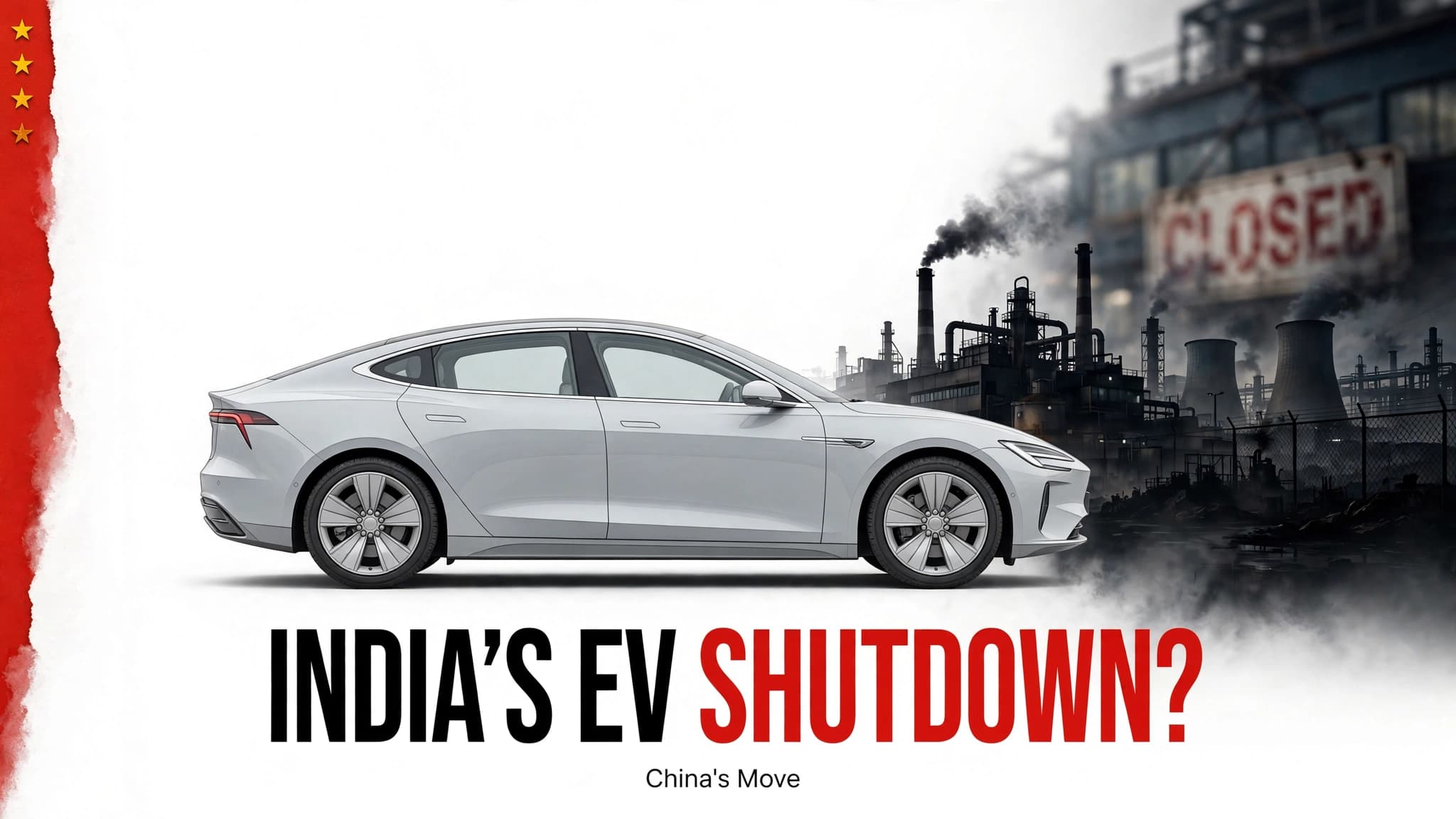
One phone call from Beijing can stop an Indian car factory in under sixty days.
Not a war. Not a tariff. Not a tank on a border. Just a signature on an export license, or the refusal to give one.
In April 2025, that's exactly what happened.
Factories that had never worried about a single component in thirty years suddenly stared at empty shelves. Not from a strike, not from a shortage of steel or rubber or glass. Empty because of a piece of metal so small you could hold twenty in your palm — a rare earth magnet.
By July, executives at India's biggest car companies were quietly admitting they had two to four weeks of stock left. Maruti Suzuki said its buffer would run out by month's end. Tata Motors said it was "comfortable" for a few more months — corporate language for "we're worried."
This wasn't some exotic material in an experimental prototype. This magnet sits inside almost every electric motor on earth — power steering, washing machines, AC compressors, wind turbines, missile guidance systems. One material. Ninety percent of the world's refining capacity for it sits in one country. And that country just showed everyone what that means.
This is the story of how four elements nobody thinks about became the most dangerous choke point in the global economy — and how India, racing to build EVs, wind farms, and missiles, discovered all of it depends on a supply chain it doesn't control.
What is a rare earth magnet, and why does an economy collapse without it?
Near the bottom of the periodic table sit seventeen elements called rare earths — neodymium, praseodymium, dysprosium, terbium, samarium. They're not actually rare in the ground. What's rare is finding them concentrated enough to mine, and then having the industrial capability to separate them — because these elements are chemically near-identical twins. Pulling them apart takes hundreds of repeated chemical steps, is toxic, and almost no country has built that capability at scale.
Except one.
The key product is neodymium-iron-boron, or NdFeB — the strongest permanent magnets ever mass-produced. That strength means smaller, lighter, more efficient motors: the difference between an EV that goes 400km on a charge versus 250km, between a wind turbine that works in low wind and one that doesn't.
So over three decades, the world built its electrified future on a handful of elements only one country could process at scale: China.
Why China, and not India?
India actually holds one of the largest rare earth reserves on earth — about 6.9 million tonnes, spread across Odisha, Andhra Pradesh, Tamil Nadu, Kerala, Karnataka, plus deposits in Rajasthan and Gujarat.
And yet India produces barely one percent of the world's refined rare earths.
The crisis was never about who has the rocks. It's about who has the refineries.
Back in 1992, Deng Xiaoping reportedly said the Middle East has oil, but China has rare earths. It sounded like a boast. It was a strategy. While the rest of the world treated rare earths as a boring input cost, China built the refineries, the separation plants, the metallurgy expertise — and tolerated the environmental cost. Rare earth processing generates enormous toxic and radioactive waste. The US, Japan, and Europe used to process rare earths too. They shut it down, undercut on price and unwilling to eat the environmental cost. China was willing.
Today China mines about sixty percent of the world's rare earths — but mining isn't the real chokepoint. China refines close to ninety percent of them. Narrow it to permanent magnets for EVs, turbines, and defense systems, and China's share of manufacturing climbs to roughly ninety-four percent.
Ninety-four percent. No other critical mineral — not oil, not lithium, not copper — is this concentrated in one country's hands.
The trigger
In early 2025, Donald Trump escalated tariffs on Chinese goods. Beijing needed leverage — and realized it didn't need tanks or missiles. It needed magnets.
On April 4, 2025, China's Ministry of Commerce announced export controls on seven rare earth elements and all related compounds, alloys, and magnets: samarium, gadolinium, terbium, dysprosium, lutetium, scandium, yttrium. Any company anywhere needed a special export license from Beijing — and Beijing was in no hurry to hand them out.
Automakers worldwide scrambled. Some shut production lines entirely.
In India, the panic hit differently, because dependency wasn't a side issue — it was the whole story. India imports roughly eighty percent of its rare earth magnet needs directly from China. Within weeks, India's auto component industry — worth over eighty billion dollars a year — was counting inventory in weeks, not months. ACMA, the industry association, found China's share of India's auto component imports had actually grown, from 29% to 32%, in the very year this vulnerability was exposed.
ACMA's director general, Vinnie Mehta, called it a wake-up call: the only real solution is self-reliance, because inventories "are not infinite."
Here's what makes it genuinely frightening: these magnets are cheap, typically under five percent of an EV's total cost. This isn't a budget problem — it's a two-dollar bolt without which the entire engine can't be assembled.
Beyond cars: defense
Rare earth magnets are essential for radar, missile guidance, precision munitions, submarine propulsion, fighter jet electronics. China's rules specifically deny licenses to anything connected to foreign militaries. For India — sharing a tense, unresolved border with China, with a deadly 2020 clash in the Galwan Valley — this isn't a normal trade dependency. It's a strategic vulnerability sitting inside its national security apparatus.
By the numbers: per the State Bank of India, overall rare earth imports were worth about $32 million in FY2025 — but magnet imports specifically were worth close to $291 million, and climbing fast, exactly as EV ambitions accelerated.
Not the first time
In 2010, after a maritime dispute with Japan near the Senkaku Islands, China quietly cut rare earth export quotas by 40%. Prices spiked nearly sevenfold. The world panicked, then — once prices fell — went right back to buying from China. That was the warning shot nobody heeded.
Fifteen years later, China pulled the same lever, with a far more sophisticated legal structure. Through 2025, the pattern cycled: restrictions tighten, factories shut, diplomacy opens a partial truce, licenses trickle back — then a new escalation arrives.
In May 2025, the US and China agreed to a 90-day truce in Switzerland meant to restore supplies. Relief was short-lived — China slow-walked actual license issuance, compliance on paper, obstruction in practice.
Then in October 2025, just before a high-stakes Xi–Trump meeting, China went further: any foreign company anywhere needed Beijing's approval to export a product containing even trace Chinese rare earth material, or made using Chinese extraction or magnet-making technology. Analysts compared it to America's "foreign direct product rule" for semiconductors — turned back around against the rest of the world. Carefully timed, not improvised.
After the Xi–Trump meeting, both sides rolled back many restrictions. Trump called the issue "settled." By September 2025, China specifically lifted restrictions toward India, following talks between Jaishankar and Wang Yi — shipments of fertilizers and tunnel boring machines resumed.
But analysts noticed the pattern: easing toward India while keeping tighter controls on the US wasn't generosity — it was a calibrated signal, rewarding India's balancing act while reminding Washington the tap can be turned. China isn't just controlling a resource; it's running foreign policy through a spreadsheet of export licenses, country by country.
What China actually controls
China mines ~60% of rare earths — not an unbreakable monopoly, since Australia, the US, Myanmar, and India all have reserves. But refining is the bottleneck: ~90% share, climbing to ~94% for sintered NdFeB magnets specifically, up from about 50% two decades ago. China built that deliberately, while the rest of the world assumed cheap magnets would always be there.
Why didn't anyone build an alternative? Separation plants take years and billions of dollars, generate radioactive waste (many ores are bound with thorium and uranium), and few countries have the regulatory appetite for that. Competing against thirty years of Chinese economies of scale is brutal. So the world kept buying and hoping nothing went wrong.
Something went wrong.
India's response
India's EV target is roughly 30% penetration by 2030 — nearly all of it needing motors, nearly all of the best motors needing rare earth magnets. The same magnets power wind turbines, defense electronics, robotics. India holds the fifth-largest reserves on the planet and still contributes barely 1% of global production — the rocks are there, the refineries aren't.
In November 2025, the Cabinet approved a ₹7,280 crore (~$850 million) scheme to build a domestic magnet industry: the Scheme to Promote Manufacturing of Sintered Rare Earth Permanent Magnets. Target: 6,000 metric tonnes/year of finished magnets across up to five companies via competitive bidding, each eligible for up to 1,200 tonnes annually. ₹6,450 crore is sales-linked incentive over five years; ₹750 crore is capital subsidy.
Minister Ashwini Vaishnaw said India aims for self-reliance within three to four years — part of the broader Atmanirbhar Bharat and Viksit Bharat 2047 push.
Can it be done in three to four years, when China took three decades? It's complicated. India isn't starting from zero — state-run IREL has decades of upstream experience (mining, separation, refining into oxide) and already runs a magnet plant in Visakhapatnam. But downstream capability — oxide to metal to alloy to finished magnet — is exactly what the new scheme is trying to build. IREL guarantees 500 tonnes/year of NdPr oxide to the first three companies; beyond that, firms must source their own raw material, possibly still via imports.
India is also moving on multiple fronts: amending mining law to open rare earth mining to private players, targeting exploration across 1,200+ potential sites, and creating Rare Earth Corridors across four mineral-rich states in the 2026–27 budget. Andhra Pradesh is set to anchor mining and processing, with plans for ₹50,000 crore in beach sand mineral investment; Tamil Nadu, with strong existing manufacturing, is positioned for downstream component production.
India is also courting Japan and South Korea. Japanese firm Proterial announced a ₹2,250 crore factory in India to produce 1,200 tonnes/year of NdFeB magnets for EVs, wind, robotics, aerospace, and defense — a signal India is trying to join a broader alliance building supply chains outside Beijing.
Reasons for caution
The scheme gives companies a two-year gestation period before the five-year incentive window even starts — meaning meaningful production might not ramp up until around 2028, with more years before it dents Chinese dependency meaningfully. Meanwhile, India's auto, defense, and renewable sectors need magnets today.
Cost is another problem: China's three-decade head start makes Indian-made magnets likely more expensive for years, absent sustained, generous incentives. And the environmental/regulatory reality that created this problem in the first place — radioactive waste, hazardous processing — will likely move slower in a democracy with active civil society than it did in China.
None of this means the effort is doomed — but the three-to-four-year timeline is, generously put, extremely ambitious.
The twist: engineering around it
While governments race to build mining and refining capacity, automakers have started asking a different question: do we need rare earth magnets at all? Some are shifting to induction motors or ferrite magnets, which need no rare earths. Ferrite is weaker, but weaker doesn't mean unusable — it means smarter design and slightly larger components. India's domestic ferrite magnet market, already over 60,000 tonnes in 2024, is projected toward 75,000 tonnes by 2033. Others are exploring hybrid designs that reduce or substitute the most vulnerable elements, like dysprosium and terbium.
This is the real twist: China's monopoly isn't a monopoly on electric motors — it's a monopoly on the current best technology for building them. And that kind of monopoly is fragile, because engineers eventually engineer around bottlenecks, especially once they become existential business risks.
Which raises the paradox: does China's aggressive use of restrictions strengthen its position, or accelerate the exact outcome it's trying to prevent? Every squeeze creates short-term leverage — but also signals to every government and automaker on earth: never be this exposed again. That signal is already driving investment into alternative mining in Australia, the US, and Brazil, alternative processing in Malaysia and Estonia, magnet-free motor R&D worldwide, and India's own $850 million sovereign push.
China appears to be choosing aggression for now — and that choice is exactly what's forcing India's hand.
The stakes on the ground
India's auto component industry employs millions, directly and indirectly. A prolonged shortage threatens production schedules, exports, and jobs in one of India's genuine manufacturing bright spots. Layer on wind energy targets and defense modernization, both running through the same chokepoint — against the backdrop of an unresolved, militarized border with China. This isn't an industrial hiccup; it's a national security exposure.
Where India stands now
Honestly: still exposed, but moving. The 80% dependency on Chinese magnets hasn't disappeared and won't for years. The manufacturing scheme is real and well-funded but racing a two-to-four-year runway against China's three-decade head start. Mining reforms are genuine but will likely move slowly, as they do in most democracies. International partnerships are promising early signals, not a realized alternative. The shift toward magnet-free motors is real but won't fully offset demand for years.
What has genuinely changed is the posture. Eighteen months ago, almost nobody in Indian industry or government treated rare earth magnets as a priority — a boring line item buried in a bill of materials. Today it's a Cabinet-level scheme, active diplomacy, and boardroom risk assessment across every major manufacturer touching electric motors.
There's a precedent worth noting: India was once heavily dependent on imported urea fertilizer. Repeated crises eventually forced investment and capacity-building, taking decades to reach around 87% self-sufficiency. That's the rough roadmap being compressed here — except the rare earth story spans EVs, renewables, and defense simultaneously, so the stakes, and the urgency, are much higher. Most serious analysts expect meaningful — not complete — self-sufficiency in the near term; a drop from 80% dependency to maybe 50–60% over several years is a more realistic outcome than full independence, and would still be a major achievement.
But this was never really a story about magnets. It's about what happens when global industry quietly outsources a critical piece of its future to a single supplier because that supplier was cheapest and most convenient for thirty straight years — and how invisible, cheap, always-available dependencies turn out to be the most dangerous vulnerabilities of all, precisely because nobody was watching them.
Oil taught the world this lesson in the 1970s. The world spent decades diversifying afterward. Rare earth magnets are teaching the same lesson fifty years later — except the tap sits in Beijing, and countries like India are only now discovering how much of their future they'd quietly handed over.
The factories are running today. The panic has faded from headlines. But nothing structural has changed — the magnets in every new Indian EV motor still trace back to the same Chinese processing plants that could tighten the tap again with a single announcement.
India knows this. That's why the scheme exists, why the mining laws changed, why Japanese investment is flowing into Andhra Pradesh, why engineers in Pune and Chennai are quietly redesigning motors to need less of a material they can no longer take for granted.
The question isn't whether China will use this leverage again — it almost certainly will. The real question is whether India will be ready next time.
Right now, the honest answer is: not yet. But for the first time in thirty years, it's finally trying to be.