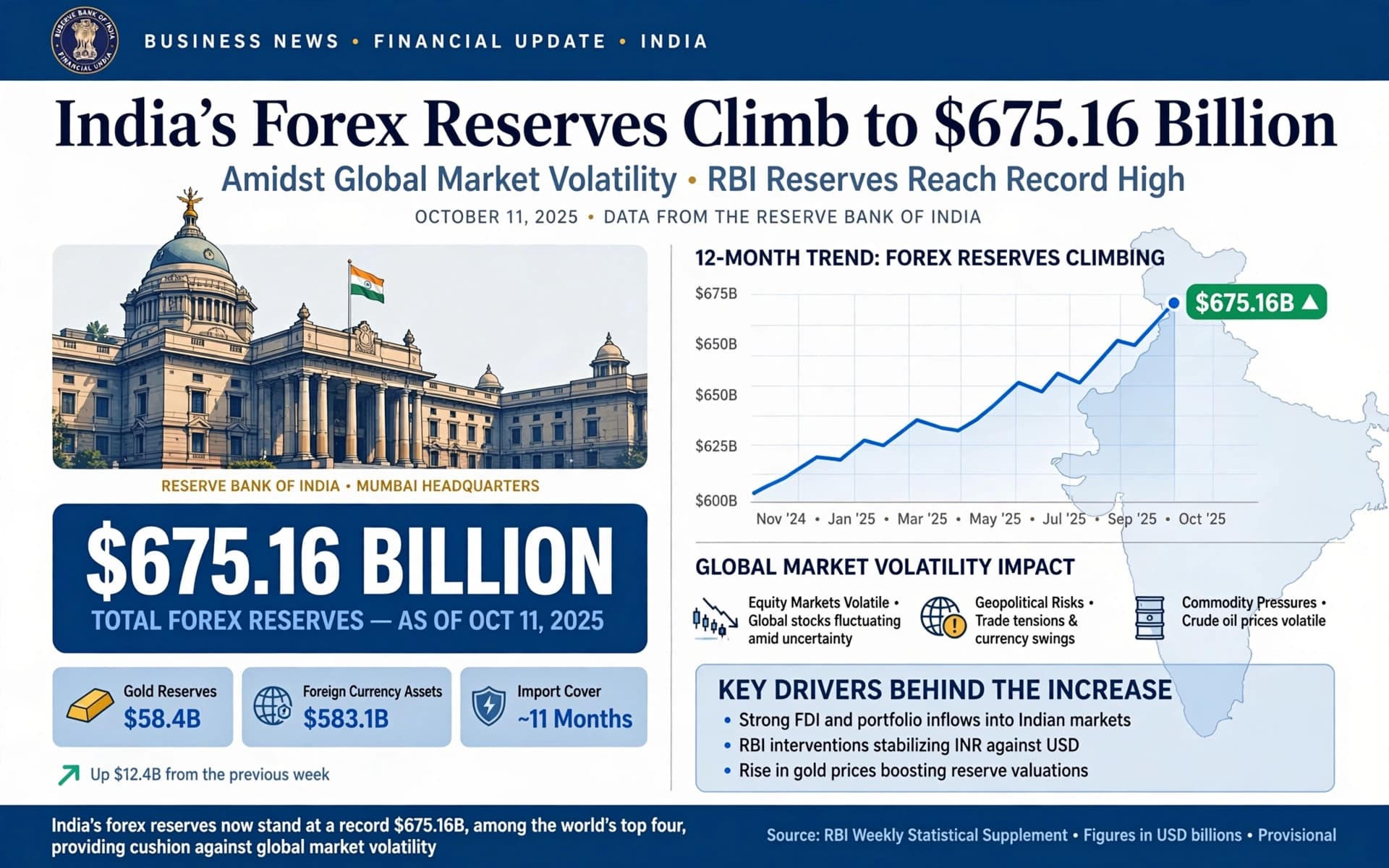
The global financial landscape remains turbulent, forcing central banks to navigate shifting capital flows and geopolitical uncertainty. For India, the latest data from the Reserve Bank of India (RBI) suggests a period of sustained accumulation, providing a buffer against external shocks currently affecting emerging market currencies.
While the recent uptick in liquidity provides security, the underlying drivers of this growth reflect a calculated effort to fortify the national balance sheet. As volatility persists in major trading pairs, the strength of these reserves serves as a critical indicator of the nation's ability to manage import costs and currency fluctuations.
Strengthening the National Buffer
The latest weekly data confirms a steady upward trajectory in the total holdings held by the central bank.
| Component | Current Value (USD) |
|---|---|
| Total Foreign Exchange Reserves | $675.16 Billion |
| Foreign Currency Assets (FCA) | $546.51 Billion |
| Gold Reserves | $105.23 Billion |
| Special Drawing Rights (SDRs) | $18.626 Billion |
| IMF Reserve Tranche Position | $4.793 Billion |
This $964 million increase in total reserves highlights a diversified approach to asset accumulation, particularly through the expansion of foreign currency assets.
Drivers of Reserve Accumulation
The recent growth in the reserve position results from several converging economic factors and strategic central bank movements.
- A $930 million rise in Foreign Currency Assets (FCA) bolstered the primary component of the total reserves.
- Strategic gold acquisitions contributed to a $24 million increase, bringing gold holdings to over $105 billion.
- Incremental gains in Special Drawing Rights (SDRs) and the IMF reserve tranche position added to the overall liquidity.
- The current position follows a $7.26 billion surge recorded in the preceding week, indicating a sustained period of inflow.
These movements suggest a proactive stance by the RBI to build liquidity ahead of potential market shifts.
Composition of Foreign Assets
The breakdown of the reserves reveals a heavy reliance on liquid foreign currency assets, which remain the primary tool for managing external liabilities.
| Asset Category | Weekly Change (USD) | Total Value (USD) |
|---|---|---|
| Foreign Currency Assets | +$930 Million | $546.51 Billion |
| Gold Reserves | +$24 Million | $105.23 Billion |
| SDRs (IMF) | +$3 Million | $18.626 Billion |
The dominance of FCAs ensures that the central bank maintains high levels of liquidity to intervene in the foreign exchange market if necessary.
Macroeconomic Implications and Policy Directives
The accumulation of reserves is occurring against a backdrop of domestic policy measures aimed at managing the current account deficit and preserving foreign exchange.
- Prime Minister Narendra Modi has issued directives to citizens to reduce non-essential overseas travel to conserve foreign exchange.
- Policy guidance has been issued to cut fuel consumption to mitigate the impact of high import bills.
- The government has encouraged citizens to postpone gold purchases to reduce the outflow of foreign currency.
- The Nifty and broader equity markets remain sensitive to these reserve levels as they influence the stability of the rupee.
These measures indicate that while reserves are growing, the government remains cautious regarding long-term pressures on the nation's external position.
Outlook
The trajectory of India's forex reserves remains a focal point for international investors and domestic policymakers. While the current $675.16 billion mark provides a robust cushion, it remains below the historic peak of $728.494 billion reached in February 2026. This gap suggests that while the current trend is positive, the economy is working to regain maximum financial security.
Looking ahead, several variables could alter this momentum. The specific impact of Middle East tensions on the rupee's volatility remains an open question that could trigger sudden capital outflows.
Furthermore, market participants are monitoring whether the RBI's intervention strategy will change in response to future reserve fluctuations, particularly if global interest rate differentials shift significantly.
The interplay between domestic consumption patterns and global commodity prices will ultimately dictate the pace of reserve growth. As the government continues to advocate for conservation in travel and gold imports, the success of these measures will be reflected in the stability of the rupee and the strength of the national balance sheet.