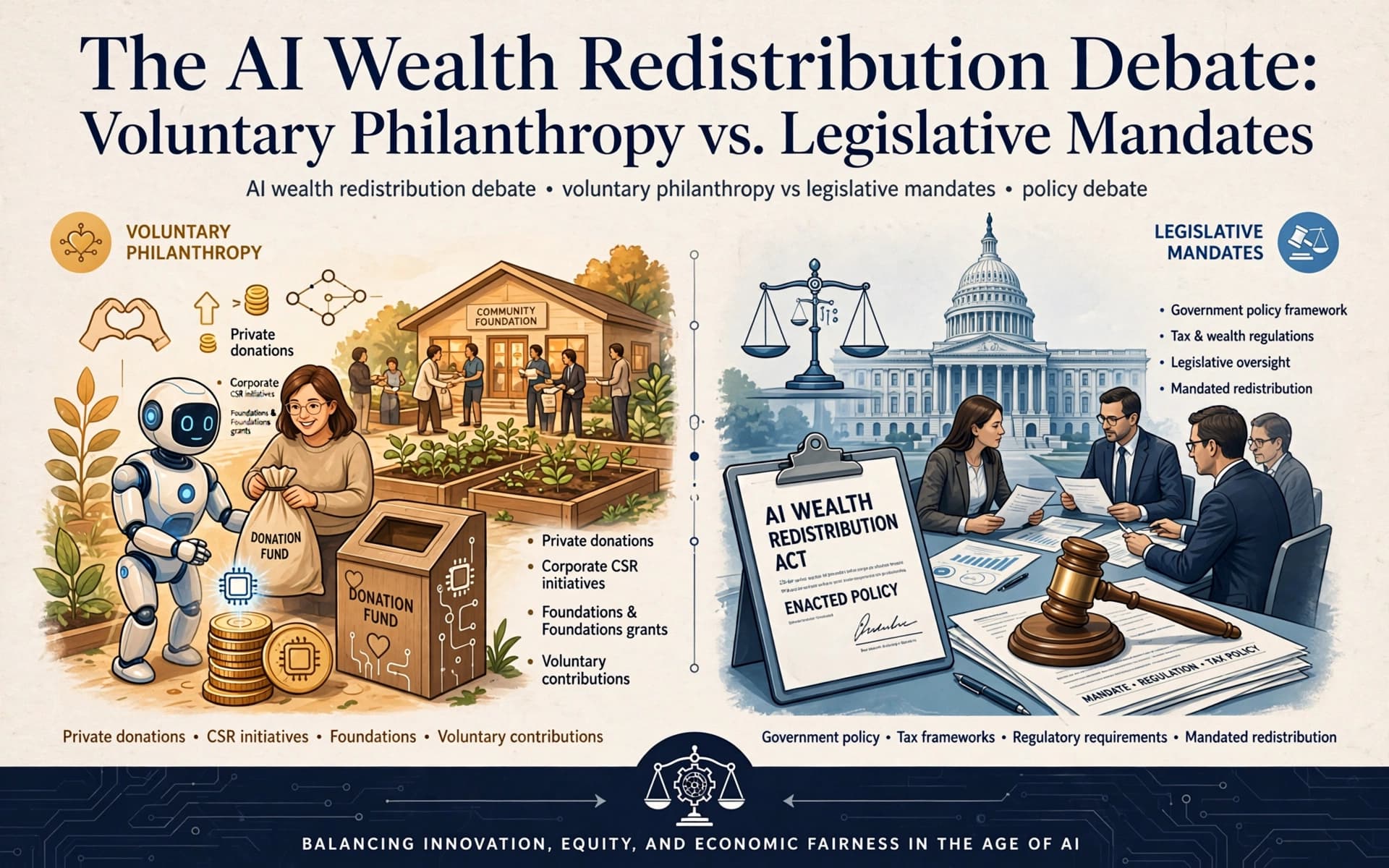
The concentration of capital within the artificial intelligence sector has reached a scale that challenges existing economic frameworks. As generative models and automated intelligence drive significant productivity gains, the resulting wealth is accumulating within a narrow corridor of founders, venture capitalists, and early investors.
This shift is not merely a matter of market fluctuation. It represents a fundamental realignment of global capital that forces a confrontation between private accumulation and social responsibility.
The tension between private profit and public necessity is intensifying as the scale of AI-driven wealth reaches the trillions. While some argue that the market will naturally address these disparities through philanthropic mechanisms, others contend that only legislative intervention can ensure the benefits of the AI era are distributed equitably.
The Divergence of Philanthropy and Wealth Concentration
The current landscape shows a widening gap between the gains seen in tech exits and the actual participation rates in traditional charitable giving.
| Metric | Data Point |
|---|---|
| Total American Charitable Giving (2024) | $592.5 billion |
| New AI Billionaires (Forbes 2026) | 45 individuals |
| Combined AI Billionaire Net Worth | $2.9 trillion |
| Top 1% U.S. Household Wealth Share (Q3) | 31.7% |
While total dollar amounts in American philanthropy reached a record high in 2024, the number of individual contributors has declined for five consecutive years. This suggests that wealth is becoming increasingly concentrated in fewer hands.
The Drivers of Economic Re-alignment
The rapid ascent of AI-centric fortunes is creating a new class of ultra-high-net-worth individuals whose assets are tied to intellectual property and computational power rather than traditional industrial assets.
- The rise of "AI Billionaires" has seen 45 new entrants in the 2026 Forbes rankings, collectively holding $2.9 trillion.
- Massive liquidity events, such as Google's acquisition of Wiz and the Figma IPO, have provided venture firms with significant capital reserves.
- The wealth of individual figures has reached historic levels, exemplified by Elon Musk’s net worth exceeding $1 trillion following the SpaceX IPO.
- A structural shift is occurring where wealth is being concentrated at a rate that outpaces traditional philanthropic models.
This concentration is driving a debate over whether the next era of economic stability will be defined by voluntary social investment or state-mandated redistribution.
Mechanisms of Redistribution
As the scale of wealth grows, the methods for managing its impact on society are being debated in both boardrooms and legislative chambers.
| Mechanism | Primary Driver | Implementation Status |
|---|---|---|
| The Giving Pledge | Voluntary Philanthropy | Declining participation (4 signers in 2024) |
| California Wealth Tax | Legislative Mandate | Pending voter decision on 5% tax |
| Equity-for-Government | Corporate/State Partnership | Proposed 5% stake for OpenAI |
These mechanisms represent two fundamentally different philosophies regarding the role of the state and the responsibility of the individual in a high-tech economy.
Market Implications and Structural Shifts
The tension between these models is creating a volatile environment for both tech founders and policymakers.
- Venture capital firms like Index Ventures, which has raised approximately $15 billion from outside investors, are seeing significant returns from recent exits.
- The potential for an OpenAI IPO in 2027 introduces questions regarding how a public company might handle social equity mandates.
- Legislative attempts, such as the proposed 5% wealth tax in California, could set a precedent for how billionaire wealth is treated across the United States.
The outcome of these shifts will determine whether the AI boom results in a period of extreme inequality or a new era of shared prosperity.
Outlook
The debate over AI wealth redistribution is moving from theoretical academic discussion to practical political reality. As the number of people participating in the Giving Pledge falls, the reliance on voluntary benevolence appears to be diminishing.
This creates a vacuum that legislative bodies are increasingly eager to fill. The decision by California voters regarding the 5% wealth tax will serve as a critical bellwether for how the nation intends to manage the immense fortunes generated by the next generation of technology.
Furthermore, the strategic moves by companies like OpenAI suggest that the intersection of corporate equity and state interest is becoming a permanent fixture of the economy. If OpenAI follows through on its proposal to grant the federal government a 5% equity stake, it will represent a fundamental shift in how sovereign states interact with private technology giants.
Ultimately, the trajectory of the AI economy depends on whether the current concentration of capital can be successfully integrated into the broader social fabric. Whether through the voluntary actions of individuals or the mandates of the state, the redistribution of AI-generated wealth is no longer an elective conversation; it is a structural necessity for long-term economic stability.