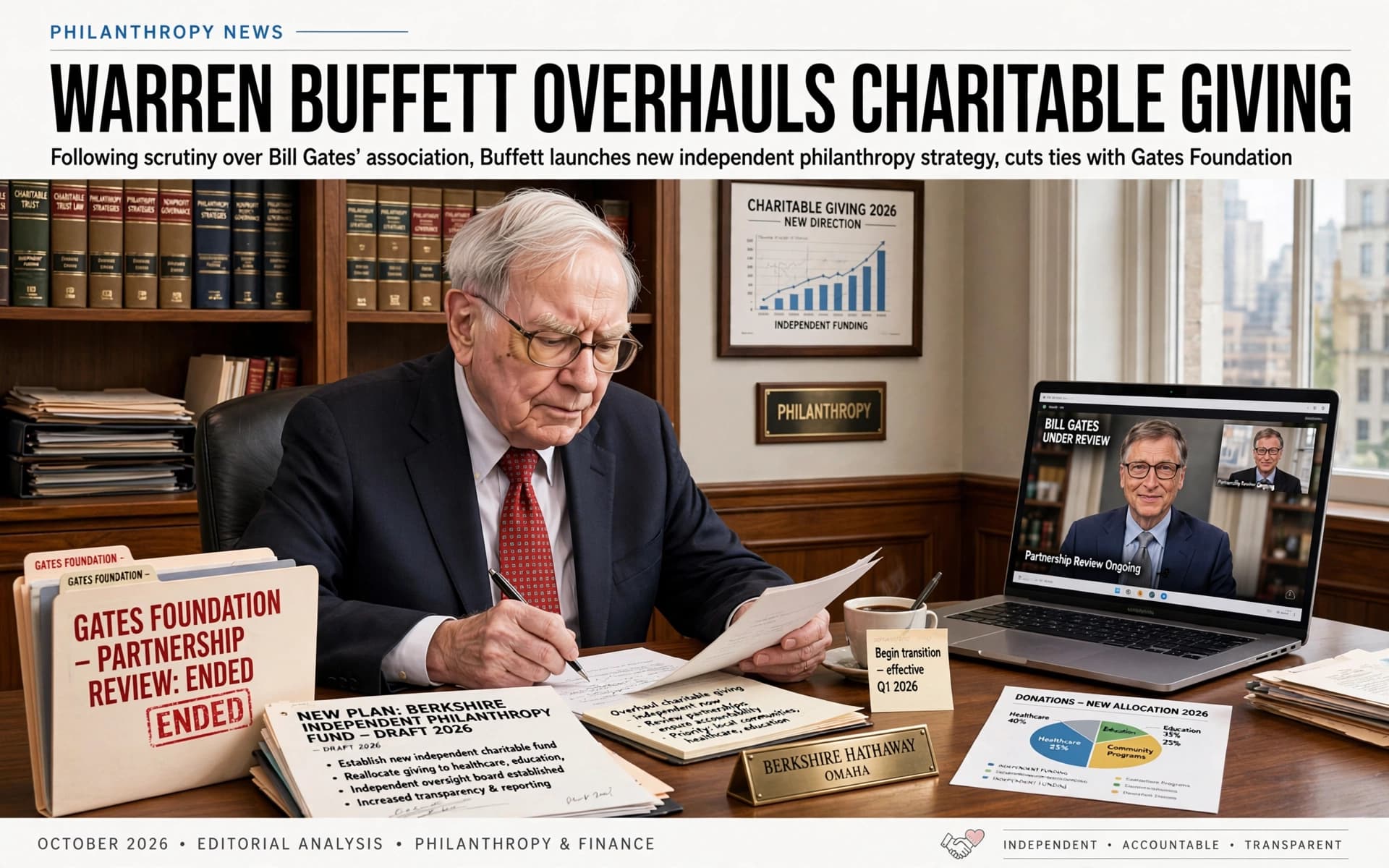
Warren Buffett, the renowned investor and CEO of Berkshire Hathaway, has made a significant change in his charitable giving strategy following his public disapproval of Bill Gates' association with the late financier Jeffrey Epstein. This development has far-reaching implications for the billionaire's philanthropic efforts and estate planning.
Quick Explanation: Class B shares are a type of Berkshire Hathaway stock that has limited voting power but offers greater liquidity.
Buffett's decision to overhaul his charitable giving comes after he publicly called Gates' association with Epstein "distasteful." This statement marked a departure from Buffett's previous support for the Gates Foundation, which has received over $47 billion worth of Berkshire stock from Buffett since 2006. The value of these donations is substantial, but the exact figure is not publicly disclosed.
Under the Hood
Buffett's charitable shift is evident in his decision to direct all of this year's donations to four family-linked foundations: the Susan Thompson Buffett Foundation, the Sherwood Foundation, the Howard G. Buffett Foundation, and the NoVo Foundation. These foundations are closely tied to Buffett's family, with his children holding key positions within the organizations.
This change in strategy suggests that Buffett is placing greater responsibility in the hands of his family members, particularly his three children.
The Strategic Pivot
The value of the 9 million Class B shares given to the Susan Thompson Buffett Foundation is not publicly disclosed. However, this donation is significant, considering the limited voting power of Class B shares. Similarly, the value of the 1 million Class B shares given to each of the three foundations run by Buffett's children is also unknown.
These donations demonstrate Buffett's commitment to his family's philanthropic efforts and his desire to maintain control over his charitable giving.
Regulatory Headwinds
Buffett's decision to overhaul his charitable giving strategy may have implications for his estate plan. With plans to dispose of all of his Berkshire shares within about eight years, Buffett is likely seeking to minimize tax liabilities and maintain control over his philanthropic efforts.
His recent surgery after breaking his leg several weeks ago may also have influenced his decision-making process.
Market Reaction
The market reaction to Buffett's charitable shift is mixed. While some investors view this decision as a positive step towards greater family involvement in philanthropy, others may see it as a sign of decreased support for the Gates Foundation.
The value of Buffett's Berkshire shares is not publicly disclosed, but this decision is likely to have a significant impact on the company's stock price.
Conclusion
Warren Buffett's decision to overhaul his charitable giving strategy is a significant development in the world of philanthropy. His public disapproval of Bill Gates' association with Jeffrey Epstein has led to a shift in his charitable efforts, with a greater emphasis on family-linked foundations.
As Buffett continues to navigate his estate plan and philanthropic efforts, investors and philanthropists alike will be watching closely to see how this decision plays out.