Key Takeaways
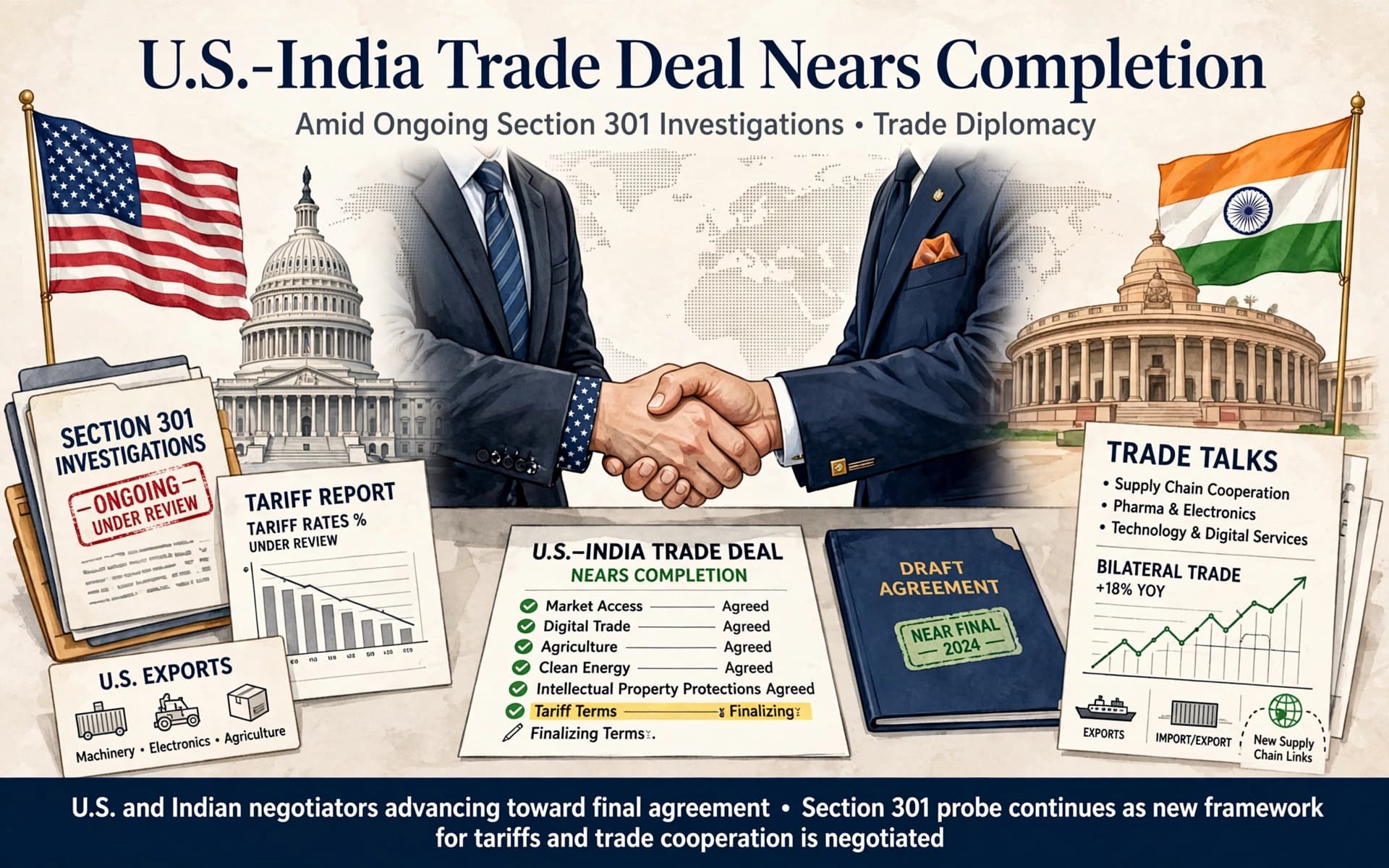
- Negotiations for a comprehensive U.S.-India trade agreement are nearing finalization, with a potential signing expected within the next three to four months.
- The resolution of U.S. Section 301 trade investigations remains the primary obstacle to finalizing the bilateral terms.
- Proposed tariff structures on generic drugs pose a significant risk to India's pharmaceutical sector, which saw $9.7 billion in exports to the U.S. in 2025.
The geopolitical landscape of global commerce is shifting as the United States and India move toward a definitive trade framework. For months, diplomats and trade officials have been working to reconcile divergent regulatory standards and protectionist pressures.
Current intelligence suggests that the core components of these negotiations are largely complete. The final timeline depends on the resolution of specific legal probes.
This development occurs as the U.S. administration intensifies its scrutiny of international supply chains. While a bilateral deal offers a pathway toward deeper economic integration, Section 301 investigations introduce volatility that investors and manufacturers must navigate.
The Path to a Bilateral Trade Agreement
The current status of the negotiations reflects a balancing act between market access and regulatory enforcement.
| Negotiation Phase | Status |
|---|---|
| Core Trade Terms | Virtually Complete |
| Regulatory Alignment | Pending Section 301 Resolution |
| Expected Signing Window | 3–4 Months |
| Primary Obstacle | Forced Labor Compliance Probes |
The completion of these talks would mark a milestone in the strategic partnership between the United States and India. Such an agreement could stabilize trade flows during a period of heightened protectionism.
Drivers of the Current Trade Friction
The delay in finalizing the agreement is tied to the application of trade enforcement mechanisms.
- The U.S. is currently conducting Section 301 investigations into labor practices across dozens of nations.
- One specific probe, encompassing 60 different countries, is expected to reach a conclusion within the next week.
- The U.S. has proposed new tariffs of up to 12.5% on dozens of nations, including India, citing failures to curb goods produced with forced labor.
- These investigations are being conducted alongside broader discussions involving the ASEAN Foreign Ministers' meeting regarding regional supply chain integrity.
The outcome of these investigations will dictate whether the trade deal proceeds under standard terms or includes punitive measures.
Pharmaceutical Tariff Projections
The pharmaceutical sector remains a sensitive point of contention in the current negotiations, particularly regarding the cost of generic medications.
| Product Category | Tariff Schedule | Effective Date |
|---|---|---|
| Generic Drugs | 0% (Tariff-free) | August 1, 2026 |
| Generic Drugs | 100% | August 1, 2027 |
| Generic Drugs | 200% | August 1, 2028 |
According to President Donald Trump, this tiered approach provides a two-year grace period for generic imports before imposing tariffs. This structure creates a deadline for the Indian pharmaceutical industry, which relies heavily on the American market.
Impact on the Indian Pharmaceutical Sector
The potential for significant tariff hikes creates a high-risk environment for one of India's most vital export industries.
- India's pharmaceutical exports to the U.S. reached $9.7 billion in 2025.
- This figure represents nearly 38% of India's total pharmaceutical export volume of $25.8 billion.
- A shift to 100% or 200% tariffs would fundamentally alter the cost-competitiveness of Indian generics in the U.S. market.
- The proposed tariff escalation leaves little room for supply chain reconfiguration.
The scale of this exposure means that any failure to resolve the Section 301 investigations could lead to a significant contraction in startups & funding within the Indian biotech and pharma sectors.
Broader Economic Implications
The resolution of this trade deal will influence global markets & IPOs and how other emerging economies approach U.S. trade standards.
- The deal could set a precedent for how the U.S. integrates labor standards into bilateral agreements.
- Success in these negotiations could encourage further AI & technology collaboration between the two nations.
- The outcome will serve as a bellwether for how the U.S. manages trade with large, complex economies.
The interplay between these trade enforcement actions and bilateral diplomacy will define the economic relationship between Washington and New Delhi for the remainder of the decade.
Outlook
As the deadline for the Section 301 investigation conclusions approaches, the global business community is watching closely. If the investigations conclude without triggering the 12.5% labor-related tariffs, a signed agreement within four months becomes highly probable. This would provide certainty for multinational corporations operating in both the U.S. and India.
However, the pharmaceutical sector faces a precarious transition. The proposed tariff escalation—moving from 0% to 200% over three years—is a mechanism designed to force rapid compliance or domestic manufacturing shifts.
For Indian exporters, the next 24 months will be a race to secure long-term contracts and potentially diversify their client base away from a single-country dependency. Ultimately, the success of this trade deal hinges on whether the U.S. can balance domestic labor enforcement goals with its strategic desire to maintain an integrated economic partnership with India.
Frequently Asked Questions
When is the U.S.-India trade deal expected to be signed?
The agreement is expected to be signed within the next three to four months, pending the resolution of Section 301 investigations.
How will the new generic drug tariffs affect Indian exports?
India's $9.7 billion pharmaceutical export market to the U.S. faces a two-year period of zero tariffs, followed by a 100% tariff in 2027 and a 200% tariff in 2028.
What is the primary cause of the current trade tension?
The tension is largely driven by U.S. Section 301 investigations regarding the use of forced labor in goods produced by dozens of nations, including India.