Key Takeaways
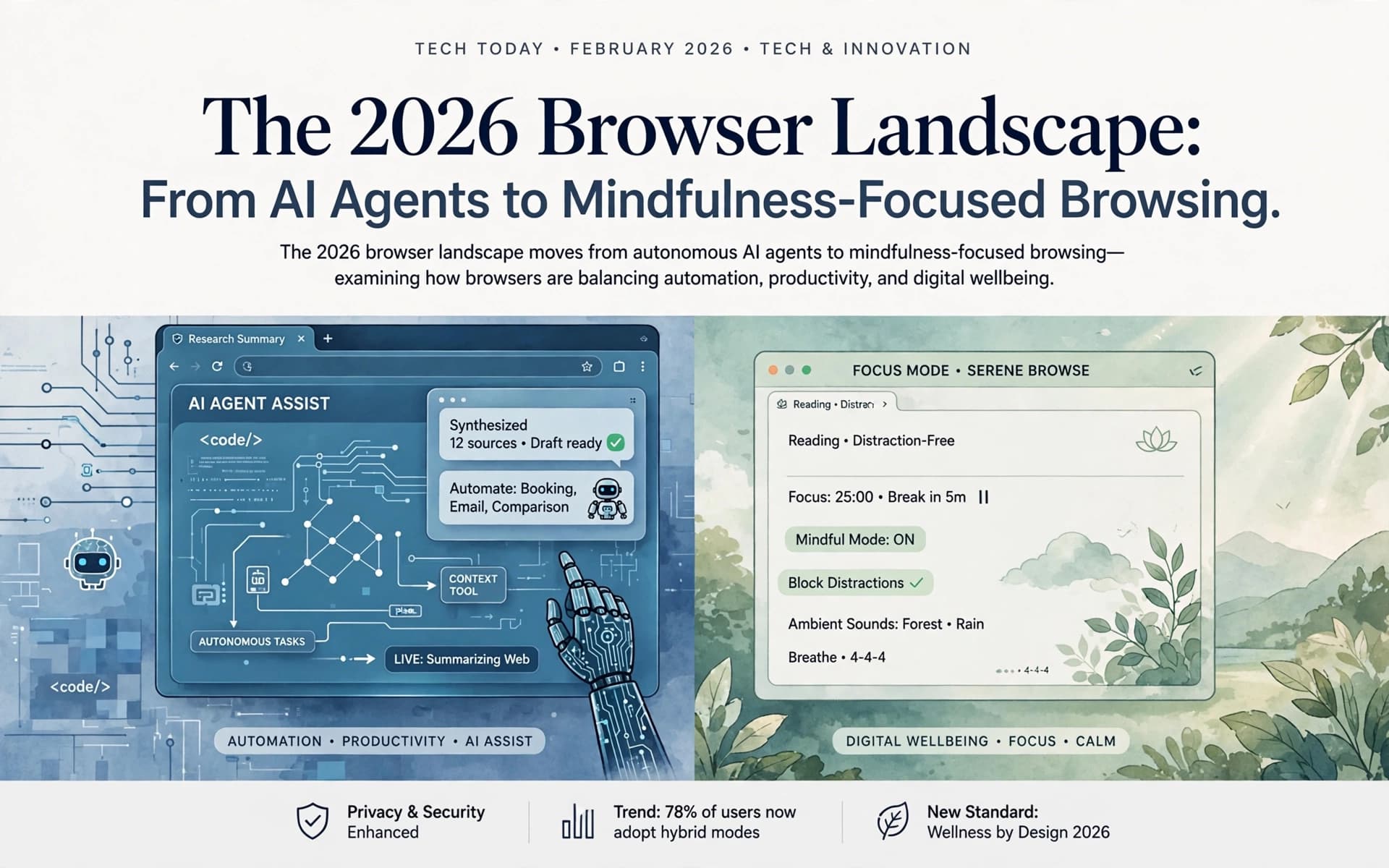
- The browser market has bifurcated into two distinct segments: high-cost agentic browsers and privacy-centric, mindfulness-focused tools.
- OpenAI's strategic pivot to integrate agentic capabilities into ChatGPT marks a significant consolidation in the AI & Technology sector.
- Premium subscription models for specialized browsing experiences are becoming the new standard for niche market players.
The digital gateway to the internet is undergoing a fundamental transformation. For decades, the browser served as a passive window to the web—a tool for viewing pages and executing basic scripts.
As we move through mid-2026, the browser has evolved into an active participant in the user's digital life. We are witnessing the rise of "agentic browsing," where the software executes complex workflows on behalf of the user rather than just displaying information.
This shift is driving capital into Startups & Funding focused on browser-native automation. While the giants still hold the majority of the market, the emergence of specialized, high-subscription-cost browsers suggests a shift away from "one size fits all" utilities toward personalized, AI-driven environments.
The Bifurcation of Browser Utility
The current market landscape shows a clear split between mass-market dominance and specialized, high-value niches.
| Market Segment | Leading Platforms | Primary Value Proposition |
|---|---|---|
| Mass Market | Google Chrome, Apple Safari | Ubiquity and ecosystem integration |
| Agentic/AI-First | Perplexity Comet, Opera Neon | Autonomous task execution and reasoning |
| Privacy & Focus | Brave, DuckDuckGo, Opera Air | Ad-blocking, privacy, and mindfulness |
| Niche/Productivity | SigmaOS, Jatter, Dia | Workspace management and integrated tools |
This division indicates that while the core infrastructure remains stable, the "intelligence layer" of the browser is where the most intense competition is occurring.
The Strategic Shift Toward Agentic Integration
The landscape has been reshaped by several key moves from major players and specialized startups.
- OpenAI's decision to shut down its Atlas browser in July 2026 represents a strategic pivot.
- Instead of maintaining a standalone browser, OpenAI is integrating its agentic capabilities directly into the ChatGPT desktop app and its Chrome extension.
- Perplexity has monetized the AI-browser experience through its Comet browser, available via the $200/month Max plan.
- Opera has pursued the high-end segment with Neon, an AI-agentic browser launched in May 2025 for $19.90 per month.
These moves suggest that the industry is moving toward a model where the browser is an extension of a larger LLM ecosystem rather than a standalone application.
Specialized Browser Features and Models
As the market matures, developers are finding success by targeting specific user pain points through unique feature sets.
| Platform | Key Feature | Pricing Model |
|---|---|---|
| Aside | Browser-native automation | Y Combinator-backed |
| Jatter | Integrated Notes app | Free / $10/month subscription |
| Brave | BAT (Basic Attention Token) | Integrated crypto/ad-blocking |
| SigmaOS | Workspace-style interface | Free / TBD for AI features |
| Dia | Advanced UI/UX | Subscription-based |
The emergence of platforms like Aside, a Y Combinator-backed automation tool, highlights the growing demand for browsers that function as operating systems for web-based tasks.
Broader Market Impact and Economic Trends
The evolution of browsing technology is influencing wider Economy & Policy discussions regarding data sovereignty and digital productivity.
- The rise of subscription-based browsing is challenging traditional ad-supported revenue models.
- New players like Ladybird, an open-source browser being built from scratch by Chris Wanstrath, represent a push for a decentralized, non-Chromium web.
- Privacy-focused tools like DuckDuckGo are expanding their utility by adding generative AI and enhanced scam blockers.
- The dominance of Chromium-based engines remains a point of contention for developers seeking independence from Google's ecosystem.
The tension between the convenience of AI-driven automation and the necessity of privacy is a defining conflict of this era.
Outlook
As we look toward the latter half of 2026, the browser market will likely continue to fragment. The consolidation of OpenAI's capabilities into existing apps suggests that the "browser" as a standalone concept may eventually merge with the "AI Assistant."
Users may eventually move from "going to a website" to "instructing an agent" to navigate the web for them.
However, the rise of mindfulness-themed browsers, such as Opera's Air, suggests a counter-movement. As AI agents increase the speed of digital interaction, there is a growing market for tools designed to slow down the user experience and promote focus.
The winners in this landscape will be those who can balance the power of autonomous agents with the human need for intentional, distraction-free browsing.
Frequently Asked Questions
How does Perplexity Comet differ from standard browsers?
Comet is an AI-powered browser designed for deep reasoning and task execution, accessible through Perplexity's premium $200/month Max plan.
What is the significance of the Ladybird project?
Ladybird is an open-source project led by Chris Wanstrath that aims to build a browser from scratch, reducing reliance on the Chromium engine.
Why did OpenAI discontinue the Atlas browser?
OpenAI shut down Atlas to focus on integrating its agentic capabilities directly into ChatGPT's desktop application and Chrome extensions.