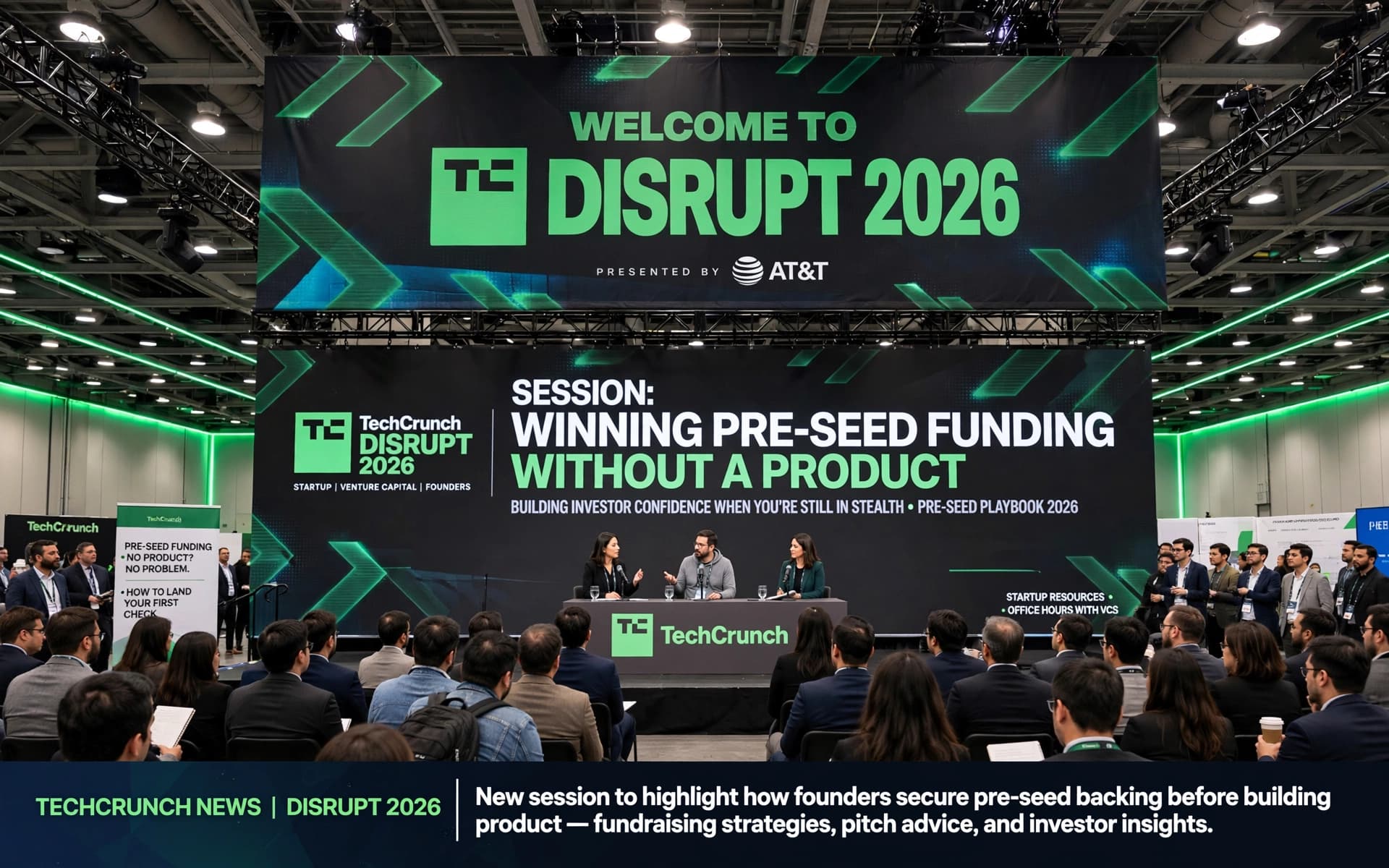
The landscape of early-stage venture capital is shifting toward a high-stakes era where the traditional requirement of a functional Minimum Viable Product (MVP) is being challenged. As founders face increasing scrutiny over burn rates and paths to profitability, the ability to secure capital based on vision, technical expertise, and market timing has become a critical skill set.
The upcoming TechCrunch Disrupt 2026 conference in San Francisco will serve as a primary forum for this debate. Industry leaders are scheduled to convene to dissect the mechanics of securing pre-seed funding when software or hardware remains in the conceptual or architectural phase.
The Disrupt 2026 Agenda
The following table outlines the core logistical details for the upcoming summit in San Francisco.
| Event Detail | Specification |
|---|---|
| Venue | Moscone West, San Francisco |
| Event Dates | October 13–15, 2026 |
| Primary Focus | Pre-Seed Funding Strategies |
This gathering marks a significant moment for the startup ecosystem, as the distinction between "idea-stage" and "product-stage" continues to blur in the age of rapid AI development.
The Evolution of Early-Stage Investing
The shift toward funding pre-product ventures is driven by several structural changes in how venture capital is deployed across the United States.
- The acceleration of AI development cycles allows founders to prototype concepts at a fraction of the previous cost and time.
- Investors are increasingly prioritizing "founder-market fit" and technical pedigree over existing user metrics.
- The rise of specialized micro-VCs has created more opportunities for niche, high-risk bets.
- Increased competition for top-tier engineering talent has forced investors to commit capital earlier in the development lifecycle.
These factors have altered the risk profile for managing partners who must balance aggressive growth targets with the inherent volatility of unproven products.
Leading Voices in Early-Stage Capital
The panel discussions will feature a group of investors who have identified high-growth trajectories before significant revenue was realized.
| Investor | Firm & Role | Notable Portfolio/Background |
|---|---|---|
| Sandhya Venkatachalam | Axiom Partners (Managing Partner) | Former GP at Khosla Ventures & Social Capital; First investor in Groq |
| Puneet Agarwal | True Ventures (Managing Partner) | Oversees 12 funds; 500+ company partnerships |
| Austin Clements | Slauson & Co. (Managing Partner) | Founding chair of PledgeLA |
The expertise of these individuals provides a view of the funding spectrum, from institutional scale to localized ecosystem building.
Market Impact and Ecosystem Dynamics
The presence of these specific leaders highlights a broader trend in how venture capital is distributed across different geographic and sectoral lines.
- The influence of Axiom Partners, a $52 million early-stage fund, demonstrates the growing importance of specialized capital for high-growth AI infrastructure.
- True Ventures' footprint, spanning 1,050 founders, provides a benchmark for how large-scale venture firms manage diversified portfolios.
- Slauson & Co.’s involvement, following their investment in Startup Battlefield 2026 victor Glid, underscores the importance of regional ecosystem support.
This concentration of capital and expertise is reshaping how founders approach the initial stages of their company lifecycles.
Outlook
As the industry moves toward the October summit, several questions remain regarding the full composition of the programming. While the core panel is set, the identity of the remaining speakers for the 'Winning Pre-Seed Without a Product' session has yet to be confirmed.
Additionally, observers are waiting for the specific dates for the TechCrunch Founder Summit in Boston to determine the full scope of the autumn conference season.
The ability to fund companies before they have a tangible product represents a significant bet on human capital and technical foresight. If the strategies discussed at Moscone West become the new standard, the barrier to entry for technical founders may lower, while the pressure on investors to perform deep technical due diligence will increase.
The success of firms like Axiom Partners and True Ventures in navigating these early-stage complexities will likely dictate the pace of innovation in the next decade. As the distinction between a "concept" and a "product" continues to diminish, the venture community must refine its methods for evaluating potential in an increasingly automated world.