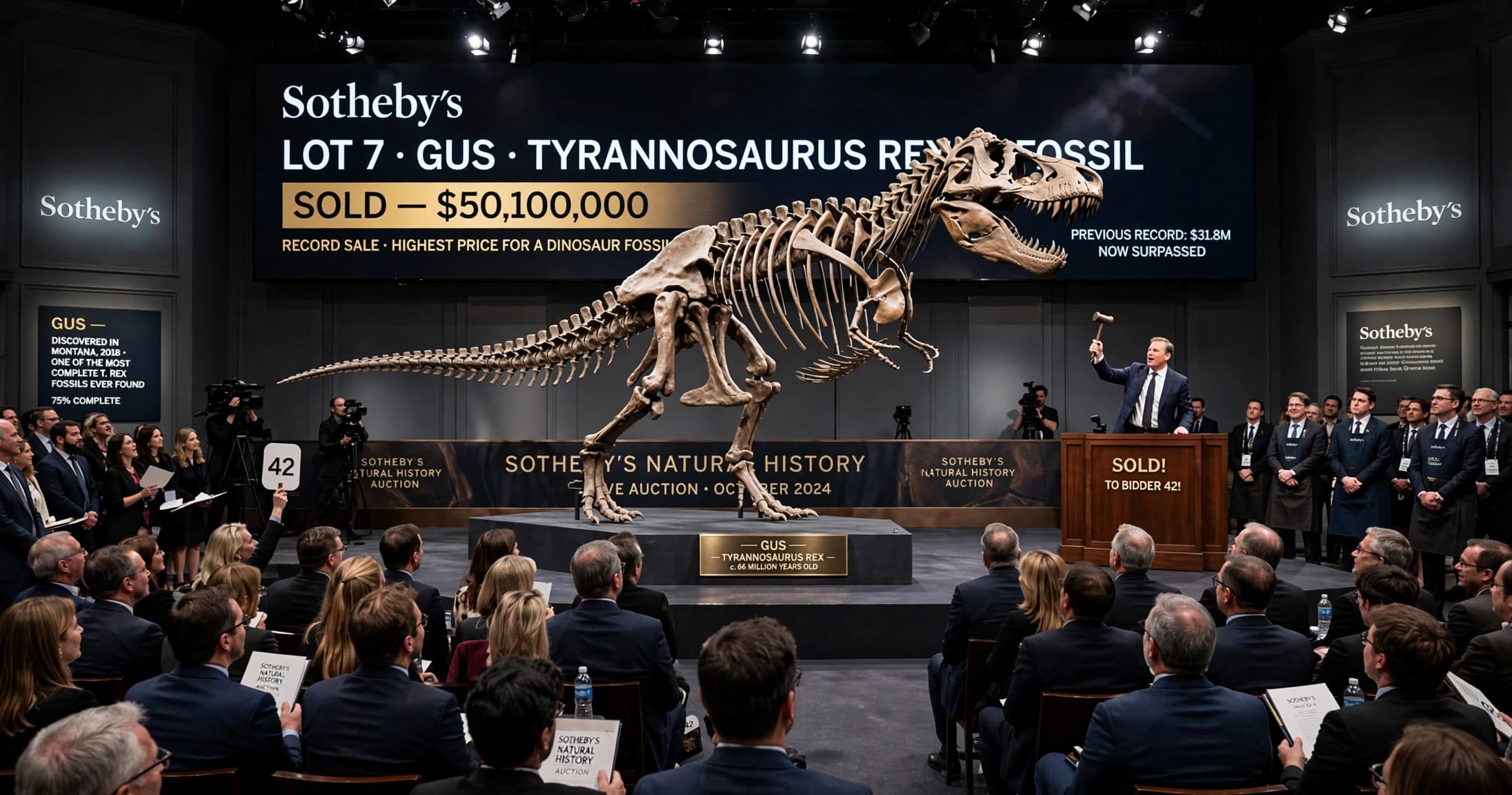
- The T. rex fossil 'Gus' sold for a record $50.1 million at Sotheby's auction.
- The sale broke the previous record held by Sotheby's for the Stegosaurus skeleton nicknamed 'Apex' in 2024 for $44.6 million.
- The T. rex fossil 'Gus' is about 61% complete by bone count, consisting of 183 fossil bone elements.
- The sale of 'Gus' highlights the growing demand for dinosaur fossils.
Why This Matters
The sale of the T. rex fossil 'Gus' for $50.1 million at Sotheby's auction is a significant event in the world of dinosaur fossils. The dinosaur fossil market is a niche industry where rare and well-preserved specimens can fetch high prices. This sale underscores the growing interest in dinosaur fossils and the willingness of collectors to pay top dollar for exceptional specimens.
What Happened
According to CNBC Economy, the T. rex fossil 'Gus' sold for $50.1 million at Sotheby's auction, breaking the previous record held by Sotheby's for the Stegosaurus skeleton nicknamed 'Apex' in 2024 for $44.6 million. The sale of 'Gus' is a testament to the growing demand for dinosaur fossils and the increasing value placed on these prehistoric specimens. The fossil has 183 fossil bone elements and is about 61% complete by bone count.
Background
The T. rex fossil 'Gus' is a significant find, with a length of about 38 feet, a height of about 12.5 feet, and a skull length of 54 inches. According to CNBC Economy, the T. rex fossil 'Gus' was discovered in South Dakota and is estimated to be about 67 million years old. The discovery of 'Gus' highlights the importance of fossil hunting and the role of collectors in preserving and studying these prehistoric specimens.
Timeline
- 2024: Sotheby's sells the Stegosaurus skeleton nicknamed 'Apex' for $44.6 million.
- 2020: Christie's sells a T. rex named 'Stan' for $31.8 million.
- 2023: Sotheby's announces the sale of the T. rex fossil 'Gus'.
Industry Impact
The sale of the T. rex fossil 'Gus' has significant implications for the dinosaur fossil industry. According to CNBC Economy, the sale of 'Gus' highlights the growing demand for dinosaur fossils and the increasing value placed on these prehistoric specimens. The sale also underscores the importance of authenticity and verification in the industry, with collectors and institutions seeking to ensure that the specimens they acquire are genuine and well-preserved.
What Happens Next
The sale of the T. rex fossil 'Gus' raises several questions about the valuation of the dinosaur fossil market and the safeguards for authenticity or verification in the industry. According to CNBC Economy, the sale of 'Gus' highlights the need for greater transparency and accountability in the dinosaur fossil industry, with collectors and institutions seeking to ensure that the specimens they acquire are genuine and well-preserved.
Key Takeaways
- The T. rex fossil 'Gus' sold for a record $50.1 million at Sotheby's auction.
- The sale broke the previous record held by Sotheby's for the Stegosaurus skeleton nicknamed 'Apex' in 2024 for $44.6 million.
- The T. rex fossil 'Gus' is about 61% complete by bone count, consisting of 183 fossil bone elements.
- The sale of 'Gus' highlights the growing demand for dinosaur fossils and the increasing value placed on these prehistoric specimens.
- The sale of 'Gus' underscores the importance of authenticity and verification in the dinosaur fossil industry.