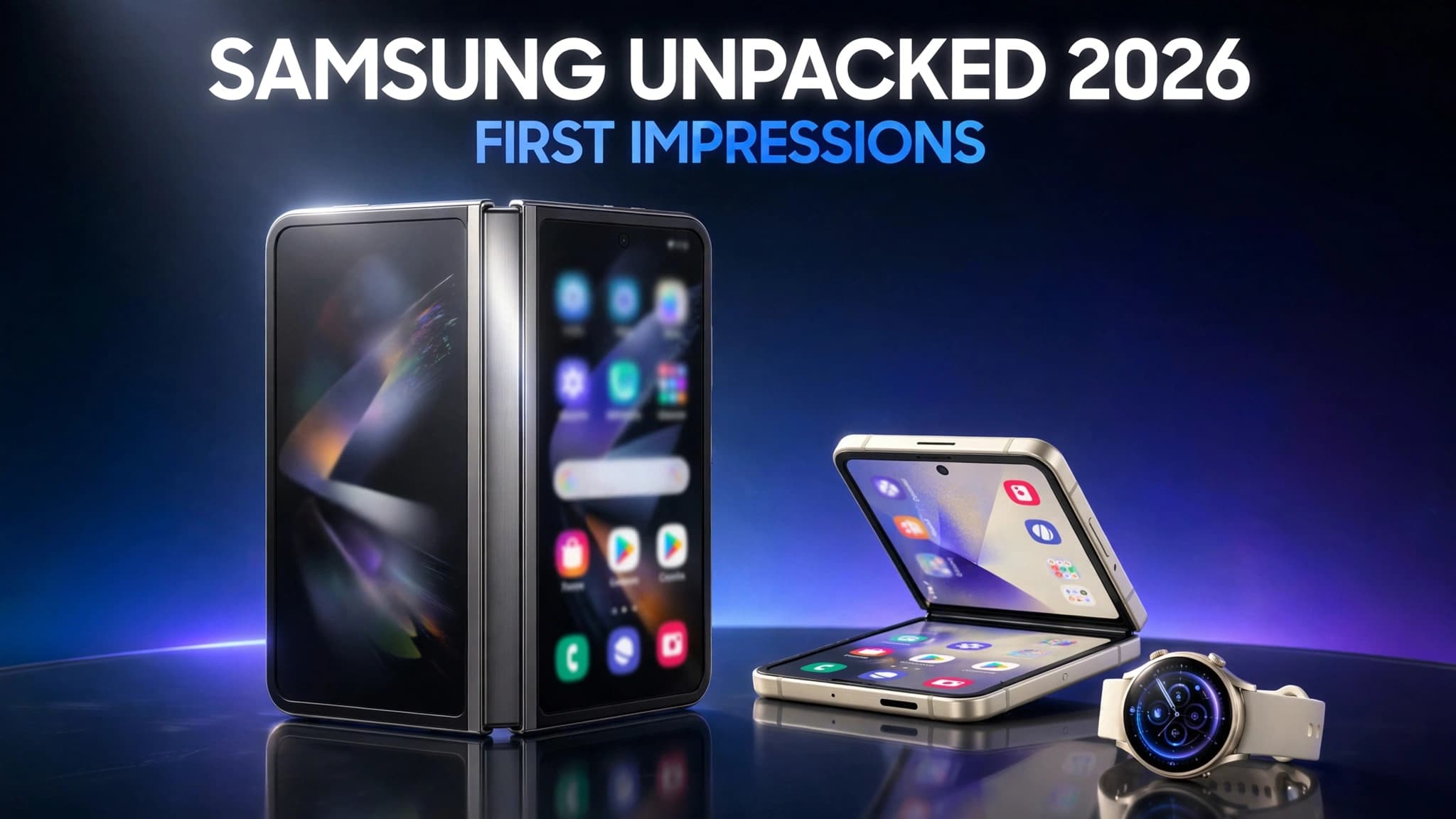
Samsung held its biggest foldable event in years on July 22, 2026, and for the first time the company chose London instead of its usual Seoul or New York stage. That location change turned out to be a small detail compared to what actually landed on stage. Samsung didn't just refresh its foldables this year, it split the whole lineup into three distinct phones, added a properly rugged watch upgrade, and quietly set the stage for its answer to Apple's rumored foldable iPhone.
This is not a full review. We only had hands on time with the devices for a short while after the keynote, so consider this a first impressions piece. A complete, in depth review of each device is coming soon once we've lived with them for longer.
Here is everything Samsung announced, how the devices felt in hand, and what they will actually cost you depending on where in the world you live.
Samsung, the Original Pioneer of Foldables
It is worth stepping back for a second before getting into specs and prices. Samsung was not the first company to talk about folding phones, but it was the first to turn the idea into a real, mass produced product people could actually buy. The original Galaxy Fold launched back in 2019, and it was rough around the edges, prone to screen issues and priced like a luxury item few could justify. Samsung stuck with it anyway.
Since then, the company has released a new Fold and Flip generation every single year without skipping a beat, something no other major phone maker has matched. Along the way it fixed the durability problems, brought the price closer to flagship territory, thinned out the hinge, and slowly turned foldables from a curiosity into a legitimate category. Samsung currently holds one of the largest shares of the global foldable phone market, and this year's Unpacked event is really the clearest sign yet of a company that is no longer experimenting, it is now defending its lead.
That defense matters more this year than in previous ones, because for the first time in a while, real competition is on the horizon.
The Apple Foldable Factor
Rumors of Apple entering the foldable market have circulated for years, but this time they feel different. Reports point to Apple's first foldable iPhone launching later in 2026, roughly six weeks after this Unpacked event, and that timing is almost certainly not a coincidence. Samsung has effectively had the premium foldable space largely to itself for seven years. That is about to change.
This context helps explain a few decisions made at Unpacked this year. Splitting the Fold lineup into two separate phones, the tall Ultra and the wide standard Fold 8, gives Samsung two different pitches to make before Apple has even shown its hand. The wider Fold 8 in particular looks like a direct answer to rumors that Apple's foldable will lean toward a more compact, book style form factor. Samsung wants to own as many shapes and price points as possible before customers have an alternative to compare against.
Whether that strategy works will depend on how Apple's device actually turns out, and how much of a premium Apple decides to charge for it. But it is clear Samsung is not sitting still waiting to find out.
A Foldable Lineup That Finally Makes Sense
For years Samsung's foldable strategy was simple: one book style Fold, one clamshell Flip. That changes now. The company has split its high end foldable into two separate products, and honestly, it is about time.
Foldable Lineup at a Glance
| Spec | Galaxy Z Fold 8 Ultra | Galaxy Z Fold 8 | Galaxy Z Flip 8 |
|---|---|---|---|
| Form factor | Tall book style | Wide book style | Clamshell |
| Main display | 8.0 inch, QXGA+ AMOLED 2X | 7.6 inch, 4:3 AMOLED 2X | 6.9 inch AMOLED |
| Cover display | 6.5 inch | 5.5 inch | 4.1 inch FlexWindow |
| Chipset | Snapdragon 8 Elite Gen 5 for Galaxy | Snapdragon 8 Elite Gen 5 for Galaxy | Snapdragon 8 Elite Gen 5 for Galaxy |
| RAM | Up to 16GB | Up to 12GB | Up to 12GB |
| Storage | Up to 1TB | Up to 512GB | Up to 512GB |
| Main camera | 200MP wide + 50MP ultra wide + 10MP telephoto (3x) | 50MP wide + 50MP ultra wide | Dual rear camera, AI focused FlexWindow |
| Battery | 5,000mAh, 45W wired | 4,800mAh, 45W wired, 20W wireless | Slimmest Flip battery to date |
| Weight | 215g | 201g | Lightest Flip build yet |
| Thickness (unfolded) | 4.1mm | 4.5mm | Slimmest Flip to date |
| Starting price (US) | $2,099 | $1,899 | $1,199 |
Galaxy Z Fold 8 Ultra: The One That Stays True to Form
The Z Fold 8 Ultra is the direct successor to last year's Z Fold 7, and it keeps the tall, narrow, book style shape that foldable fans already know. What is new is how thin this thing feels. Samsung has trimmed it down to 4.1mm when unfolded and 215 grams in weight, which genuinely surprised us when we picked it up. It does not feel like a device with two full displays crammed inside.
The screens themselves are excellent right out of the gate, an 8 inch main display and a 6.5 inch cover screen, both running Dynamic AMOLED 2X panels with adaptive refresh rates up to 120Hz. Samsung has also moved to a new Flex Titanium display structure, which the company claims reduces crease visibility over time. We could still see a faint line at certain angles, but it was noticeably softer than on last year's model.
Camera wise, this is the flagship of the flagships. A 200MP main sensor leads a triple camera setup that includes a 50MP ultra wide and a 10MP telephoto with 3x optical zoom, and it can shoot 8K video. Power comes from the Snapdragon 8 Elite Gen 5 for Galaxy chip, paired with up to 16GB of RAM and storage options stretching to 1TB. Battery capacity has been bumped to 5,000mAh with 45W wired charging.
In our brief time with it, the Z Fold 8 Ultra genuinely felt like the phone Samsung wants its most loyal foldable buyers to upgrade to. It is fast, it is polished, and it is very obviously expensive.
Galaxy Z Fold 8: A Completely Different Shape
This is the real headline of the event. The standard Galaxy Z Fold 8 is not simply a smaller Ultra, it is a brand new device with a wider, shorter form factor. When folded, the cover screen measures 5.5 inches with a taller aspect ratio built for scrolling and messaging. Unfold it and you get a 7.6 inch inner display with a roughly 4:3 aspect ratio, closer to a small tablet than a traditional foldable.
Samsung is clearly aiming this one at first time foldable buyers and people who want a device built around reading, browsing and content consumption rather than a phone that opens into a narrower workspace. It weighs 201 grams, making it the lightest Z Fold Samsung has ever built.
The camera setup is simpler, two 50MP sensors covering wide and ultra wide, plus a 10MP camera on each display for selfies and video calls. A new feature called My FanCam tracks a chosen subject and automatically reframes the shot for different social platforms, which is a fun touch for anyone creating short form video. It runs on the same Snapdragon 8 Elite Gen 5 chip as the Ultra, with a 4,800mAh battery and 45W wired plus 20W wireless charging.
Handling both Fold models side by side, the difference in personality is obvious. The Ultra feels like a productivity tool. The standard Fold 8 feels like a phone built for everyday comfort.
Galaxy Z Flip 8: Slimmer and Smarter
The Z Flip 8 rounds out the trio as Samsung's slimmest clamshell foldable yet. It keeps the familiar 6.9 inch inner display and 4.1 inch FlexWindow cover screen, but the cover screen now leans harder into AI features, letting you handle quick replies, widgets and camera previews without opening the phone at all.
Camera updates are more evolutionary than revolutionary here, but the combination of the redesigned hinge and slimmer body makes it noticeably more pocketable than last year's Flip 7. There has also been chatter from reliable leakers suggesting the Flip 8 could be Samsung's last small folding phone in its current form, though Samsung has not confirmed anything along those lines.
The Watches: Smaller News, Still Worth Knowing
Samsung didn't forget its wearables lineup this time around.
The Galaxy Watch Ultra 2 is the rugged option, built around an 800mAh battery, a Sapphire Crystal display and a deeper set of advanced health tracking metrics. Samsung says the new model is roughly 25 percent lighter than before, which was noticeable the moment we strapped it on.
The Galaxy Watch 9 is the everyday option, available in 40mm and 44mm sizes and powered by the new Snapdragon Wear Elite chipset. It is a smaller update than the Ultra 2, but the lighter build and the new chip should translate into smoother day to day performance.
Watch Lineup at a Glance
| Spec | Galaxy Watch Ultra 2 | Galaxy Watch 9 |
|---|---|---|
| Positioning | Rugged, outdoor focused | Everyday, mainstream |
| Case sizes | Single rugged size | 40mm and 44mm |
| Display | Sapphire Crystal | Standard AMOLED |
| Battery | 800mAh | Standard, size dependent |
| Chipset | Latest Samsung wearable chip | Snapdragon Wear Elite |
| Weight change vs predecessor | Approximately 25 percent lighter | Standard |
| Starting price (US) | $699 | $379 |
Global Pricing: What You'll Actually Pay
Prices went up across the board this year, and Samsung has been fairly open about the reason, rising memory chip costs are being passed on to customers. Here is how the base storage configurations break down in major markets. Keep in mind exchange rates shift daily, so treat non US figures as close approximations, and some markets had not published final numbers at the time of writing.
Galaxy Z Fold 8 Ultra Pricing (Base Storage)
| Market | Price |
|---|---|
| United States | $2,099 |
| Europe | €2,199 |
| United Kingdom | £1,899 (approx) |
| Japan | approx JPY 296,780 to JPY 346,300 (listing varies by retailer) |
| India | Rs 1,99,990 |
| UAE | AED 7,999 |
| China | No official Samsung retail listing |
Galaxy Z Fold 8 Pricing (Base Storage)
| Market | Price |
|---|---|
| United States | $1,899 |
| Europe | approx €1,899 to €1,999 (not yet finalized) |
| United Kingdom | approx £1,699 to £1,799 |
| Japan | Not yet confirmed on Samsung's regional site |
| India | Expected two to four weeks after global unveiling |
| UAE | AED 7,199 |
| China | No official Samsung retail listing |
Galaxy Z Flip 8 Pricing (Base Storage)
| Market | Price |
|---|---|
| United States | $1,199 |
| Europe | approx €1,299 |
| United Kingdom | approx £1,099 |
| India | Rolling out with pre orders |
| Japan | Rolling out with pre orders |
| UAE | Rolling out with pre orders |
| China | No official Samsung retail listing |
Galaxy Watch Ultra 2 and Watch 9 Pricing (US Baseline)
| Market | Watch Ultra 2 | Watch 9 |
|---|---|---|
| United States | $699 | $379 |
| Europe | To be confirmed | To be confirmed |
| United Kingdom | To be confirmed | To be confirmed |
| Japan | To be confirmed | To be confirmed |
| India | To be confirmed | To be confirmed |
| UAE | To be confirmed | To be confirmed |
A quick note on China. Samsung's foldable market share there is small compared to domestic brands like Huawei and Honor, and the company has historically skipped simultaneous global launches for its foldables in that market. We will update this section the moment official Chinese pricing appears.
So, Worth Buying?
That is the question everyone actually wants answered, and it is genuinely too early to say with confidence. A short hands on session at an Unpacked event is not enough time to judge battery life, camera performance in real conditions, software quirks or how the hinge holds up after weeks of folding and unfolding.
What we can say after our first impressions is this. The decision to split the Fold lineup into two genuinely different phones is the smartest move Samsung has made with this product line in years. The Ultra keeps the format that loyal fans love, while the standard Fold 8 finally gives Samsung a foldable that doesn't feel intimidating to a first time buyer. The Flip 8 is a smart, incremental refinement. The watches are solid but unspectacular updates.
Pricing is the real sticking point. Every single device costs more than its predecessor, and for the Fold 8 Ultra and Flip 8 specifically, that is a $100 jump in the US alone. Whether that price hike is worth it will depend entirely on how these devices perform once we've spent real time with them.
We will be back soon with a complete review covering battery life, camera samples, software performance and long term hinge durability. For now, this is where things stand fresh off the Unpacked stage in London.
This article will be updated as more regional pricing details are confirmed by Samsung.