Key Takeaways
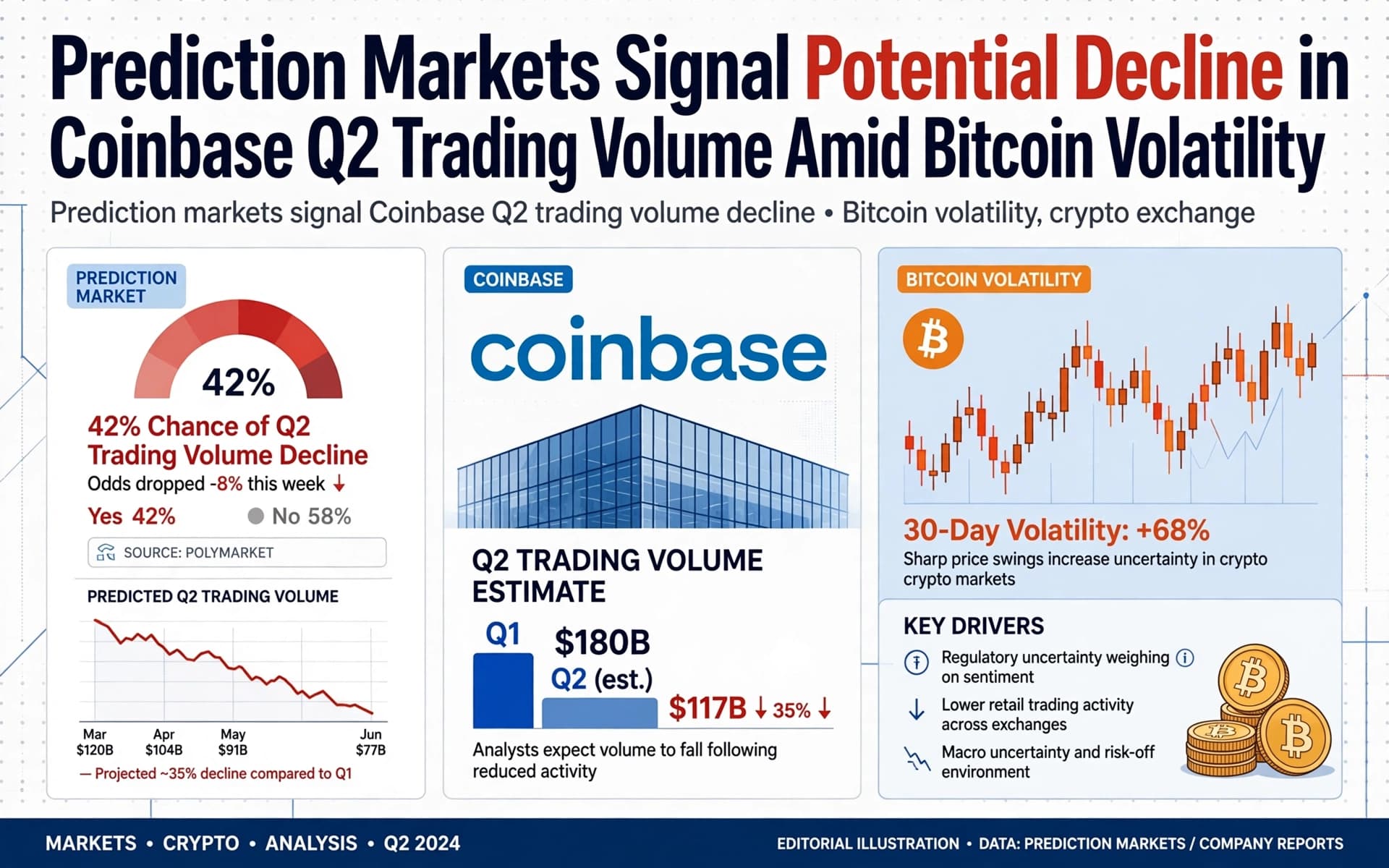
- Prediction markets on Kalshi suggest Coinbase's Q2 trading volume may fail to reach the $160 billion threshold.
- Current market sentiment diverges significantly from the FactSet consensus estimate of $168.5 billion.
- Continued Bitcoin volatility and a 12% decline in BTC prices during Q2 are driving downward pressure on exchange activity.
The intersection of prediction markets and traditional financial forecasting is highlighting growing skepticism regarding the upcoming quarterly performance of major crypto exchanges. As the industry navigates a period of heightened volatility, the metrics used to gauge exchange health are showing signs of contraction.
The upcoming earnings season will serve as a critical test for the platform's ability to maintain liquidity and user engagement. With Bitcoin prices experiencing a notable downturn, the correlation between underlying asset performance and exchange transaction throughput remains a primary concern for institutional investors.
Divergence in Volume Projections
The following table compares the various forecasting models currently circulating in the market.
| Forecast Source | Projected Q2 Trading Volume |
|---|---|
| FactSet Consensus | $168.5 Billion |
| Kalshi Trader Sentiment (High) | >$170 Billion (25% probability) |
| Kalshi Trader Sentiment (Mid) | >$160 Billion (41% probability) |
| Kalshi Trader Sentiment (Low) | <$160 Billion (Majority Probability) |
The discrepancy between professional analyst estimates and speculative market bets suggests a lack of confidence in a high-volume outcome for the quarter.
Drivers of Declining Activity
Several macroeconomic and sector-specific factors have converged to create a challenging environment for exchange volumes.
- A 12% decline in Bitcoin prices throughout the second quarter has dampened speculative trading fervor.
- The platform has experienced two consecutive quarters of declining trading volumes.
- Increased volatility in the broader AI & Technology and digital asset sectors has shifted capital toward more stable assets.
- The broader Economy & Policy landscape has influenced liquidity flows, reducing the frequency of high-value trades.
These factors have contributed to a significant erosion in shareholder value, as reflected in the company's stock performance.
Market Performance Metrics
The relationship between asset price movement and exchange equity value is visible in recent data.
| Metric | Performance Data |
|---|---|
| Coinbase Share Price Change | -55% since October 2025 Bitcoin peak |
| Bitcoin Price Movement (Q2) | -12% |
| Next Earnings Date | July 30, 2026 |
The data indicates that the exchange is highly sensitive to the price action of its primary underlying asset, Bitcoin.
Broader Market Implications
The results of this earnings report will likely serve as a bellwether for the health of the entire digital asset ecosystem.
- The outcome will influence Markets & IPOs sentiment regarding the scalability of centralized exchanges.
- Trading volume trends will dictate whether startups & funding in the crypto space will see a resurgence in venture interest.
- If volumes fall below $200 billion, it will mark the first time this threshold has been breached since Q3 2024.
The ability of the exchange to navigate this period of contraction will determine its standing in the next market cycle.
Outlook
As the July 30 earnings release approaches, the market is bracing for a potential miss against the FactSet consensus. The primary question remains whether the exchange can stabilize its volume or if the downward trend observed over the last two quarters is part of a more prolonged structural shift in how users interact with digital asset platforms.
If the trading volume fails to meet the $168.5 billion mark, it may trigger further volatility in the exchange's equity. Investors are closely watching to see if the platform can pivot toward new revenue streams to offset the decline in traditional transaction fees.
The upcoming report will provide clarity on whether the current volatility is a temporary fluctuation or a fundamental shift in market participation.
Frequently Asked Questions
What is the current consensus for Coinbase's Q2 volume?
The FactSet consensus estimate currently sits at $168.5 billion.
How has Bitcoin's performance affected the exchange?
Bitcoin prices fell approximately 12% during the second quarter, contributing to a decline in trading volumes.
When will the official earnings report be released?
Coinbase is scheduled to release its second-quarter earnings report on July 30, 2026.