Key Takeaways
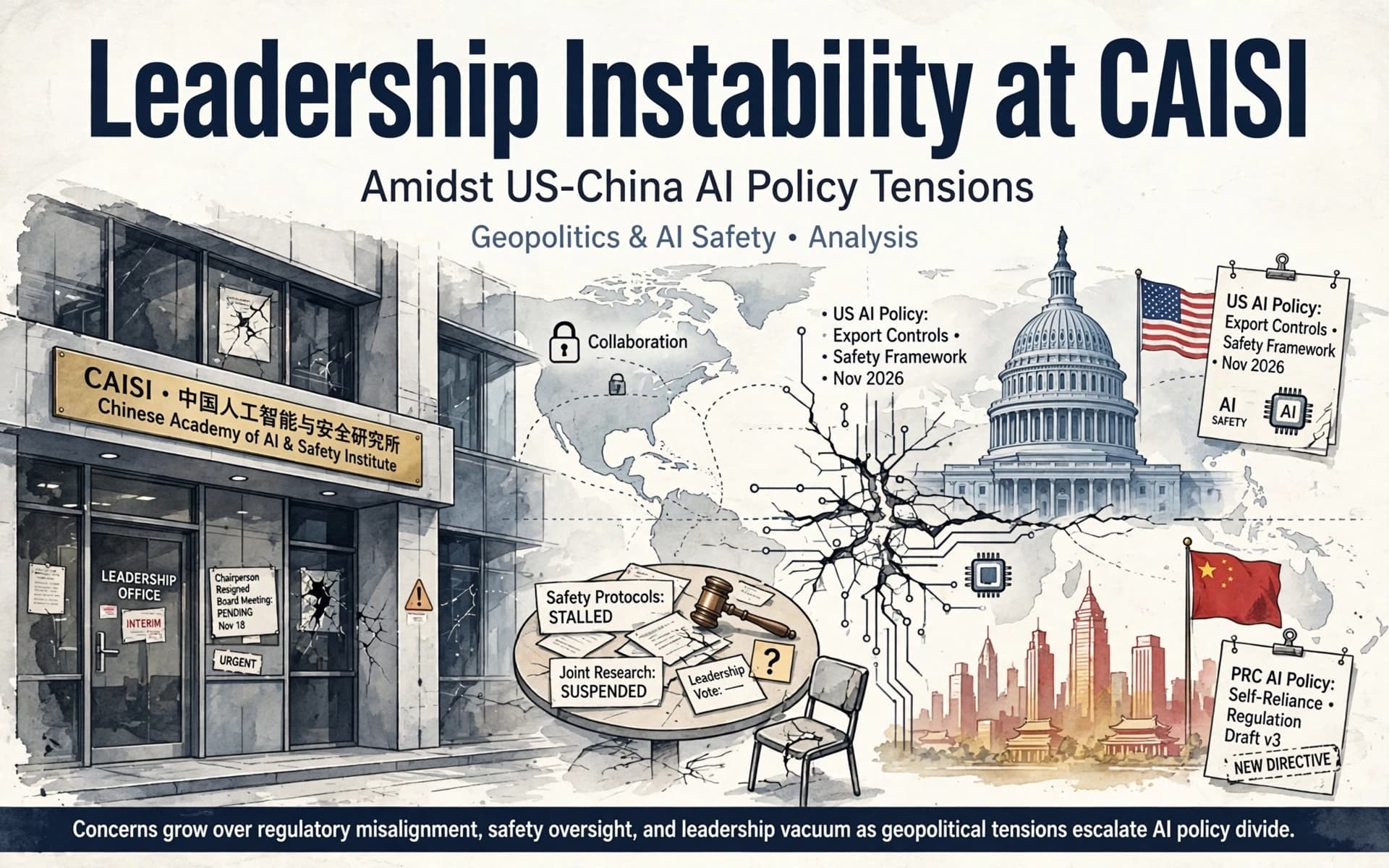
- The Center for AI Standards and Innovation (CAISI) faces leadership instability following the resignation of Director Chris Fall.
- Recent executive actions, including the "Gold Eagle" safety oversight program, signal an intensifying intersection between national security and AI & Technology regulation.
- Policy volatility is driven by aggressive export controls and the strategic assessment of Chinese open-weight models, such as Z.ai’s GLM-5.2.
The landscape of federal artificial intelligence oversight is experiencing a period of volatility. As the United States attempts to balance innovation with national security imperatives, the agencies tasked with setting guardrails are seeing rapid turnover in high-level leadership.
This instability occurs as the administration grapples with the dual pressures of maintaining a competitive edge against China and managing the risks posed by frontier models. The friction between regulatory oversight and industry interests has intensified.
Recent maneuvers by the U.S. Commerce Department regarding model availability and the implementation of new safety oversight programs suggest that the era of light-touch regulation is transitioning into a period of rigorous, security-focused intervention.
Leadership Turnover at CAISI and NIST
The administrative core of the nation's AI standards framework has seen three major departures in recent months.
| Leadership Role | Individual | Status |
|---|---|---|
| Director, CAISI | Chris Fall | Resigned |
| AI Czar | Collin Burns | Departed (April) |
| White House AI/Crypto Czar | David Sacks | Stepped down (March) |
The departure of Chris Fall marks the latest in a series of exits that have left the Center for AI Standards and Innovation (CAISI), which operates under the National Institute of Standards and Technology (NIST), in a state of transition.
Drivers of Regulatory Volatility
The instability within these agencies is rooted in the geopolitical tensions defining current Economy & Policy decisions.
- The resignation of Collin Burns occurred less than a week after his appointment, reportedly due to scrutiny regarding his previous employment at Anthropic.
- The administration's focus has shifted toward cybersecurity vulnerability coordination through the "Gold Eagle" program.
- Export control directives have directly impacted market availability for leading private sector models.
- There is an increasing focus on the performance benchmarks of foreign open-weight models.
This churn suggests a struggle to define the boundaries between private sector expertise and public sector oversight. As the administration moves to implement the Gold Eagle program—a joint effort between the Commerce Department and the Department of Homeland Security—the pressure on CAISI to provide technical legitimacy has increased.
Recent Regulatory Actions and Market Impact
The intersection of commerce and security has led to direct interventions in the deployment of specific AI models.
| Action Type | Entity Involved | Outcome |
|---|---|---|
| Export Control Directive | Anthropic | Mythos and Fable models pulled from market |
| Policy Reversal | Secretary Howard Lutnick | Lifting of previous model restrictions |
| Oversight Program | Gold Eagle | New cybersecurity vulnerability coordination |
While the restrictions on Anthropic's Mythos and Fable models were eventually lifted by Secretary Howard Lutnick, the incident highlighted the government's willingness to use market access as a lever for security compliance.
Broader Geopolitical and Market Implications
The strategic competition with China is reshaping how the U.S. views open-source and open-weight AI development.
- The administration has considered banning Chinese open models following performance benchmarks of Moonshot's Kimi model.
- CAISI has released technical reports analyzing the capabilities of Z.ai’s GLM-5.2 and DeepSeek V4 Pro.
- Industry leaders, including Google DeepMind's Demis Hassabis, are advocating for an independent, industry-run standards body modeled after FINRA.
The tension between open-weight accessibility and national security is creating a bifurcated market. As startups & funding flows toward companies that can navigate these regulatory hurdles, the technical benchmarks set by NIST and the Commerce Department will become the primary determinants of market viability.
Outlook
The trajectory of AI governance in the United States appears to be moving toward a more rigid, security-centric model. The implementation of the Gold Eagle program indicates that the Department of Homeland Security will play an increasingly central role in how AI models are vetted for cybersecurity vulnerabilities.
This shift may create a higher barrier to entry for new entrants in the Markets & IPOs space, as compliance with federal oversight becomes a prerequisite for large-scale deployment.
Furthermore, the debate over Chinese models remains a critical unknown. If the administration proceeds with a ban on certain open models based on the performance of entities like Moonshot, it could trigger a significant shift in how global developers approach model weights and distribution.
The industry's push for an independent standards body, as suggested by Demis Hassabis, represents a desire to decouple technical standards from the perceived volatility of political administrations. Ultimately, the stability of CAISI and the clarity of NIST's evaluation processes will determine whether the U.S. can maintain its pace of innovation while securing its digital infrastructure.
The current leadership vacuum at the heart of these agencies leaves a significant question mark over the consistency of future policy.
Frequently Asked Questions
What was the reason for Chris Fall's resignation?
The specific reasons for Chris Fall's resignation have not been officially disclosed by CAISI or NIST.
How do the LLM evaluations at the DoC and NIST work?
The exact technical methodologies for how the Department of Commerce and NIST evaluate Large Language Models remain a subject of internal agency process and are not fully transparent to the public.
Will the administration proceed with efforts to ban Chinese open models?
The administration is currently weighing the security risks posed by models like Moonshot's Kimi against the benefits of open-weight development, and a final decision on a broad ban has not been reached.