Key Takeaways
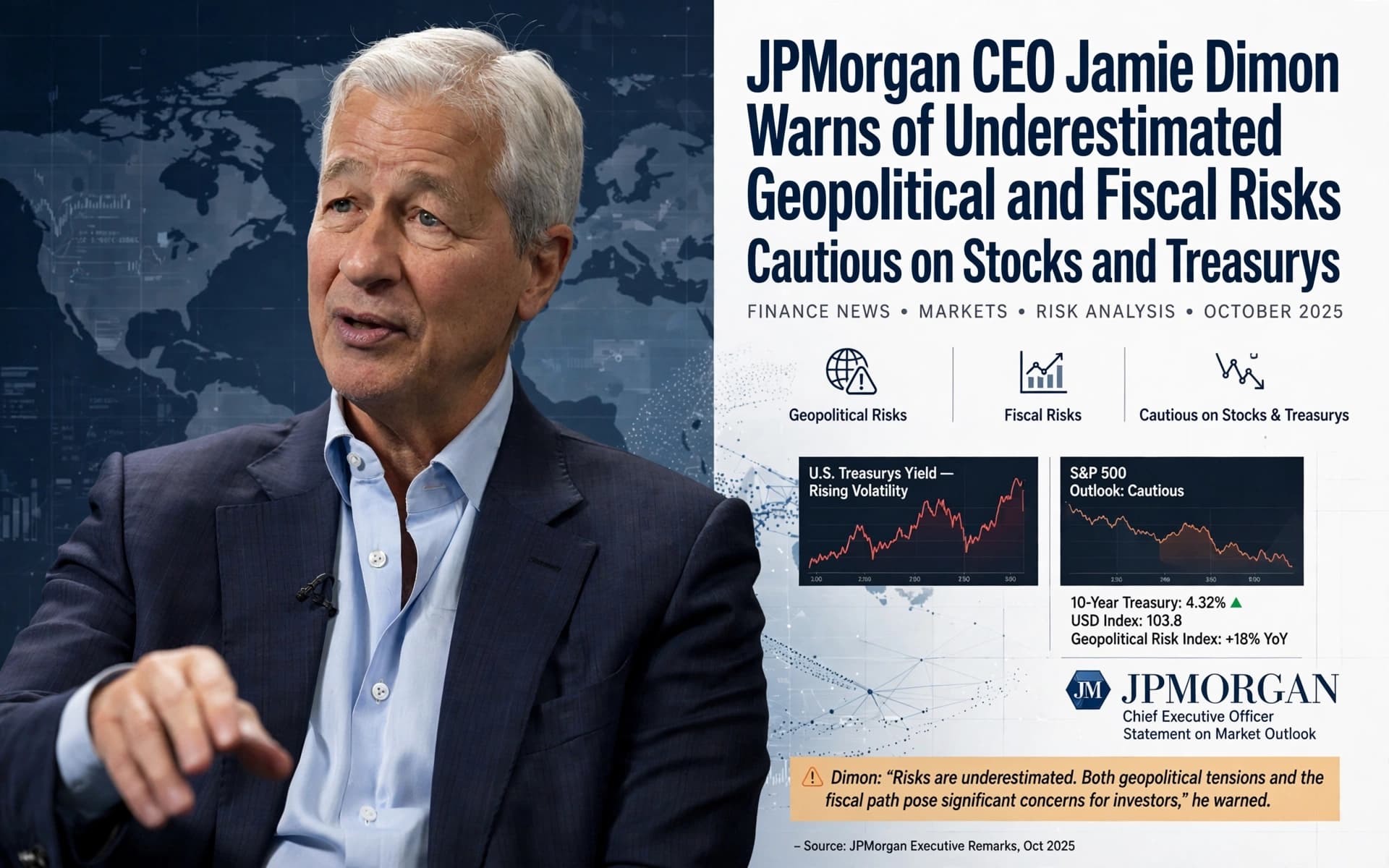
- Jamie Dimon warns that current market valuations fail to account for significant geopolitical instability and fiscal deficits.
- The JPMorgan Chase CEO expressed reluctance to enter equity or long-dated U.S. Treasury positions at prevailing price levels.
- Projections suggest 10-year Treasury yields may settle between 4% and 4.5%, regardless of whether the Federal Reserve hits its 2% inflation target.
The global financial landscape is navigating a period of high optimism, yet leadership at the world's largest bank suggests a volatile path lies ahead. As the S&P 500 has returned nearly 10% this year, many market participants have transitioned into an aggressive growth stance. This focus centers heavily on the rapid expansion of AI & Technology sectors. However, this enthusiasm may overlook structural vulnerabilities that could trigger significant market corrections.
Jamie Dimon, the Chairman and CEO of JPMorgan Chase, has signaled a cautious stance. He noted that current market pricing does not reflect the true magnitude of global risks. According to Dimon, the confluence of military spending and mounting government deficits creates a fiscal environment fundamentally different from previous decades.
The Dimon Caution: A Divergence from Market Sentiment
The following table outlines the divergence between current market optimism and the risk assessment provided by JPMorgan leadership.
| Market Sentiment | Dimon's Risk Assessment |
|---|---|
| High confidence in S&P 500 momentum | Underestimation of geopolitical volatility |
| Focus on AI-driven productivity gains | Concerns over massive capital expenditure ROI |
| Expectation of stabilizing interest rates | Persistent upward pressure on yields due to deficits |
This divergence highlights a growing gap between equity valuations and the underlying macroeconomic realities of fiscal policy and international conflict.
Drivers of Macroeconomic Uncertainty
The current landscape is being shaped by several interconnected variables that complicate the outlook for Markets & IPOs.
- Geopolitical Instability: Ongoing conflicts in Ukraine and the Middle East continue to create supply chain and energy price volatility.
- U.S.-China Tensions: Escalating friction between the world's two largest economies introduces systemic risks to global trade and technology manufacturing.
- Fiscal Deficits: Rising government spending, particularly in military sectors, is driving a structural increase in national debt.
- Inflationary Persistence: The interplay between high debt and geopolitical shocks makes the Federal Reserve's path toward a 2% inflation target highly uncertain.
These factors create a complex environment where traditional correlations between stocks and bonds may no longer hold true. This shift may force investors to rethink long-term asset allocation.
Comparative Analysis: The AI Spending Cycle
Dimon has drawn a parallel between the current surge in artificial intelligence investment and the historical internet boom of the late 1990s.
| Era | Primary Driver | Outcome/Risk |
|---|---|---|
| The Internet Boom | Netscape, Google, Facebook | Massive capital outlay followed by market correction |
| The AI Era | Large-scale GPU/Data Center spend | Uncertain ROI on massive infrastructure investment |
While the technological shift is significant, the question remains whether current capital expenditure will yield the productivity gains required to justify current valuations.
Broader Market and Economic Implications
The warnings from JPMorgan leadership have significant implications for how capital will flow through the Economy & Policy landscape in the coming years.
- Fixed Income Volatility: Even if inflation reaches the Federal Reserve's target, 10-year Treasury yields are expected to remain elevated between 4% and 4.5%.
- Equity Valuation Pressure: High interest rates, driven by deficit spending, act as a natural ceiling for stock market multiples.
- Capital Allocation Shifts: Investors may move away from long-dated Treasurys as the "term premium" increases to compensate for fiscal risk.
The combination of these factors suggests that the era of low-yield stability is being replaced by a regime defined by higher volatility and higher costs of capital.
Outlook
As we move further into 2026, the central question for institutional investors is whether the current market has priced in a "major shock." While the S&P 500's performance has been robust, the structural underpinnings—specifically the U.S. budget deficit—suggest that interest rates may remain higher for longer than the consensus expects.
The massive spending on AI represents a significant bet on the future of global productivity. However, much like the early days of the internet, the transition from infrastructure build-out to widespread economic monetization can be long and difficult for investors. Whether the AI cycle results in a sustainable growth cycle or a speculative bubble remains the defining uncertainty of this decade.
Ultimately, the market is caught between the promise of technological advancement and the reality of fiscal and geopolitical friction. Investors who ignore mounting debt and shifting geopolitical alliances may find themselves unprepared for the next phase of the economic cycle.
Frequently Asked Questions
Why is Jamie Dimon cautious about U.S. Treasurys?
Dimon believes that mounting government deficits and geopolitical risks will keep yields higher than currently priced, making long-dated bonds unattractive at current levels.
How does the AI boom compare to the internet era?
Dimon compares the current AI spending to the early days of the internet, noting that while the technology is transformative, the massive capital expenditures required do not always translate to immediate market stability.
What is the predicted yield for 10-year Treasury bonds?
Dimon predicts that 10-year Treasury yields should likely sit between 4% and 4.5%, even if inflation successfully reaches the Federal Reserve's 2% target.