Key Takeaways
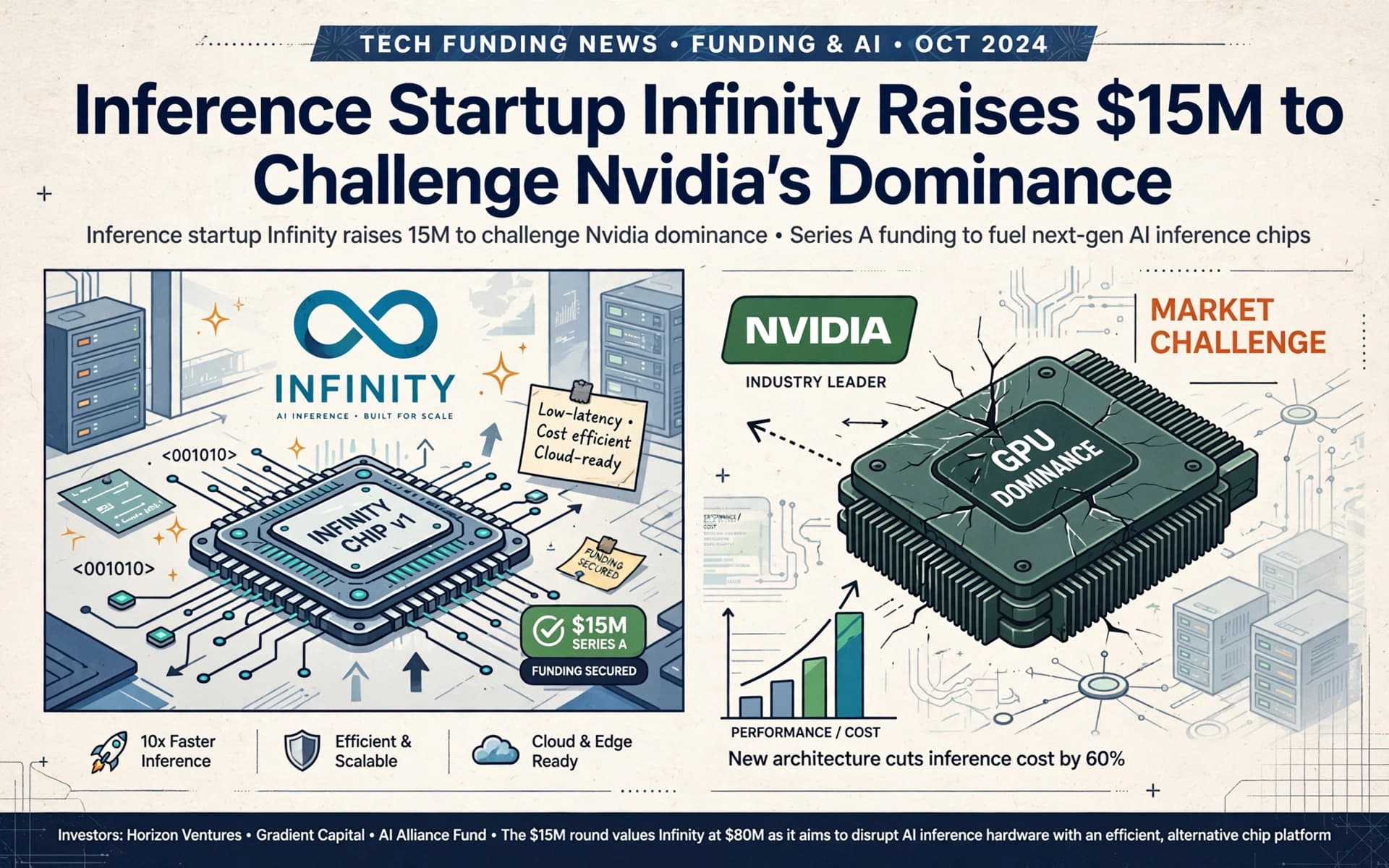
- Infinity, an inference startup, has secured $15 million in funding from prominent investors, including Touring Capital and researchers from OpenAI and Anthropic, valuing the company at $100 million.
- The startup aims to challenge Nvidia's dominance in the AI chip market with its software designed to facilitate the operation of AI models on various types of chips, potentially offering a CUDA-alternative kernel software.
- With 26 employees and a focus on innovation, Infinity is poised to make a significant impact in the AI & Technology sector, particularly in the realm of Startups & Funding.
The recent funding round for Infinity marks a significant milestone for the startup, which was launched last year by Jeremy Nixon, a former researcher at Google Brain. This investment underscores the potential of Infinity's technology and highlights the growing interest in alternatives to Nvidia's solutions in the AI chip market. As the demand for efficient and versatile AI processing continues to grow, startups like Infinity are emerging to challenge the status quo and provide innovative solutions that can work seamlessly with a variety of chips.
The potential of Infinity's software lies in its ability to act as a bridge between AI models and the hardware they run on, making it easier for developers to deploy their models without being locked into specific chip architectures. This is particularly relevant in the context of the broader Markets & IPOs landscape, where the performance and adaptability of AI solutions can significantly impact a company's competitiveness. Infinity's AI research agent, Ignition, plays a crucial role in this endeavor by automatically writing the low-level code needed for AI inference on non-Nvidia chips, thereby streamlining the development process and reducing the barriers to entry for companies looking to leverage AI.
Funding and Valuation
The $15 million funding round is a testament to the confidence investors have in Infinity's vision and technology.
| Key Highlights | Details |
|---|---|
| Funding Amount | $15 million |
| Investors | Touring Capital, researchers from OpenAI and Anthropic |
| Valuation | $100 million |
| This significant investment will likely be used to further develop Infinity's software and expand its team, currently comprising 26 employees across design, operations, and engineering. The valuation of $100 million reflects the market's belief in Infinity's potential to provide a viable alternative to CUDA for running AI models on diverse hardware platforms. |
Competitive Landscape
Infinity's emergence into the AI chip market is driven by the need for more flexible and accessible solutions.
- The dominance of Nvidia in the AI chip market has created a void for alternatives that can offer similar or better performance without the constraints of proprietary technology.
- The involvement of researchers from OpenAI and Anthropic in Infinity's funding round suggests a strong backing from the AI research community, which is crucial for the development of cutting-edge AI technologies.
- The ability of Infinity's software to work with any type of chip, including those from startups like D-Matrix, positions it as a versatile solution that can cater to a wide range of applications and use cases.
- The potential for Infinity's software to support popular AI frameworks like PyTorch and TensorFlow further enhances its appeal to developers and researchers.
Technical Capabilities
Infinity's technical approach is centered around its software's capability to optimize AI model performance on various chips.
| Feature | Description |
|---|---|
| Ignition | AI research agent that writes low-level code for AI inference |
| CUDA-alternative | Kernel software designed to work with any type of chip |
| Compatibility | Supports deployment on diverse hardware platforms |
| The development of such software requires a deep understanding of both AI models and chip architectures, making Infinity's team, led by Jeremy Nixon, well-positioned to tackle this challenge. | |
| The focus on making AI inference more accessible and efficient aligns with the broader trends in Economy & Policy, where the adoption of AI is seen as a key driver of economic growth and competitiveness. |
Market Impact
The implications of Infinity's funding and technological advancements are far-reaching.
- The potential to challenge Nvidia's dominance could lead to a more competitive AI chip market, driving innovation and reducing costs for consumers.
- Infinity's software could enable smaller chip makers to compete more effectively, potentially altering the Markets & IPOs landscape for AI and semiconductor companies.
- The applications of Infinity's software extend beyond the AI chip market, with potential uses in areas such as edge computing and autonomous vehicles, further expanding its market potential. As the AI and chip industries continue to evolve, the role of startups like Infinity in shaping the future of AI processing will be critical, influencing not just the technology itself but also the Startups & Funding ecosystem that supports innovation.
Outlook
The future of Infinity and its impact on the AI chip market will depend on several factors, including the company's ability to execute its vision, the reception of its software by developers and chip manufacturers, and the evolving landscape of the AI industry. While there are open questions regarding the current market share of Nvidia and how Infinity's software compares to existing solutions in terms of performance and cost, the potential for Infinity to make a significant impact is undeniable. As the company moves forward, it will be essential to address these questions and demonstrate the value proposition of its technology to a wider audience, including potential customers in the AI & Technology sector. With the right strategy and execution, Infinity could challenge Nvidia's dominance and pave the way for a more diverse and innovative AI chip market.