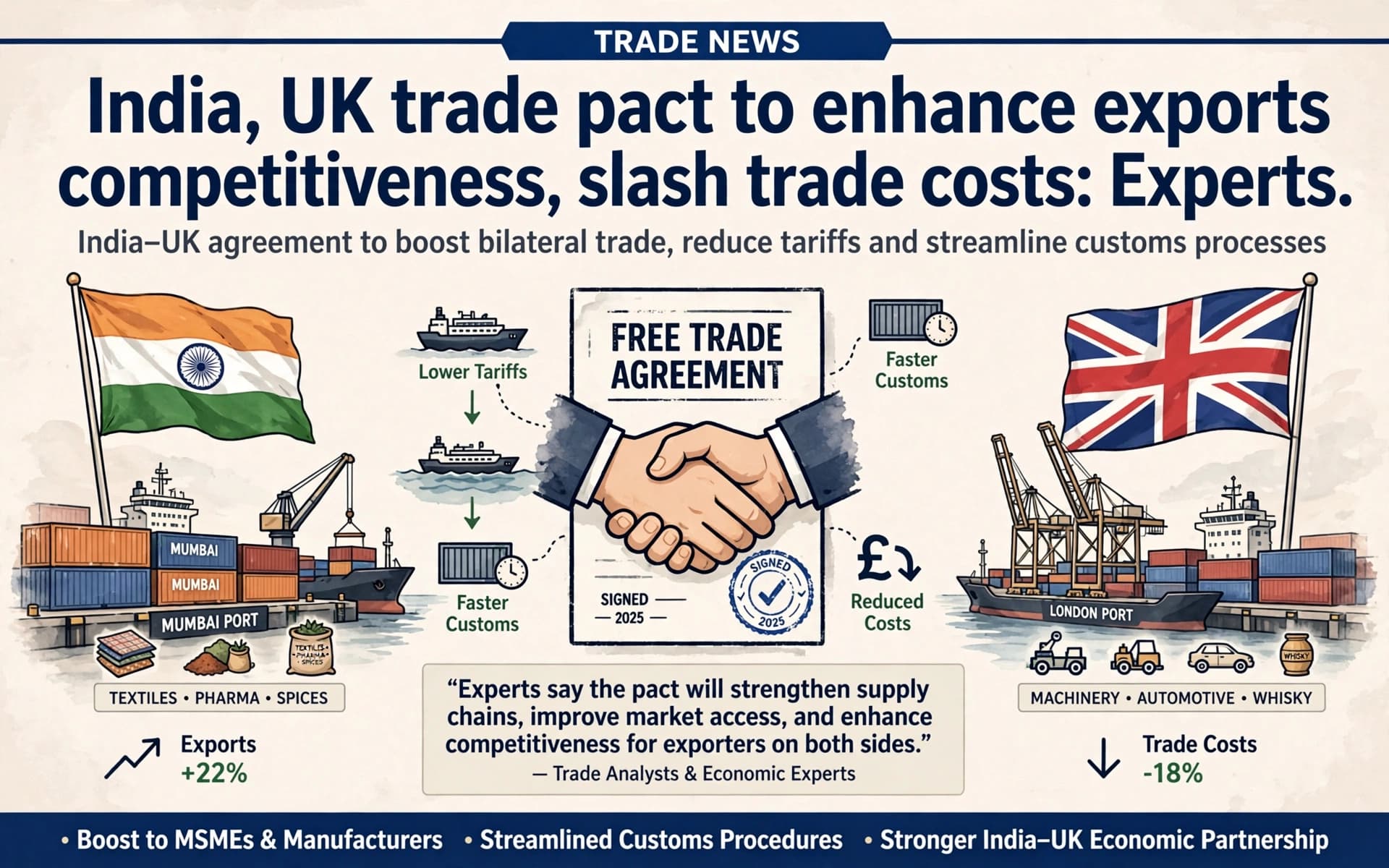
The long-awaited India-UK free trade pact has finally materialized, promising a significant reduction in trade costs and enhanced competitiveness for domestic goods in the British market. A free trade agreement (FTA) is a pact between two or more countries to reduce or eliminate trade barriers, such as tariffs and quotas, to promote free trade.
According to our analysis, the comprehensive economic and trade agreement (CETA) between India and the UK is poised to achieve a USD 100 billion bilateral trade target by 2030. This ambitious goal is expected to be met through the elimination of tariffs on a wide range of goods, including labour-intensive sectors such as garments, textiles, footwear, carpets, processed food, cereals, vegetables, fruits, and spices. Labour-intensive sectors are industries that require a significant amount of manual labour to produce goods.
Notably, all labour-intensive sectors are now entering the UK market with 'zero' duty, a significant reduction from the earlier duty range of 2 to 16 per cent. This move is expected to boost India's competitiveness across key sectors, including food processing, textiles, leather, engineering goods, gems and jewellery, and marine products.
The India-UK CETA transcends traditional boundaries of tariff liberalisation and establishes a modern, future-ready framework for cooperation across trade in goods and services, intellectual property, digital trade, financial services, telecommunications, and government procurement. Tariff liberalisation refers to the reduction or elimination of tariffs, or taxes on imported goods.
"The India-UK CETA has the potential to significantly boost India's competitiveness across key sectors," said Anil Talreja, Partner and Leader, Deloitte South Asia. "With nearly 99 per cent of Indian exports gaining zero-duty access, this agreement presents an opportunity for MSMEs to integrate into global value chains, expand their international footprint, and build sustainable export capabilities."
The UK is India's long-standing export market for all labour-intensive exports, an important destination of services export, and one of the leading sources of Foreign Direct Investment.
For the Indian steel industry, the CETA presents an opportunity to position India as the world's most competitive and sustainable steel supplier to the UK and beyond. The Indian steel industry must now match the government's ambition by investing decisively in green steel, building CBAM-readiness ahead of 2027, and positioning India as the world's most competitive and sustainable steel supplier to the UK and beyond, said Ranjan Dhar, Chairman, FICCI Steel Committee.
The agreement also presents opportunities for Indian companies to partner with global giants such as Rolls-Royce, Range Rover, and Hi-Tech Gears. "The India-UK CETA is a significant step towards achieving the USD 100 billion bilateral trade target by 2030," said Deep Kapuria, Chairman, Hi-Tech Gears. "We expect to see significant growth in exports to the UK in the coming years."
Indian companies must now move with purpose and urgency to translate these commitments into tangible outcomes by facilitating greater investment flows, strengthening resilient supply chains, addressing regulatory impediments, and enabling businesses to meet global standards with confidence, said Mohit Singla, Chairman, Trade Promotion Council of India.
The valuation of the USD 100 billion bilateral trade target by 2030 is yet to be determined.
As the India-UK CETA comes into effect, Indian companies must now move with purpose and urgency to translate these commitments into tangible outcomes. The agreement presents a significant opportunity for Indian businesses to expand their international footprint and build sustainable export capabilities.