Key Takeaways
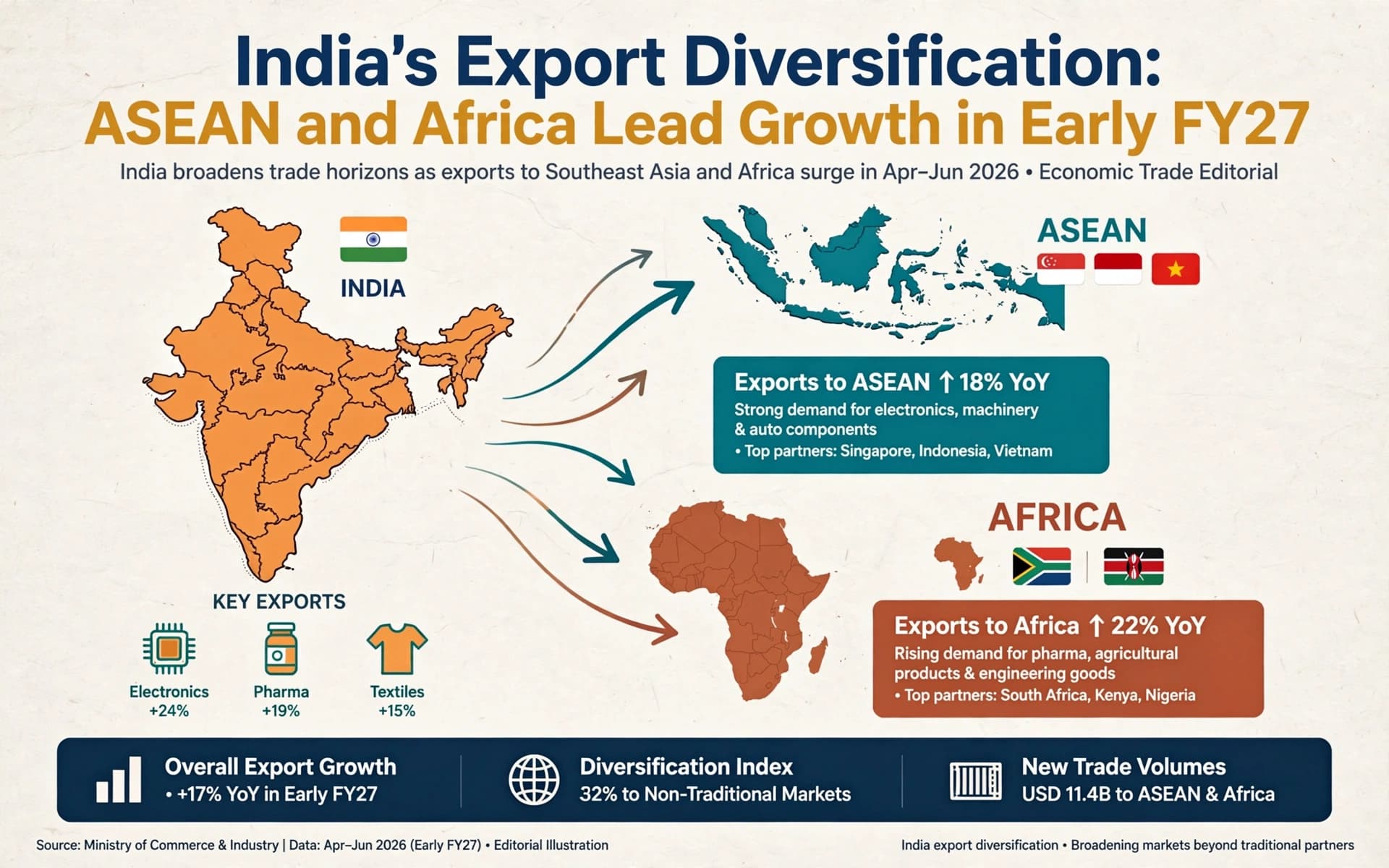
- India's total exports for April-May FY27 reached USD 162.69 billion, marking a 14.66% year-on-year increase.
- Emerging markets in ASEAN and Africa are driving growth, with combined shipments increasing by over $7.6 billion compared to the previous year.
- Non-traditional markets now represent more than 50% of India's total export volume, signaling a shift in global trade patterns.
The first two months of fiscal year 2027 have revealed a pivot in India's trade strategy. While traditional Western markets remain vital, growth is concentrated in the Global South and Southeast Asia. This shift suggests that Indian exporters are navigating complex geopolitical landscapes to tap into high-growth corridors.
Data from the Commerce Ministry indicates a robust upward trajectory for the nation's trade balance. The surge in shipments to developing regions represents a structural realignment of where Indian goods and services find new demand. As Economy & Policy shifts toward South-South cooperation, the scale of this expansion is significant.
Regional Export Performance Breakdown
The following table outlines the performance of India's primary export destinations during the April-May FY27 period.
| Export Destination | Value (USD Billion) | Year-on-Year Growth |
|---|---|---|
| NAFTA (US, Canada, Mexico) | 19.3 | 2.6% |
| Europe | 17.0 | 4.0% |
| ASEAN | 10.5 | 66.9% |
| Africa | 9.6 | 53.1% |
| North East Asia | 8.3 | 30.7% |
| South Asia | 6.1 | 40.2% |
| LAC (Latin America & Caribbean) | 3.0 | 12.5% |
| Oceania (Australia & NZ) | 2.1 | 29.0% |
| CIS (Russia, Armenia, etc.) | 1.1 | 7.7% |
The data highlights a contrast between the steady growth in Western markets and the expansion seen in emerging economies.
Drivers of the Export Surge
The acceleration in trade volume is driven by several interconnected economic factors.
- Diversification of supply chains away from single-source dependencies.
- Increased demand for Indian manufactured goods and services in developing economies.
- Strategic trade agreements and improved logistics corridors.
- Strong performance in the services sector alongside traditional goods.
This momentum suggests that India is positioning itself as a central hub in the evolving global trade network. The ability to scale shipments to diverse regions simultaneously reflects the resilience of current startups & funding ecosystems and large-scale manufacturing initiatives.
Comparative Regional Growth Analysis
The following table compares the growth rates of established markets versus high-growth emerging markets.
| Market Category | Growth Profile | Primary Trend |
|---|---|---|
| Established (NAFTA/Europe) | Low to Moderate | Stability and steady demand |
| Emerging (ASEAN/Africa) | High | Rapid market penetration |
| Regional (South Asia/NE Asia) | High | Strengthening intra-regional ties |
The divergence in growth rates confirms that the primary engine of India's export expansion has moved toward the Global South.
The Shift Toward Non-Traditional Markets
Regions outside of North America and Europe now account for more than half of India's total exports.
- ASEAN shipments rose 66.9% to reach $10.5 billion.
- African shipments rose 53.1% to $9.6 billion.
- Combined, these two regions added over $7.6 billion in volume compared to the same period last year.
- North East Asia and South Asia also showed significant double-digit growth.
This transition reduces reliance on any single economic bloc and provides a buffer against localized recessions in the West. This diversification is a key component of modern AI & technology driven logistics and market intelligence, allowing exporters to react to real-time demand shifts.
Outlook
The trajectory for the remainder of FY27 remains optimistic, though several variables require monitoring. While the current growth in ASEAN and Africa is notable, the specific commodities driving this surge—whether refined petroleum, pharmaceuticals, or electronics—remain a subject of ongoing analysis. Understanding the exact product mix will be essential for long-term policy planning.
As India continues to expand its footprint in the CIS region and Latin America, the government will likely face pressure to streamline trade regulations and reduce non-tariff barriers. Maintaining this 14.66% aggregate growth rate will depend on whether momentum in the Global South can offset potential slowdowns in North American or European markets.
Looking ahead, the focus will likely shift toward the sustainability of these growth rates. If the current trend holds, India may see a fundamental reclassification of its trade profile by the end of the decade, moving from a traditional exporter to a dominant force in the South-South trade corridor.
Frequently Asked Questions
Which region showed the highest growth in exports?
ASEAN recorded the highest growth rate, with shipments rising by 66.9% to reach $10.5 billion.
Is India's trade still heavily dependent on the US and Europe?
While NAFTA and Europe remain large destinations, they no longer dominate the total share; regions outside North America and Europe now account for more than 50% of exports.
How much did total exports increase this year?
Total exports of goods and services for April-May FY27 reached USD 162.69 billion, a 14.66% increase year-on-year.