Key Takeaways
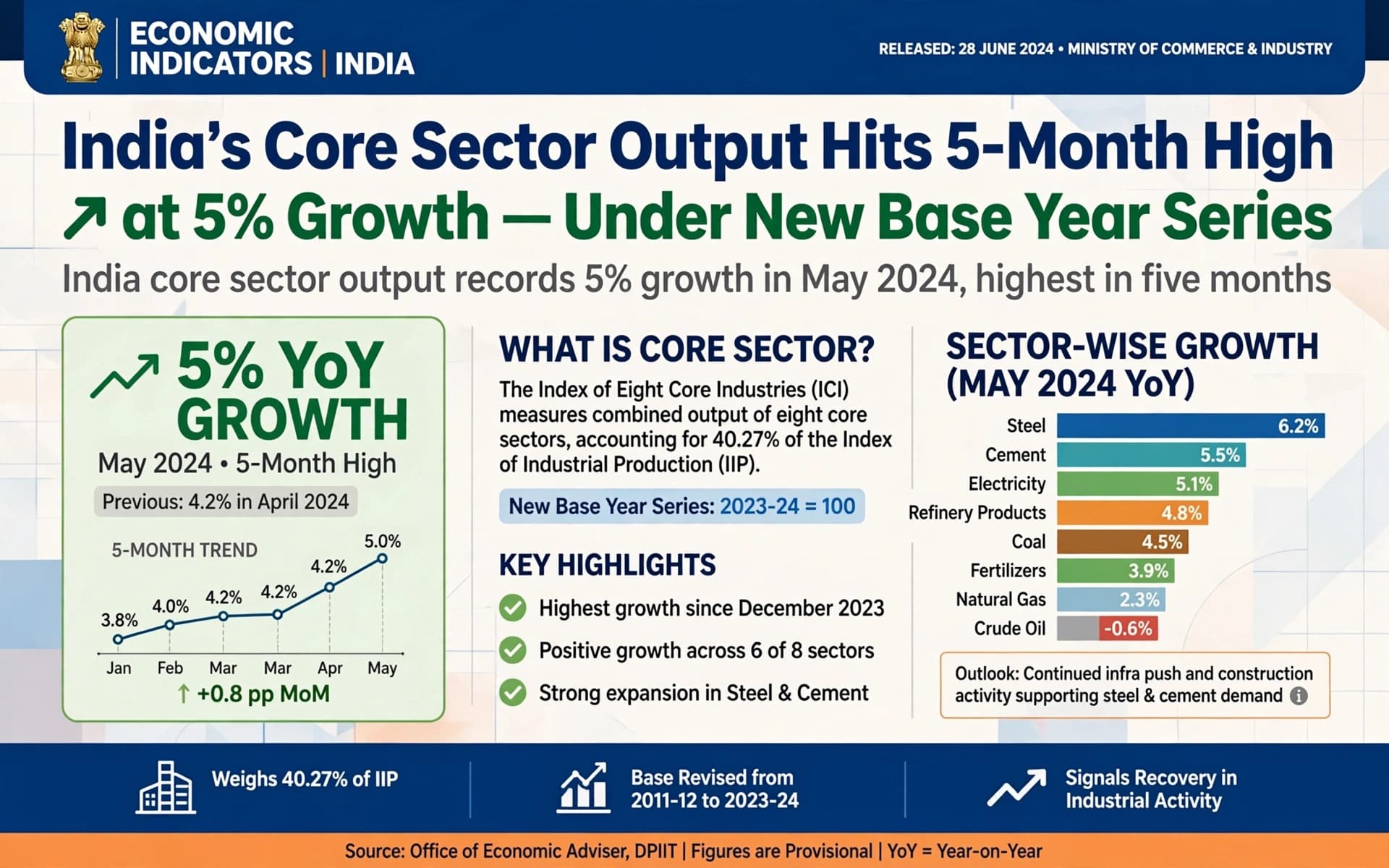
- India's Index of Core Industries (ICI) reached a five-month high, posting 5% year-on-year growth in June 2026.
- This marks the inaugural release under the revised 2022-23 base year series, replacing the previous 2011-12 framework.
- While heavy industrial output like iron ore and cement surged, the energy sector faced contractions in natural gas and crude oil.
The Indian industrial landscape is undergoing a structural shift, evidenced by the latest data from the Index of Core Industries (ICI). For June 2026, the index recorded a 5% year-on-year expansion, marking the strongest performance in five months.
This growth occurs as the Government of India transitions to a new statistical framework designed to better reflect modern industrial compositions. The transition to the 2022-23 base year series represents a recalibration of how Economy & Policy metrics are calculated.
By moving away from the 2011-12 series, the new methodology aims to capture the evolving weight of sectors like electricity and refinery products. These sectors now play a more central role in determining the overall index trajectory.
Industrial Performance Under the New Base Year
The following table outlines the performance of the nine core industries included in the revised index for June 2026.
| Key Highlights | Details |
|---|---|
| Index Growth (YoY) | 5.0% |
| Cumulative Growth (Apr-Jun 2026) | 3.6% |
| Highest Weightage Sector | Electricity |
| Primary Growth Driver | Iron Ore (+43.9%) |
The shift in weightage toward electricity and refinery products means the index is now more sensitive to energy consumption and downstream processing than the previous iteration.
Drivers of Industrial Expansion
The surge in the ICI is largely attributed to a rebound in mineral and construction-related sectors.
- Iron ore production saw a significant spike, growing by 43.9% year-on-year.
- Cement and electricity output both recorded growth of 9.8%.
- Steel production increased by 4.6%, supporting infrastructure demand.
- Coal production rose by 1.4%, providing a steady baseline for heavy industry.
This momentum has bolstered the quarterly outlook. Cumulative growth for the April-June 2026 period reached 3.6%, a rise from the 1% recorded during the same period last year.
Sectoral Divergence and Contractions
Despite the headline growth, the data reveals a split between heavy manufacturing and the energy extraction sectors.
| Contracting Sectors | June 2026 Performance |
|---|---|
| Natural Gas | -7.4% |
| Refinery Products | -4.7% |
| Crude Oil | -4.2% |
| Fertiliser | -3.3% |
The contraction in energy-related sectors suggests a complex interplay between supply-side constraints and shifting consumption patterns. While companies like Reliance and Adani continue to dominate the energy landscape, the specific factors contributing to the decline in natural gas and crude oil outputs remain a subject of scrutiny for analysts.
Broader Economic Implications
The performance of these core sectors serves as a bellwether for the wider Markets & IPOs and the broader industrial health of the nation.
- Increased cement and steel output signals sustained activity in large-scale infrastructure projects led by firms such as L&T.
- The rise in electricity demand reflects growing industrialization and the expansion of digital infrastructure.
- The divergence in energy outputs may impact the cost structures for various startups & funding ventures in the logistics and manufacturing space.
The transition to a new base year is a technical necessity that provides a more accurate lens through which to view India's industrial trajectory.
Outlook
As India moves into the second half of 2026, the focus will shift toward whether growth in manufacturing and construction can offset volatility in the energy sector. The 5% growth in June provides a positive signal for the industrial sector. However, the contraction in refinery products and crude oil suggests that energy security and supply chain stability remain critical variables.
The new methodology introduced by the Government of India will likely lead to more precise economic forecasting. However, the specific impact of the new base year methodology on long-term economic forecasting remains an open question. Economists and institutional players like ICICI Bank and Deloitte will be monitoring this closely.
If the momentum in iron ore and cement persists, the industrial sector will likely remain a primary driver of GDP growth. Conversely, if the contraction in natural gas and crude oil continues, it could introduce inflationary pressures. These pressures might influence broader AI & Technology investments and capital expenditure across the country.
Frequently Asked Questions
What is the new base year for the Index of Core Industries?
The index has transitioned from the 2011-12 base year series to the 2022-23 series to better reflect modern industrial weights.
Which sectors have the most influence on the new index?
Electricity currently carries the highest weight in the revised ICI, followed by refinery products and steel.
How does the current quarterly growth compare to last year?
The cumulative growth for the April-June 2026 period is 3.6%, which is higher than the 1% growth seen in the same period last year.