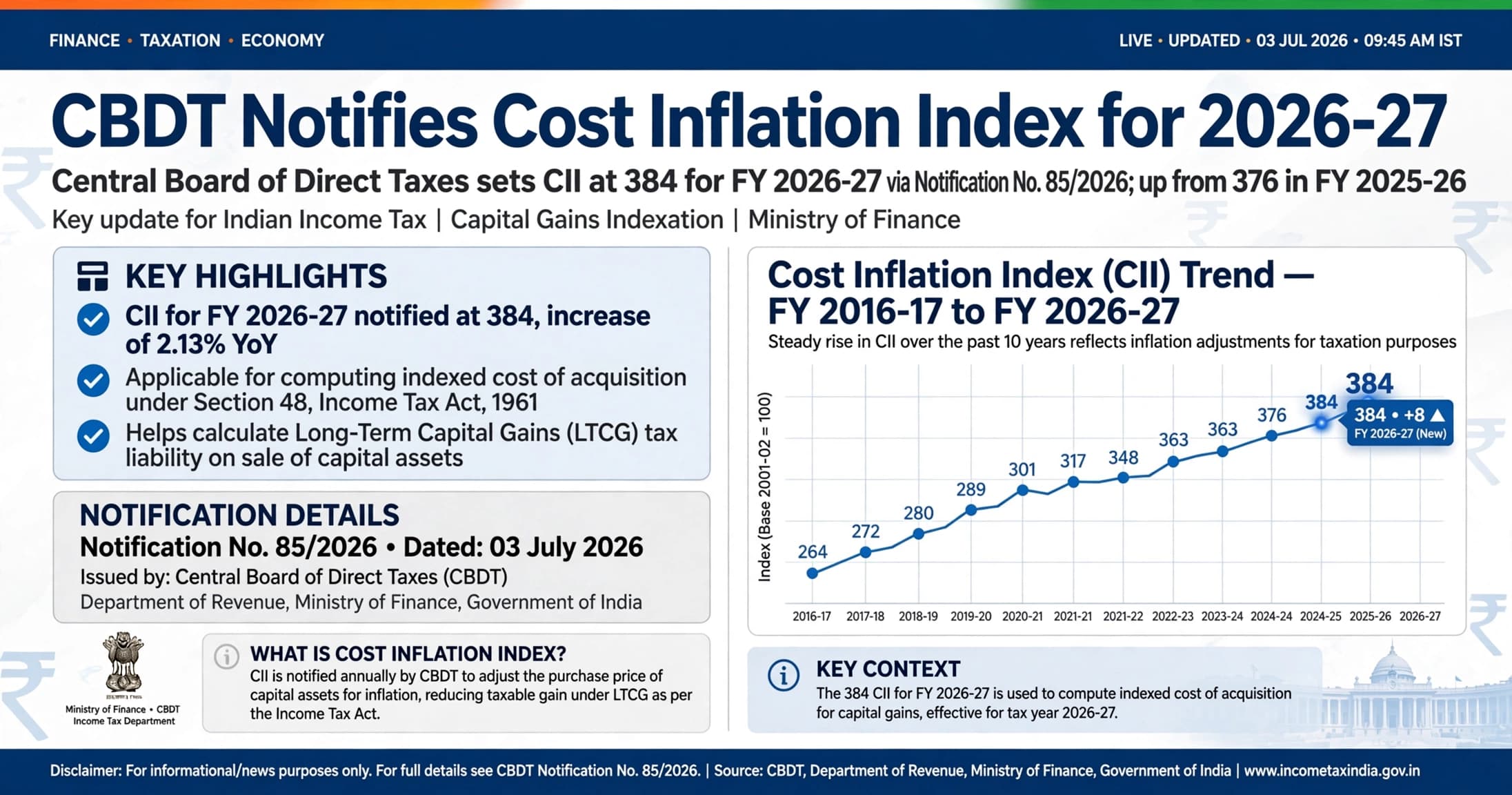
Auroraspace has obtained exclusive access to the latest notification from the Central Board of Direct Taxes (CBDT) regarding the Cost Inflation Index (CII) for the financial year 2026-27. This development is set to have a significant impact on long-term capital gains tax for investors in India.
The CBDT has officially set the CII at 384 for the upcoming financial year, marking a substantial increase from the previous year's value. The Cost Inflation Index is a measure defined under Section 48 of the Income Tax Act, 1961, to account for the rise in prices. The base year for the CII is 2001-02, which has been assigned a value of 100.
This indexation benefit is available only for eligible long-term capital gains, and only where permitted under the applicable tax rules. The CII is a critical component in determining the long-term capital gains tax for investors.
By using the CII, investors can claim an indexation benefit while calculating their long-term capital gains tax. This benefit is calculated by subtracting the cost of acquisition of the asset from its sale price, indexed to the CII. The indexed cost of acquisition is then used to determine the long-term capital gains tax liability.
The notification from the CBDT is expected to have a significant impact on the investment landscape in India. Investors who have held long-term capital assets, such as real estate or stocks, will be able to claim the indexation benefit using the new CII value. This is likely to result in a reduction in their long-term capital gains tax liability.
However, the impact of the CII on long-term capital gains tax is still unclear. Long-term capital gains tax refers to the tax levied on profits made from the sale of long-term capital assets. The tax rate and eligibility criteria for long-term capital gains tax are governed by the Income Tax Act, 1961. The CII is used to determine the indexed cost of acquisition of the asset, which in turn affects the long-term capital gains tax liability.
Investors are advised to consult with their tax advisors to determine the exact impact of the CII on their long-term capital gains tax liability. The CBDT's notification is a significant development in the Indian tax landscape, and investors would do well to stay informed about the latest changes.
The CII is a critical component in determining the long-term capital gains tax for investors. By using the CII, investors can claim an indexation benefit while calculating their long-term capital gains tax. This benefit is calculated by subtracting the cost of acquisition of the asset from its sale price, indexed to the CII. The indexed cost of acquisition is then used to determine the long-term capital gains tax liability.
The notification from the CBDT is expected to have a significant impact on the investment landscape in India. Investors who have held long-term capital assets, such as real estate or stocks, will be able to claim the indexation benefit using the new CII value. This is likely to result in a reduction in their long-term capital gains tax liability.
However, the exact impact of the CII on long-term capital gains tax is still unclear. Investors are advised to consult with their tax advisors to determine the exact impact of the CII on their long-term capital gains tax liability. The CBDT's notification is a significant development in the Indian tax landscape, and investors would do well to stay informed about the latest changes.
Auroraspace Analysis: The CBDT's notification is a significant development in the Indian tax landscape. The CII is a critical component in determining the long-term capital gains tax for investors. By using the CII, investors can claim an indexation benefit while calculating their long-term capital gains tax. This benefit is calculated by subtracting the cost of acquisition of the asset from its sale price, indexed to the CII. The indexed cost of acquisition is then used to determine the long-term capital gains tax liability.
The CBDT's notification is expected to have a significant impact on the investment landscape in India. Investors who have held long-term capital assets, such as real estate or stocks, will be able to claim the indexation benefit using the new CII value. This is likely to result in a reduction in their long-term capital gains tax liability.
However, the exact impact of the CII on long-term capital gains tax is still unclear. Investors are advised to consult with their tax advisors to determine the exact impact of the CII on their long-term capital gains tax liability. The CBDT's notification is a significant development in the Indian tax landscape, and investors would do well to stay informed about the latest changes.
Key Takeaways:
- The CBDT has set the CII at 384 for the financial year 2026-27.
- The CII is a measure defined under Section 48 of the Income Tax Act, 1961, to account for the rise in prices.
- The CII is used to claim the indexation benefit while calculating long-term capital gains tax.
- Investors are advised to consult with their tax advisors to determine the exact impact of the CII on their long-term capital gains tax liability.