Key Takeaways
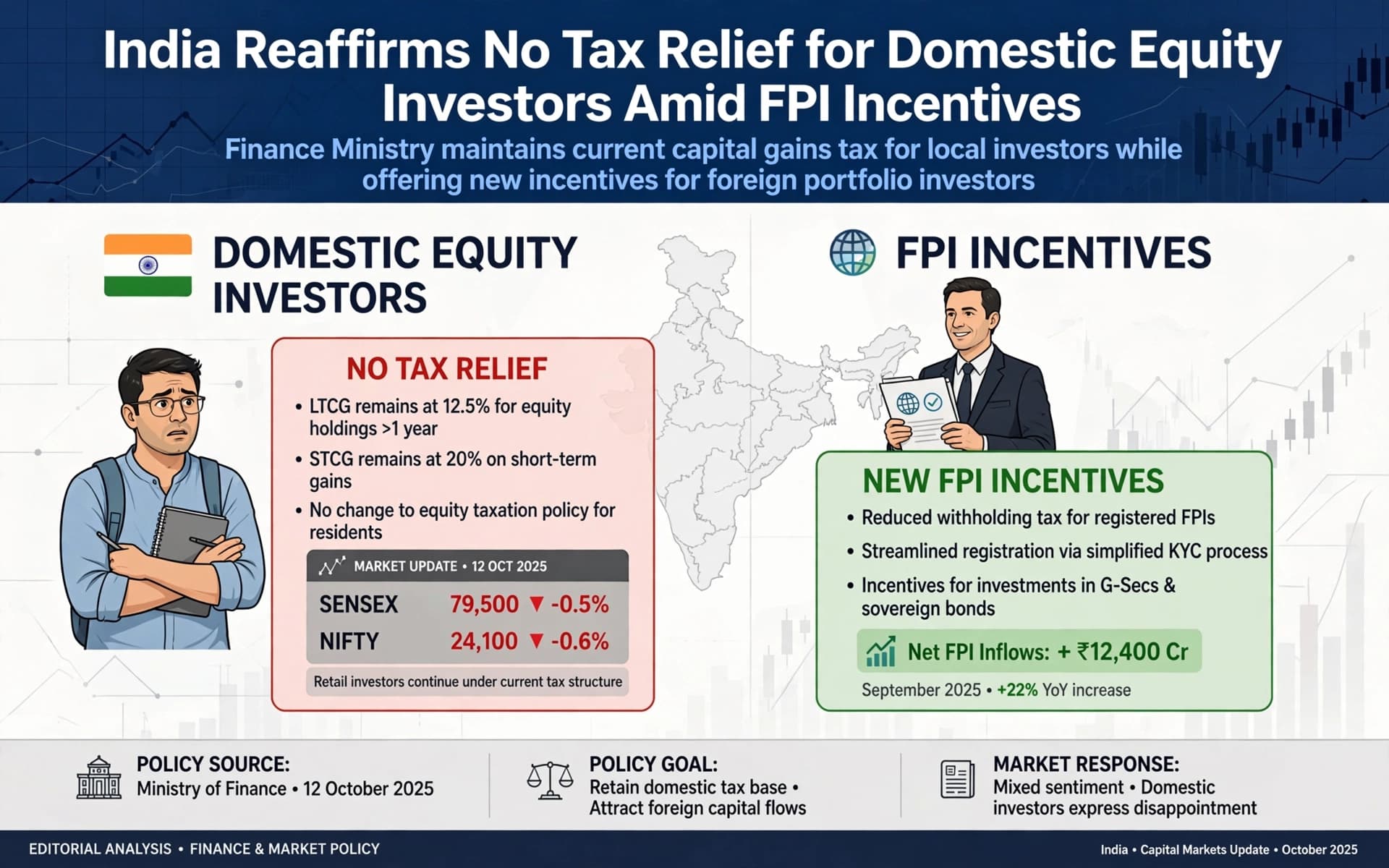
- The India Finance Ministry has confirmed that no tax relief is planned for domestic equity investors regarding Long-Term Capital Gains (LTCG).
- Domestic retail investors remain subject to a 12.5% LTCG tax, while Foreign Portfolio Investors (FPIs) received specific exemptions for government securities.
- Significant volatility persists in the Nifty 50, which has declined by 7.2% in 2026, amid shifting capital flows between domestic and foreign entities.
The landscape of Indian capital markets is facing intense scrutiny as the government balances domestic tax revenues with the need to attract international liquidity. As the fiscal year progresses, the distinction between the treatment of domestic retail investors and foreign entities has become a central point of debate for market participants.
While the tax burden on local participants remains static, the strategic pivot toward incentivizing foreign capital through specific exemptions suggests a complex approach to managing Economy & Policy objectives. This divergence is occurring while the Nifty 50 index navigates significant downward pressure, reflecting broader shifts in investor sentiment.
Tax Policy Stance for Domestic and Foreign Entities
The following table outlines the current tax treatment for different investor classes in the Indian equity market.
| Investor Category | Tax Treatment for Equities | Specific Exemptions |
|---|---|---|
| Domestic & Retail Investors | 12.5% LTCG Tax | None |
| Foreign Portfolio Investors (FPIs) | Standard LTCG | Exempt from LTCG on Govt Securities |
The decision to maintain the 12.5% LTCG rate for domestic investors ensures a steady stream of revenue for the treasury, even as market volatility increases.
Drivers of Fiscal Policy and Market Volatility
The current fiscal trajectory is shaped by several converging economic factors and the government's need for stable tax collections.
- The Finance Ministry has explicitly stated there is no proposal to remove LTCG tax on equities for domestic investors.
- Tax collections from equity-related LTCG rose to 1.29 trillion rupees ($13.38 billion) in the 2025-26 assessment year, according to official data. This represents a significant increase from 722.49 billion rupees the previous year.
- The Nifty 50 index has faced headwinds, recording a loss of approximately 7.2% so far in 2026.
- FPIs have engaged in significant selling activity, offloading roughly $28.03 billion worth of Indian equities throughout 2026.
These factors highlight a tension between maintaining high tax yields and the necessity of encouraging long-term domestic participation in Markets & IPOs.
Capital Flow Dynamics
The movement of capital between local and international players reveals a stark contrast in recent trading sessions.
| Metric | Value |
|---|---|
| FPI Equity Outflows (2026 YTD) | $28.03 Billion |
| Overseas Inflows (July 2026) | $1.25 Billion |
| Nifty 50 Year-to-Date Return | -7.2% |
The scale of FPI outflows underscores the sensitivity of the Indian market to global liquidity shifts and regulatory changes.
Broader Economic Implications
The divergence in tax treatment between domestic and foreign investors carries weight for the stability of the Indian financial ecosystem.
- The exemption for FPIs on government securities, effective April 1, 2026, is a strategic move to bolster the bond market.
- High LTCG collections provide the government with significant fiscal headroom but may dampen retail enthusiasm during market downturns.
- The volatility in the Nifty 50 affects the valuation of major conglomerates, including Adani, Reliance, and L&T.
The interplay between these tax policies and market performance will dictate the pace of Startups & Funding and large-cap valuations in the coming quarters.
Outlook
The Indian government's refusal to grant tax relief to domestic equity investors suggests a priority on fiscal consolidation and revenue stability. By maintaining the 12.5% LTCG rate, the Ministry ensures that the growth in equity trading translates directly into state revenue. This is evidenced by the nearly doubled collections in the last assessment year.
However, the strategic exemption for FPIs in the government securities market indicates a desire to deepen the debt market and attract more stable, long-term foreign capital. Whether this targeted incentive can offset the massive equity outflows seen in 2026 remains a critical question for analysts.
As we move further into 2026, the market will be watching for any signs of a policy pivot. Two primary uncertainties remain: the specific impact of the government securities tax exemption on the stability of the rupee, and whether the current LTCG rate for domestic investors will be reviewed in future fiscal cycles to prevent a contraction in retail participation.
Frequently Asked Questions
What is the current LTCG tax rate for domestic investors?
Domestic and retail investors are required to pay a 12.5% Long-Term Capital Gains tax on qualifying equity gains.
How are Foreign Portfolio Investors (FPIs) being incentivized?
Effective April 1, 2026, FPIs are exempt from LTCG tax on their investments in government securities.
How has the Nifty 50 performed in 2026?
The Nifty 50 index has experienced a decline of approximately 7.2% so far in 2026.