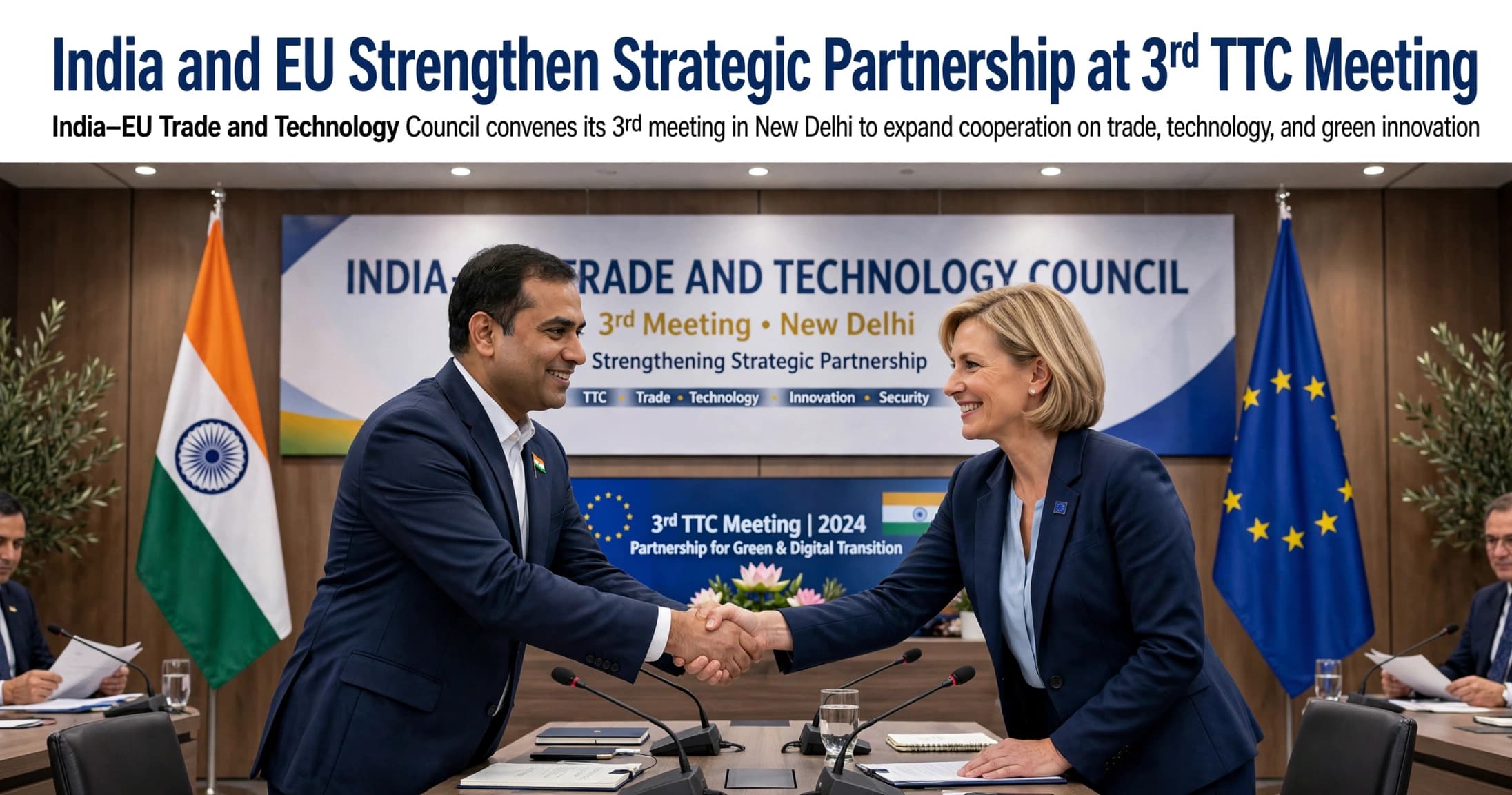
As the global economy continues to navigate the complexities of a rapidly changing world, the India-EU Trade and Technology Council (TTC) has emerged as a crucial platform for advancing the strategic partnership between the two nations. At the third meeting of the TTC, India and the European Union have strengthened their collaboration in key areas, solidifying their commitment to a mutually beneficial partnership.
Quick Explanation: The India-EU Trade and Technology Council (TTC) is a high-level forum established in 2022 to promote cooperation between India and the European Union on trade, technology, and innovation.
The meeting, which took place recently, saw both sides agreeing to deepen collaboration in artificial intelligence, semiconductors, quantum technologies, clean energy, and resilient supply chains. This move is expected to foster greater economic cooperation and promote the growth of innovative industries in both regions. The TTC has been recognized as a central platform for advancing the EU-India strategic partnership, and the meeting acknowledged its importance in driving forward the partnership's objectives.
"The EU-India strategic partnership is a cornerstone of our foreign policy, and we are committed to taking it to the next level," said Ursula von der Leyen, President of the European Commission. "The TTC is a key instrument in achieving this goal, and we look forward to working closely with our Indian partners to drive forward our shared objectives." The EU's commitment to the partnership is a significant development, as it underscores the bloc's willingness to engage with emerging economies like India.
India's Prime Minister, Narendra Modi, also emphasized the importance of the partnership, stating that it would "further strengthen our economic ties and promote the growth of innovative industries in both regions." The meeting saw the two sides agreeing to begin formal negotiations on India's association with Horizon Europe, the European Union's flagship research and innovation funding programme. This move is expected to provide Indian researchers and innovators with greater access to EU funding and expertise.
Quick Explanation: Horizon Europe is the European Union's flagship research and innovation funding programme, which aims to promote research and innovation in key areas such as climate change, health, and digital technologies.
In addition to the agreement on Horizon Europe, the two sides also agreed to establish the first EU-India Innovation Hub focused on electric vehicle charging technologies. This hub will serve as a platform for collaboration between Indian and EU companies, researchers, and policymakers, with the aim of promoting the development of electric vehicle charging technologies in both regions. The partners also agreed to explore further collaboration in high-performance computing through joint research initiatives related to natural hazards, climate change, and bioinformatics.
The meeting also discussed market access issues, including sanitary and phytosanitary applications. The ministers tasked the three TTC working groups with taking forward the agreed actions and regularly reporting progress. The TTC working groups will focus on areas such as trade facilitation, digital trade, and technology cooperation.
While the economic benefits of the EU-India strategic partnership are difficult to quantify, the partnership is expected to have significant economic benefits for both regions. The partnership is expected to promote the growth of innovative industries, increase trade and investment, and foster greater economic cooperation between the two nations.
The specific outcomes expected from the EU-India Innovation Hub focused on electric vehicle charging technologies are expected to be significant, with the hub serving as a platform for collaboration between Indian and EU companies, researchers, and policymakers. The hub is expected to promote the development of electric vehicle charging technologies in both regions, with a focus on reducing greenhouse gas emissions and promoting sustainable transportation.
The details of the joint research initiatives related to natural hazards, climate change, and bioinformatics are expected to be announced in the coming weeks. The initiatives are expected to promote greater collaboration between Indian and EU researchers and policymakers, with a focus on developing innovative solutions to address some of the world's most pressing challenges.
In conclusion, the third meeting of the India-EU Trade and Technology Council has marked a significant milestone in the development of the EU-India strategic partnership. The partnership is expected to promote the growth of innovative industries, increase trade and investment, and foster greater economic cooperation between the two nations. As the global economy continues to navigate the complexities of a rapidly changing world, the partnership between India and the EU is expected to play an increasingly important role in shaping the future of international trade and innovation.