Key Takeaways
- Pending home sales saw a 5.4% monthly decline in June, signaling a cooling in transaction volumes.
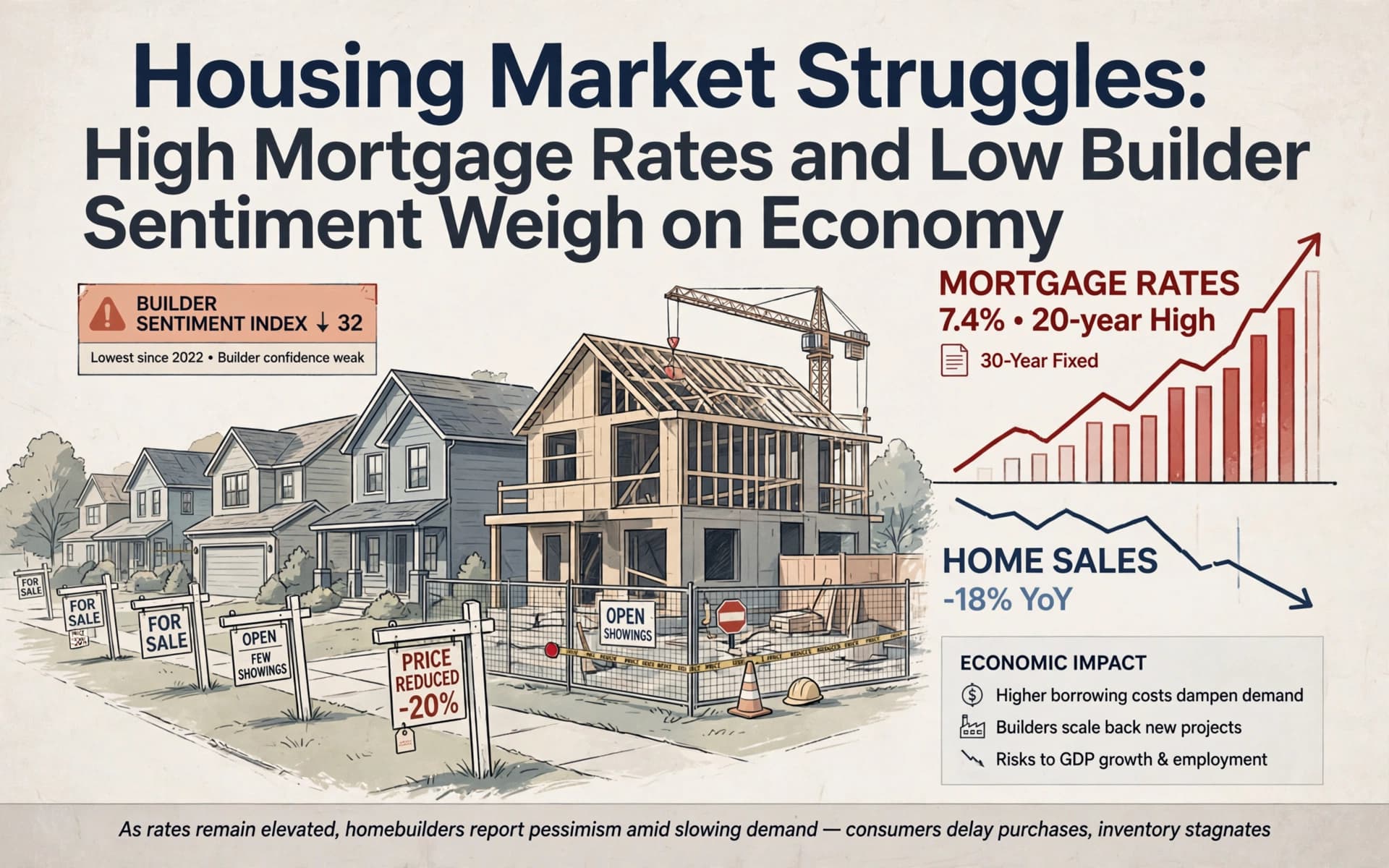
- Homebuilder sentiment has remained in contractionary territory for 15 consecutive months, with recent indices falling to 34.
- Rising mortgage rates and builder incentives are creating a bifurcated market where record prices coexist with declining sales.
The United States housing market is navigating a complex period of stagnation characterized by high borrowing costs and diminishing confidence among developers. While the median price for existing homes reached a new record in June, this price appreciation is increasingly disconnected from actual transaction volumes.
This disconnect suggests that while scarcity maintains high valuations, buyer entry into the market is being restricted.
The broader implications for Economy & Policy are significant, given that housing activity typically accounts for approximately 15-18% of the total US economy. As transaction volumes contract, the ripple effects are expected to move through construction, real estate services, and consumer spending. This trend could potentially act as a drag on overall GDP growth.
Declining Transaction Volumes and Rising Costs
The following data highlights the recent contraction in market activity and the upward trajectory of borrowing costs.
| Metric | June 2026 Performance | Comparison to Previous Period |
|---|---|---|
| Pending Home Sales | Down 5.4% | vs. May 2026 |
| Year-over-Year Sales | Down 0.3% | vs. June 2025 |
| 30-Year Fixed Mortgage Rate | 6.64% (Average) | Increasing Trend |
The combination of falling sales and rising interest rates indicates a tightening of buyer purchasing power across the country.
Drivers of Market Stagnation
Several macroeconomic and industry-specific factors are converging to create this period of uncertainty for both buyers and sellers.
- Persistent high mortgage rates, which have pushed the 30-year fixed average to 6.64%, are deterring potential move-up buyers.
- A significant decline in homebuilder sentiment, which fell to 34 in July from 36 in June, reflects growing uncertainty in the construction sector.
- Supply constraints continue to push median prices to record highs, even as demand wanes.
- Geopolitical tensions, specifically the ongoing Iran war, are being monitored for their potential to drive up mortgage rates through energy market volatility.
The sustained low sentiment among builders suggests that the industry is bracing for a prolonged period of volatility.
Builder Response and Incentive Strategies
As demand softens, homebuilders are increasingly using financial levers to move inventory and maintain cash flow.
| Builder Action | July 2026 Statistic | Trend Direction |
|---|---|---|
| Price Reductions | 37% of builders | Increasing (from 32% in May) |
| Sales Incentives | 63% of builders | High usage |
Builders are increasingly relying on incentives to offset the impact of high interest rates on prospective buyers.
Broader Economic Implications
The contraction in the housing sector is expected to have wide-ranging effects on the national Markets & IPOs and broader economic stability.
- Reduced construction activity may lead to a long-term supply shortage, complicating efforts to stabilize home prices.
- Decreased transaction volume impacts the revenue streams of real estate brokerages and related service providers.
- The contraction in builder confidence could lead to a slowdown in Startups & Funding within the PropTech and construction technology sectors.
The interplay between high prices and low volume creates a precarious environment for the national economy.
Outlook
The trajectory of the housing market remains heavily dependent on Federal Reserve actions and the resolution of international conflicts. While current data shows a clear cooling in sales activity, record-high median prices suggest the supply-demand imbalance is not yet resolved.
If mortgage rates remain elevated, the current trend of price cuts and increased incentives by builders is likely to become the standard operating procedure for the remainder of the year.
Looking forward, several variables remain unresolved. Analysts are closely watching for the specific impact of newly enacted housing legislation on long-term supply levels. Additionally, the degree to which state and local policy changes will affect regional housing costs remains a critical unknown.
As the market navigates these shifts, the ability of the economy to absorb a prolonged housing slowdown will be a primary focus for policymakers in Congress.
Frequently Asked Questions
Why are home prices rising if sales are falling?
The record median prices are driven by a fundamental lack of inventory, which maintains a floor under home valuations despite lower transaction volumes.
How long has builder sentiment been low?
Homebuilder sentiment has remained below the neutral threshold of 50 for 15 consecutive months.
What is the role of mortgage rates in this slowdown?
The average 30-year fixed mortgage rate has risen to 6.64%, significantly increasing the monthly cost of ownership and reducing buyer affordability.