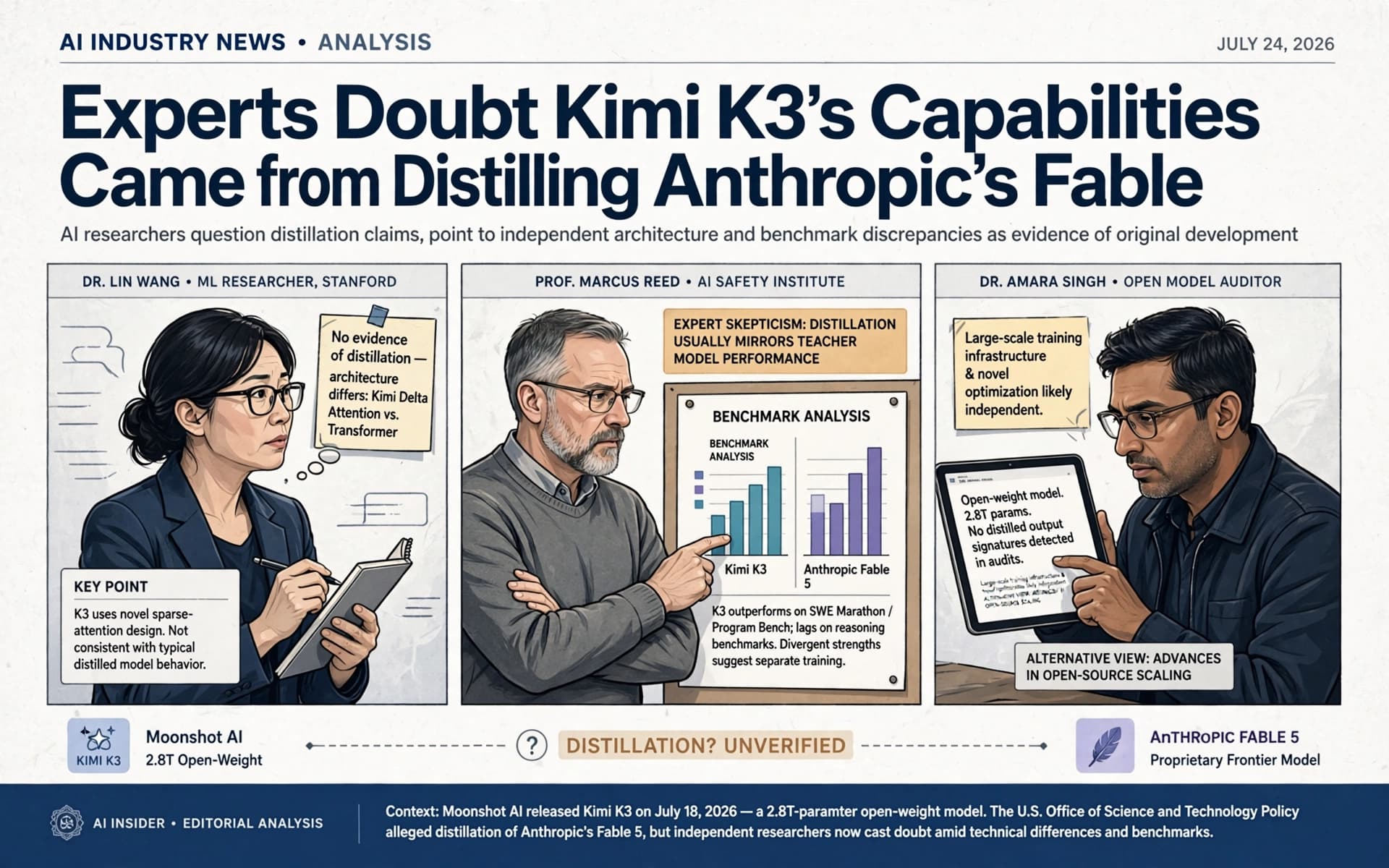
Key Takeaways
- Experts question the claim that Kimi K3's advanced capabilities came from distilling Anthropic's Fable large language model, citing the complexity and sophistication of Kimi K3's features.
- The development of Kimi K3 by Moonshot, a Chinese company, has raised concerns about the use of advanced chips not cleared for export to China, as well as the potential for intellectual property theft.
- The incident highlights the ongoing tensions between the US and China in the field of AI and technology, with implications for markets and economy.
The recent emergence of Kimi K3, a large language model developed by Moonshot, has sparked debate among experts in AI. White House science advisor Michael Kratsios stated that Moonshot built its model by copying Anthropic's Fable LLM while using chips not cleared for export to China. However, experts such as Braden Hancock, a researcher at the Laude Institute and co-founder of Snorkel AI, are skeptical that distillation is responsible for Kimi K3's advanced capabilities. This skepticism is shared by Nathan Lambert, an AI researcher at the Allen Institute for AI.
Development of Kimi K3
The table below highlights the key aspects of Kimi K3's development:
| Key Highlights | Details |
|---|---|
| Model Architecture | Built by copying Anthropic's Fable LLM |
| Hardware Used | Advanced chips not cleared for export to China |
| Development Process | Unclear, with experts questioning the role of distillation |
| The development process of Kimi K3 is unclear, with many experts questioning the claim that distillation was the primary method used to achieve its advanced capabilities. |
The use of advanced chips not cleared for export to China has raised concerns about the potential for intellectual property theft and the circumvention of export controls. According to Treasury Secretary Scott Bessent, the US has found watermarks of its large language models on many Chinese models.
Reasons Behind the Skepticism
Several factors contribute to the skepticism surrounding Kimi K3's development. These include the complexity and sophistication of Kimi K3's features, which may be difficult to achieve through distillation alone. The lack of transparency about the development process has led to speculation and uncertainty.
The history of intellectual property theft and the use of unauthorized hardware in the development of Chinese AI models also contributes to the skepticism. Elon Musk's testimony that his company SpaceXAI distilled OpenAI models to develop Grok highlights the potential for distillation to be used in developing AI models.
Deal Structure
The table below highlights the key aspects of the deal structure:
| Key Highlights | Details |
|---|---|
| Parties Involved | Moonshot, Anthropic, and potentially other Chinese companies |
| Technology Used | Advanced chips not cleared for export to China |
| Potential Consequences | Intellectual property theft, circumvention of export controls |
| The deal structure surrounding Kimi K3's development is complex, with implications for the AI sector. |
Market Impact
The emergence of Kimi K3 has significant implications for the market. These include the potential for Chinese companies to develop advanced AI models using unauthorized hardware and intellectual property. The incident highlights the ongoing tensions between the US and China in the field of AI, with potential consequences for markets and economy.
Outlook
The development of Kimi K3 has significant implications for the future of AI. As the US and China continue to compete in the field of AI, the need for increased transparency and regulation will become increasingly important. The incident also highlights the potential risks associated with the use of advanced chips and intellectual property in the development of AI models.
The founder of Supermicro, a US server builder, was indicted for smuggling advanced chips into China. This highlights the potential risks associated with the use of unauthorized hardware in the development of AI models. According to Elon Musk, his company SpaceXAI distilled OpenAI models to develop Grok, which highlights the potential for distillation to be used in developing AI models.
Frequently Asked Questions
What is the significance of Kimi K3's development?
Kimi K3's development has significant implications for the global AI landscape, with potential consequences for markets and economy.
How did Moonshot obtain advanced Nvidia chips banned from export to China?
The exact process used by Moonshot to obtain advanced Nvidia chips banned from export to China is unclear, with many experts questioning the potential for intellectual property theft and the circumvention of export controls.
What are the potential consequences of Kimi K3's development for the global AI landscape?
The development of Kimi K3 has significant implications for the global AI landscape, with potential consequences for startups and funding, as well as the need for increased transparency and regulation in the development of AI models.