Key Takeaways
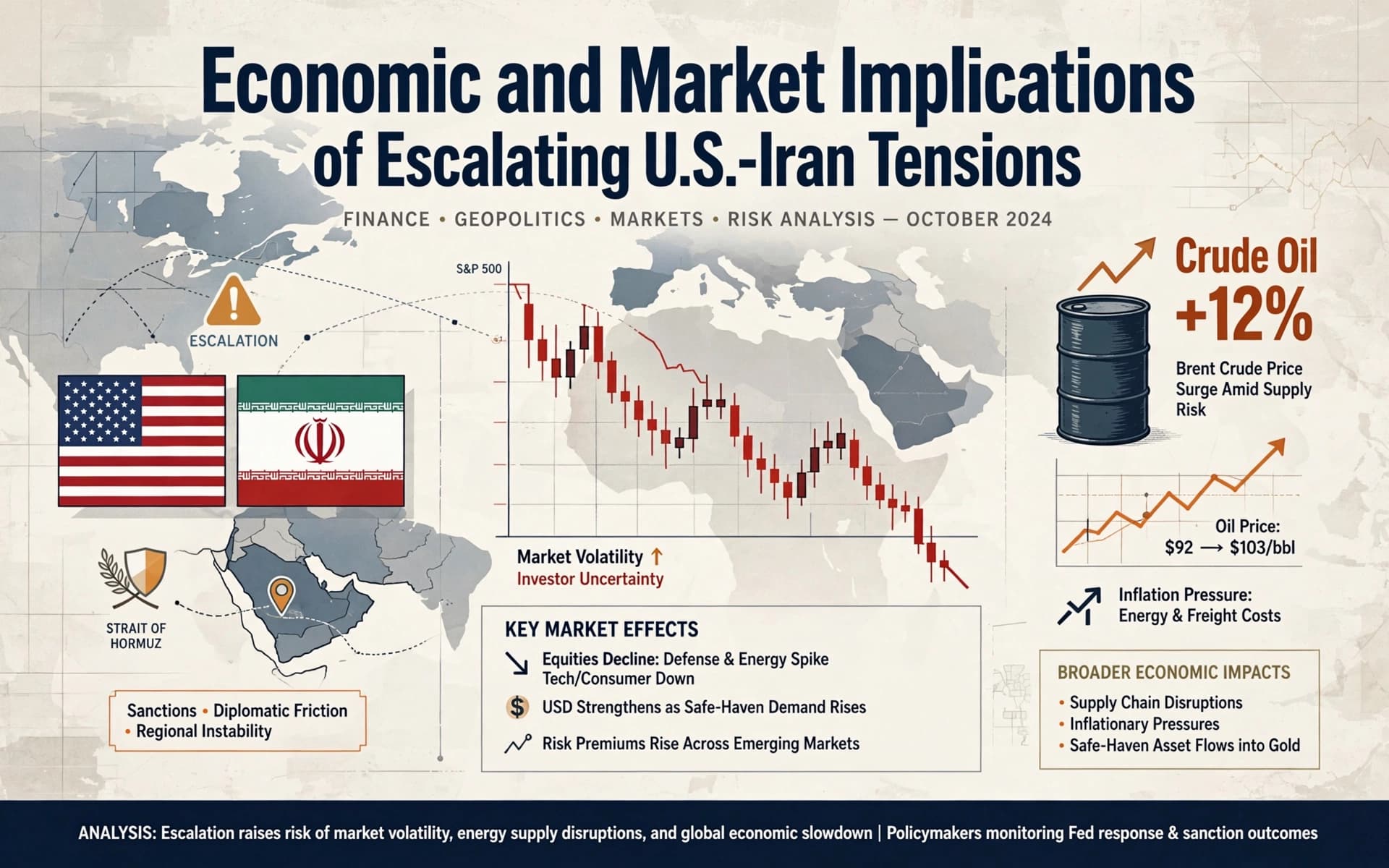
- Escalating military strikes in the Middle East have pushed Brent crude near the $90 threshold, increasing global energy price volatility.
- Rising fuel costs are impacting consumer behavior, evidenced by declining personal saving rates and shifting retail volumes.
- Financial markets remain cautious as the S&P 500 sits 2% below its June peak, with investors weighing geopolitical risk against Federal Reserve policy.
The geopolitical landscape has entered a period of heightened volatility following the completion of the U.S.'s 10th straight night of strikes against Iran. This escalation has moved beyond localized skirmishes, triggering immediate ripples across global Markets & IPOs.
As military operations continue, the intersection of energy security and monetary policy has become the primary focus for institutional investors and central planners. The instability is not confined to military theaters; it is actively reshaping trade routes and consumer spending patterns.
From maritime embargoes declared by the Houthis in Yemen against Saudi Arabia to the fluctuating yields on the U.S. 10-year Treasury, the economic fallout is becoming visible in daily market data.
Energy and Commodity Volatility
The surge in geopolitical risk has directly impacted the energy sector, causing significant price swings in global benchmarks.
| Commodity | Recent Price Action | Market Context |
|---|---|---|
| Brent Crude | Briefly topped $90/barrel | Driven by strike escalation and maritime threats |
| U.S. Gasoline | Reached $4.00 per gallon | First time exceeding this level in over a month |
The rapid ascent of oil prices reflects a growing premium for supply security, particularly as tensions threaten vital shipping lanes like the Strait of Hormuz.
Drivers of Market Instability
Several converging factors are currently pressuring both equity and fixed-income markets.
- Military escalation involving the U.S. and Iran has increased the risk premium on energy assets.
- The Houthi declaration of a maritime embargo against Saudi Arabia threatens regional trade stability.
- Rising energy costs are exerting upward pressure on consumer-facing inflation metrics.
- Uncertainty regarding the scale of U.S. military deployment is creating a "wait-and-see" approach on Wall Street.
These factors have created a complex environment where traditional correlations are being tested by sudden geopolitical shocks.
Macroeconomic Indicators and Consumer Trends
The impact of the Middle East crisis is moving from the commodities desk to the broader Economy & Policy landscape.
| Indicator | Current Status | Trend Observation |
|---|---|---|
| S&P 500 | 2% below June peak | Facing resistance near all-time highs |
| U.S. 10-year Treasury | Trading above 4.6% | Reflecting heightened inflation and risk concerns |
| Personal Saving Rate | 3% (May data) | Down nearly 2 percentage points year-over-year |
| Fed Funds Futures | 83% likelihood of hold | Pricing in stability for the next meeting |
The decline in the personal saving rate suggests that higher costs for essentials, such as gasoline, are consuming a larger portion of household income. This shift in consumer behavior is already visible in the earnings reports of major retailers and travel providers.
Sector-Specific Impacts
The ripple effects of the current crisis are being felt across various industries, from aviation to discount retail.
| Sector | Impacted Entity | Observed Effect |
|---|---|---|
| Aviation | Ryanair | Weak Q1 profits due to delayed bookings |
| Discount Retail | Costco | Record-breaking gas volumes at end of Q3 |
| Consumer Staples | Dollar General / Tractor Supply | Shift toward value-oriented spending |
| Hospitality | Texas Roadhouse | Exposure to rising input and logistics costs |
The divergence in retail performance highlights a bifurcated consumer. While some sectors face headwinds from reduced discretionary spending, others see increased volume as consumers pivot toward essential value.
Broader Economic Implications
The current trajectory of the Middle East conflict presents several systemic risks to the global economy.
- Energy price surges may bleed through to core inflation, complicating the Federal Reserve's path toward rate cuts.
- Sustained volatility in the Strait of Hormuz could lead to long-term shifts in global supply chain logistics.
- A worst-case scenario involving a full-scale regional war could trigger a significant correction in the S&P 500.
As these risks materialize, the interplay between AI-driven productivity gains and geopolitical friction will determine the overall direction of global growth.
Outlook
The trajectory of the U.S.-Iran conflict remains the most significant variable for market participants heading into the latter half of 2026. If the current cycle of strikes continues, the risk of a transition from targeted strikes to outright war increases.
Such a scenario would likely drive energy prices well beyond the $90 mark. This would force the Federal Reserve to reconsider its current stance, as the 83% likelihood of a rate hold may be insufficient to combat renewed inflationary pressures from energy.
Furthermore, the domestic economic impact of these tensions is becoming undeniable. The drop in the personal saving rate indicates that the "inflation tax" is being felt directly at the pump and in the grocery aisle.
Investors must now weigh the potential for a technical correction in the S&P 500 against the possibility of a "soft landing" where energy volatility is contained. Ultimately, the market is waiting for clarity on two fronts: the scale of U.S. military involvement and the resilience of the consumer. Until the geopolitical situation stabilizes, volatility in both the energy and fixed-income markets is expected to remain the baseline for global economic activity.
Frequently Asked Questions
How are energy prices affecting the S&P 500?
Rising gasoline and Brent crude prices increase input costs for many companies, which can squeeze profit margins and lead to lower equity valuations.
What is the significance of the 10-year Treasury yield at 4.6%?
A yield above 4.6% indicates that investors are demanding higher returns, often due to expectations of sustained inflation or increased government borrowing.
Why are airline profits being impacted by the Middle East crisis?
Geopolitical instability leads to consumer uncertainty, resulting in delayed bookings and higher operational costs due to fluctuating fuel prices.