Key Takeaways
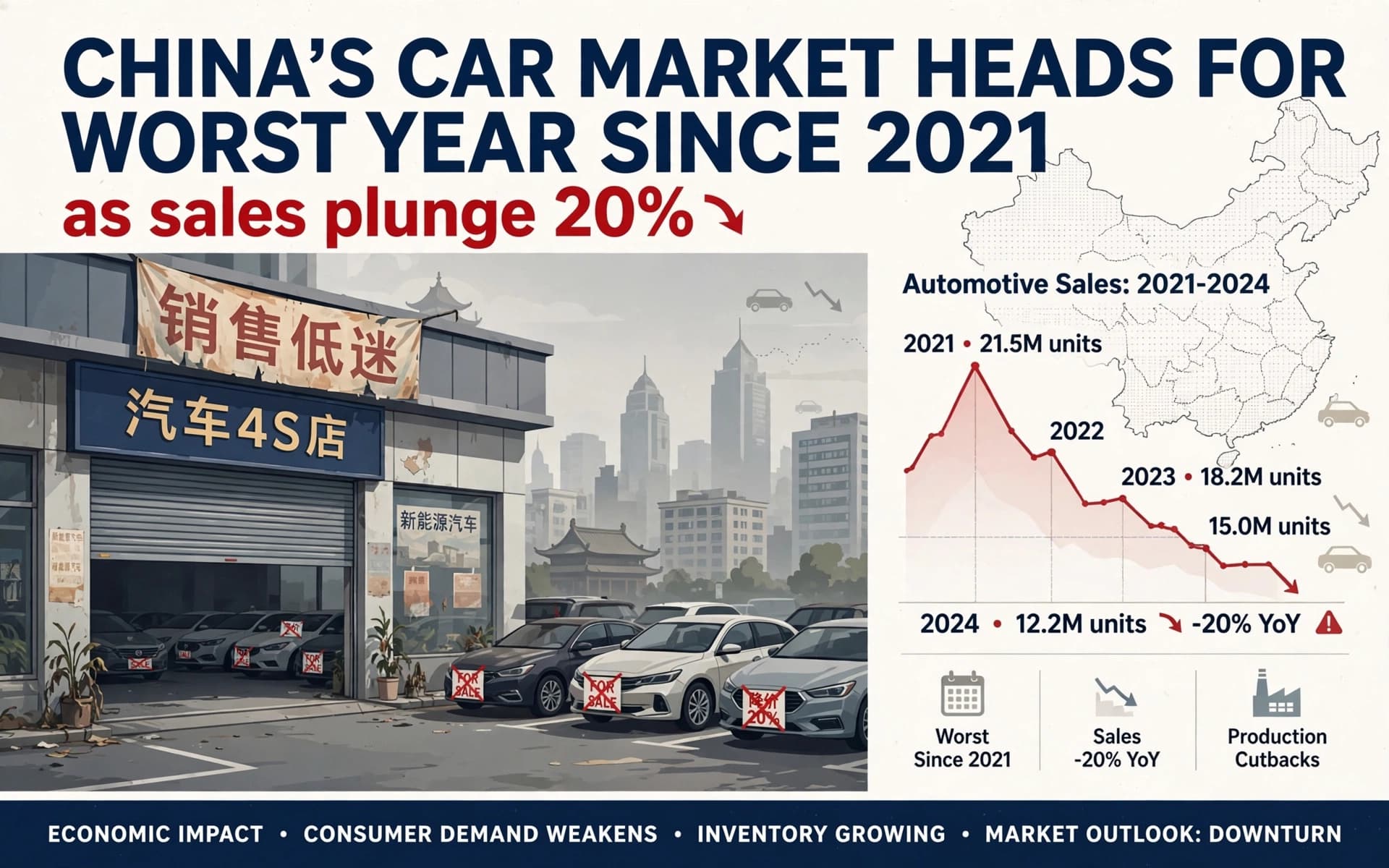
- China's passenger vehicle sales fell 20.2% year-on-year during the first half of 2026, signaling a contraction in domestic demand.
- Industry profit margins tightened to 3.4% for the first five months of the year as rising energy and component costs squeezed manufacturers.
- While domestic sales declined, passenger vehicle exports rose by 82.3% year-on-year, indicating a strategic shift toward international markets.
The Chinese automotive landscape is undergoing a period of contraction as 2026 unfolds. After years of expansion driven by electrification and government support, the market faces a dual crisis of shrinking domestic demand and escalating operational costs.
This downturn affects multiple segments. Both traditional internal combustion engine (ICE) vehicles and new energy vehicles (NEVs) are experiencing significant headwinds.
As manufacturers compete for dwindling market share, the financial stability of major players is being tested. High interest rates, shifting consumer preferences, and rising logistics costs have created a volatile environment for Markets & IPOs participants and industrial giants alike.
A Sharp Decline in Domestic Sales Volume
The following data summarizes the contraction in passenger vehicle sales and the revised industry forecasts for the 2026 calendar year.
| Metric | 2026 Forecast / Actual | Trend |
|---|---|---|
| H1 2026 Passenger Vehicle Sales | -20.2% YoY | Decreasing |
| Full Year 2026 Sales Forecast (CPCA) | -14% Growth | Decreasing |
| 2025 Total Deliveries | 23.7 Million Units | Baseline |
| 2026 Total Deliveries Forecast | 20.4 Million Units | Decreasing |
The data indicates a structural shift, with the China Passenger Car Association (CPCA) lowering its growth expectations for the remainder of the year.
Drivers of the Automotive Downturn
Several interconnected economic and industrial factors are contributing to the current market slump.
- Diminishing Subsidies: The phase-out of previous government incentives has reduced consumer purchasing power.
- Rising Energy Costs: Transportation energy costs rose 15.3% year-over-year in June, according to the National Bureau of Statistics.
- ICE Market Collapse: Retail sales of internal combustion engine vehicles fell 39% year-on-year in June alone.
- Margin Compression: Industry profits fell 20% year-on-year, with sales profit margins averaging 3.4% from January to May 2026.
These factors have created a high-pressure environment for Startups & Funding in the EV space and established manufacturers alike.
Comparative Performance of Major Manufacturers
The first half of 2026 has seen a divergence between domestic leaders and international legacy brands.
| Manufacturer | H1 2026 Deliveries | Performance Context |
|---|---|---|
| BYD | 1.8 Million | Market Leader |
| Geely | 1.4 Million | Strong Domestic Presence |
| Volkswagen Group | 973,000 | Significant Volume Decline |
| Leapmotor | 356,000 | Growing Mid-Market Share |
| Toyota | 579,000 (Jan-May) | Legacy Brand Pressure |
The performance gap highlights the difficulty legacy manufacturers face when competing with high-volume domestic players. For example, Volkswagen saw a 25.9% year-on-year drop in deliveries.
Broader Market and Global Implications
The contraction in China is influencing global trade dynamics and Economy & Policy discussions.
- Export Surge: Total passenger vehicle exports rose 82.3% year-on-year, reaching 877,000 units in June as firms seek external markets.
- NEV Slowdown: New energy vehicle sales are expected to decline 5% to 6% year-on-year, reversing the previous trend of rapid growth.
- Supply Chain Volatility: Analysts are monitoring how geopolitical tensions and shipping costs impact the bottom line of global exporters.
The shift toward exports suggests that Chinese manufacturers are attempting to offset domestic losses by capturing market share in Southeast Asia, the Middle East, and Europe.
Outlook
The trajectory for the Chinese automotive sector remains uncertain through the end of 2026. While the surge in exports provides a vital lifeline, the domestic market is entering a period of consolidation.
According to Xiao Feng of Citic CLSA, cumulative auto sales could fall as much as 20% year-on-year. This figure underscores the severity of the current downturn.
Looking toward 2030, the industry faces significant structural questions. It remains unclear whether market consolidation will result in a small group of major players or if a more fragmented landscape will persist.
Furthermore, manufacturers must navigate rising component costs. While lithium and memory chips are known drivers, the specific raw materials driving the sharp rise in other component costs remain under scrutiny.
Finally, the external environment remains a variable. It is unclear to what extent Middle East conflicts will impact global shipping costs for the automotive sector. As manufacturers pivot toward export-led growth to survive the domestic slump, their exposure to global logistical volatility and geopolitical shifts will increase.
Frequently Asked Questions
How much did passenger vehicle sales drop in H1 2026?
Sales fell by 20.2% year-on-year during the first half of the year.
What is the impact on manufacturer profitability?
Industry profits fell 20% year-on-year, with sales profit margins dropping to 3.4% for the period of January to May 2026.
Are electric vehicles still growing in China?
No, new energy vehicle (NEV) sales are expected to decline by 5% to 6% year-on-year.