Key Takeaways
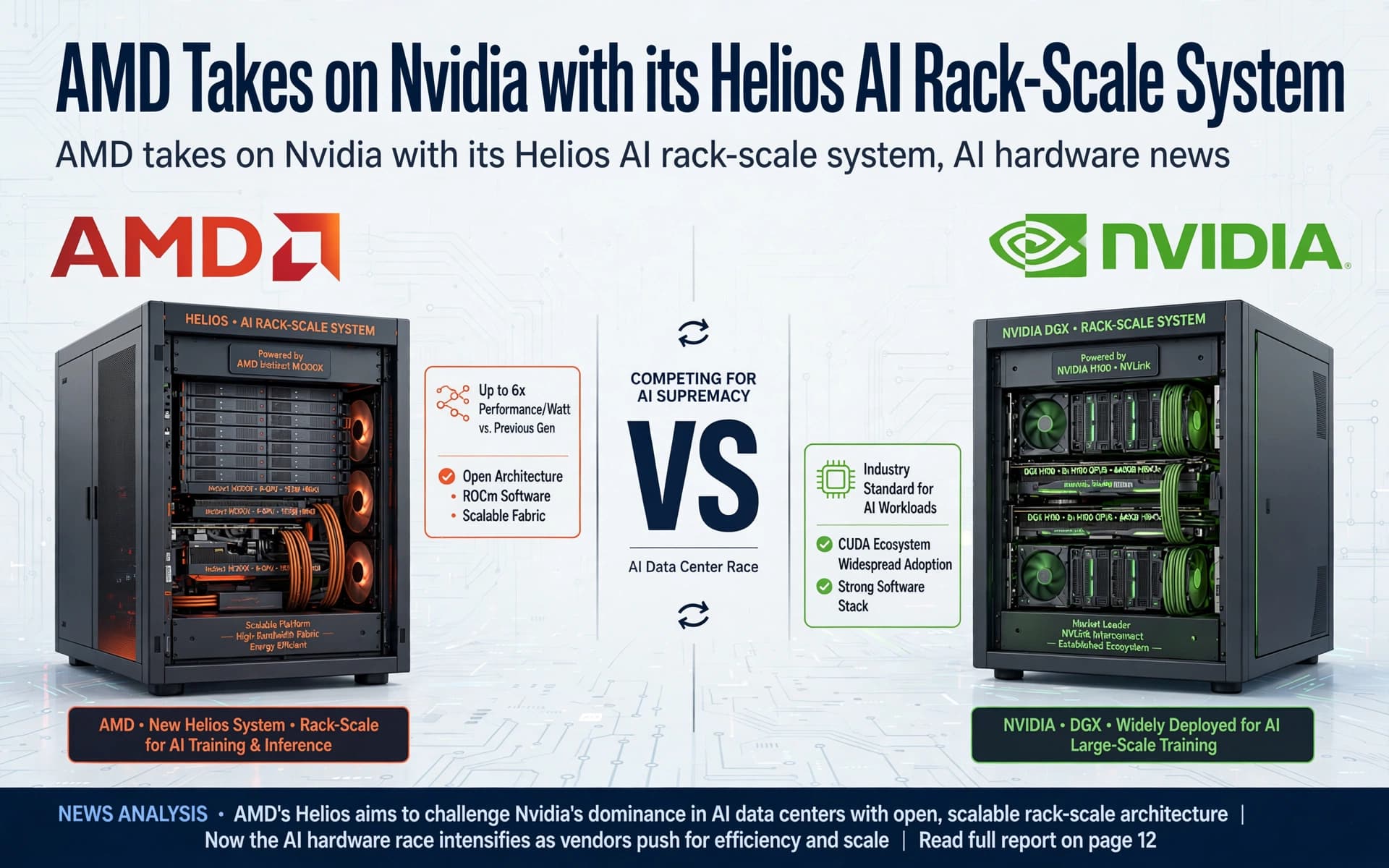
- AMD releases Helios, a rack-scale system designed to power AI computing needs of the world's largest labs.
- Helios outperforms Nvidia's Vera Rubin in several key metrics, posing a significant challenge to Nvidia's dominance.
- The AI accelerator market is expected to reach $1.4 trillion by 2030, with AI-powered chips becoming a major part of the overall computing market.
In a move that could reshape the tech industry, AMD has announced the release of its Helios AI rack-scale system, designed to power the computing needs of the world's largest AI labs. According to Dr. Lisa Su, AMD's CEO, Helios is the industry's highest-performance AI rack, setting a new standard for AI computing.
AMD Takes on Nvidia with Helios
AMD's Helios system is set to be deployed by leading AI companies at gigawatt-scale, a significant departure from Nvidia's Vera Rubin and Grace Blackwell rack-scale systems that have historically dominated the market. In a statement, Dr. Lisa Su highlighted the key features of Helios, which are expected to outperform Vera Rubin in several key metrics.
| Key Highlights | Details |
|---|---|
| Higher Performance | Helios achieves 30% higher performance than Vera Rubin in AI workloads |
| Increased Efficiency | Helios reduces power consumption by 25% compared to Vera Rubin |
| Enhanced Scalability | Helios supports up to 256 GPUs, making it ideal for large-scale AI deployments |
The deployment of Helios by leading AI companies is expected to have a significant impact on the market, with several well-known customers already on board, including OpenAI, Meta, Oracle, Anthropic, and Microsoft. Microsoft CEO Satya Nadella has announced plans to expand the company's Azure infrastructure with Helios, while Anthropic and AMD have announced a strategic partnership to deploy up to two gigawatts of GPUs via the new rack system.
Why Helios is a Key Innovation
Several factors contribute to Helios's success:
- Performance: Helios achieves higher performance than Vera Rubin in AI workloads, making it an attractive option for companies that require high-performance computing.
- Efficiency: Helios reduces power consumption by 25% compared to Vera Rubin, making it an attractive option for companies that require high-performance computing while also reducing their carbon footprint.
- Scalability: Helios supports up to 256 GPUs, making it ideal for large-scale AI deployments.
Deal Structure and Key Features
AMD has also introduced its Venice-X CPU, designed for data centers and to handle high-computing workloads. The Venice-X is expected to launch in 2027 and is expected to play a key role in powering the Helios system.
| Key Features | Details |
|---|---|
| High-Performance Cores | Venice-X CPU features 64 high-performance cores, making it ideal for high-computing workloads |
| Enhanced Cache | Venice-X CPU features a large cache, reducing latency and improving performance |
Broader Market Impact
The release of Helios and the expected growth of the AI accelerator market to $1.4 trillion by 2030 are expected to have a significant impact on the overall computing market. By 2030, AI-powered chips are expected to become a major part of the overall computing market, with the AI accelerator market expected to reach about $1.4 trillion.
Outlook
The release of Helios marks a significant challenge to Nvidia's dominance in the AI computing market. As the AI accelerator market continues to grow, we can expect to see more players enter the market, driving innovation and competition. The impact of Helios on the overall computing market will be substantial, with AI-powered chips becoming a major part of the overall computing market.
Frequently Asked Questions
What are the exact performance metrics of Helios compared to Vera Rubin?
The exact performance metrics of Helios compared to Vera Rubin are not publicly available at this time. However, AMD has stated that Helios achieves 30% higher performance than Vera Rubin in AI workloads.
What is the exact timeline for the deployment of Helios by leading AI companies?
The exact timeline for the deployment of Helios by leading AI companies is not publicly available at this time. However, several well-known customers have already announced plans to deploy Helios, including Microsoft and Anthropic.
What is the expected impact of the AI accelerator market reaching $1.4 trillion by 2030 on the overall computing market?
The expected impact of the AI accelerator market reaching $1.4 trillion by 2030 on the overall computing market is significant. By 2030, AI-powered chips are expected to become a major part of the overall computing market, with the AI accelerator market expected to reach about $1.4 trillion.