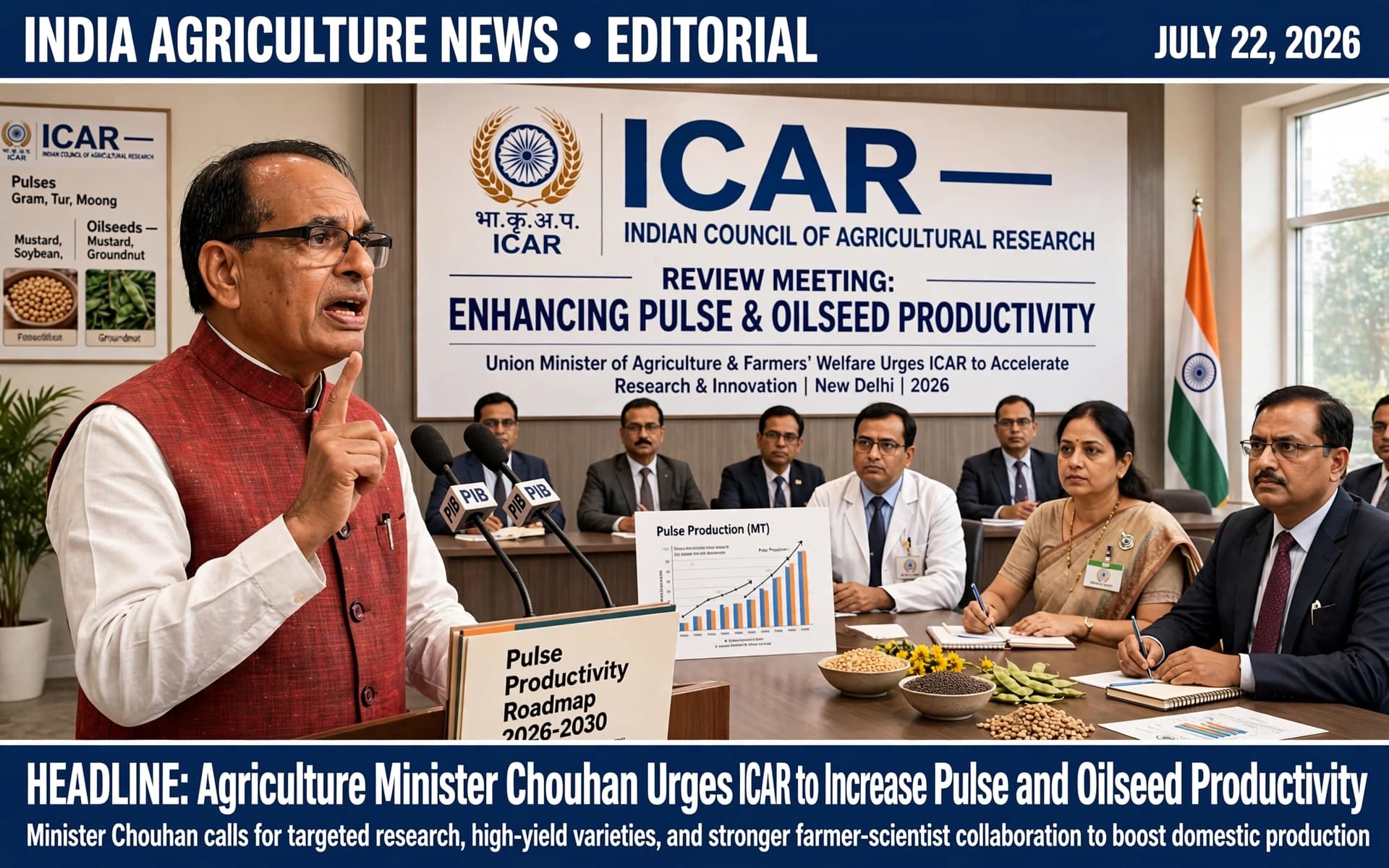
As the Indian economy continues to grapple with the challenges of food security and import dependence, Agriculture Minister Shivraj Singh Chouhan has issued a call to the Indian Council of Agricultural Research (ICAR) to increase pulse and oilseed productivity. The ICAR is a premier agricultural research organization in India, responsible for promoting and coordinating agricultural research and education.
In a significant move, Minister Chouhan urged ICAR to develop climate-smart villages and deploy young scientists to frontier areas, emphasizing the need to raise the incomes of small and marginal farmers through integrated farming. This focus on integrated farming is a critical component of the government's Viksit Krishi Sankalp Abhiyan, which aims to promote holistic and sustainable agricultural practices.
India's dependence on imports is a pressing concern, with the country importing about 6-7 million tonnes of pulses and 15-16 million tonnes of edible oils annually. This has significant economic implications, as the import bill for these commodities is substantial.
To address this challenge, Minister Chouhan proposed a set of concrete commitments for the ICAR, including the development of at least 100 climate-smart villages by the centenary of the institution. He also suggested that ICAR scientists spend a week to ten days working directly in villages, to gain a deeper understanding of the needs and challenges faced by farmers.
Furthermore, Minister Chouhan set a goal of at least 100 million farmers gaining direct access to ICAR's scientific solutions by the time the institution completes 100 years. This will require significant investments in infrastructure, technology, and human resources.
To achieve this goal, ICAR's 113 institutes and affiliated agricultural universities will need to develop, within two years, one innovation with demonstrable national impact. Each ICAR institution will also need to adopt one aspirational district and build a replicable model of agricultural transformation there.
The minister's proposals are timely, given the current challenges facing Indian agriculture. The El Nino phenomenon has had a significant impact on agricultural productivity in recent years, and the country is also facing the challenge of climate change.
To address these challenges, ICAR will need to leverage cutting-edge technologies such as artificial intelligence, robotics, and gene editing to develop innovative solutions for farmers. These technologies have the potential to transform agricultural productivity and efficiency, but will require significant investments in research and development.
The implementation of ICAR's integrated farming models will also require careful planning and execution. The models need to be implemented and validated on the ground, and the institution will need to work closely with farmers, extension services, and other stakeholders to ensure their success.
Finally, the minister's proposals highlight the need for ICAR to adopt a more farmer-centric approach to research and development. This will require a significant shift in the institution's culture and mindset, but has the potential to yield significant benefits for farmers and the broader agricultural sector.
In conclusion, Minister Chouhan's proposals to ICAR are a significant step forward in promoting agricultural productivity and food security in India. The institution will need to work closely with farmers, extension services, and other stakeholders to implement the minister's proposals and achieve the desired outcomes.