Key Takeaways
- The 30th anniversary Solar Car Challenge is currently traversing 630 miles across Texas, marking three decades of student-led renewable energy competition.
- A new 'cruiser' division has been introduced for the 2026 season, featuring four-seater vehicles with integrated solar arrays.
- The program has scaled from its 1993 origins to managing over 260 active high school solar projects globally.
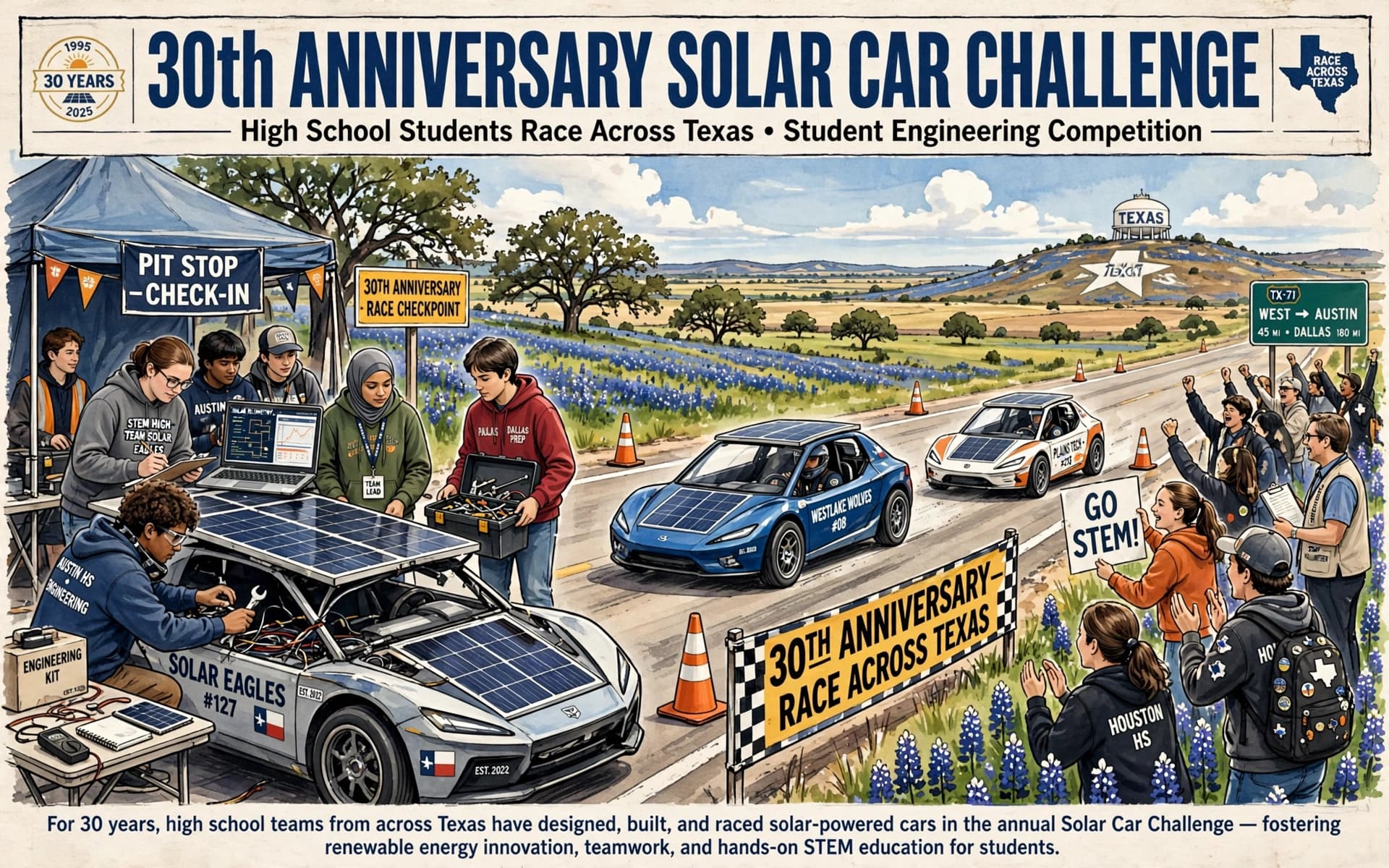
The landscape of renewable energy education is currently on display across the Texas highway system. As of July 19, 2026, the 30th anniversary Solar Car Challenge has officially commenced its annual trek, testing student-led engineering and sustainable transport. This year’s race serves as a milestone for a program that has shaped the careers of thousands of future engineers and scientists.
The route spans 630 miles, beginning in Fort Worth and winding through the diverse geography of Texas before reaching a final destination in Fort Stockton. For the participating students, the race is a rigorous test of vehicle durability and strategic energy management. They must navigate through key waypoints including Palestine, Round Rock, Fredericksburg, and San Angelo.
The 2026 Texas Race Route
The following table outlines the primary logistical milestones for this year's 630-mile competition.
| Milestone | Details |
|---|---|
| Start Location | Fort Worth, Texas |
| End Location | Fort Stockton, Texas |
| Total Distance | 630 Miles |
| Key Waypoints | Palestine, Round Rock, Fredericksburg, San Angelo |
This route presents a significant challenge for teams. Participants require precise calculations to ensure solar energy collection is maximized despite varying weather conditions and terrain.
Evolution of the Solar Car Challenge
Founded in 1993 by Dr. Lehman Marks, the program has grown from a localized initiative into a global educational standard.
- The program has engaged over 85,000 students across 39 states and multiple international territories.
- International participation includes students from Canada, Mexico, Costa Rica, Spain, and Singapore.
- There are currently over 260 active high school solar projects participating in the ecosystem.
- The program serves as a pipeline for talent entering the AI & Technology and renewable energy sectors.
By fostering early interest in complex engineering, the challenge creates a foundation for future innovation in sustainable mobility.
Competitive Divisions and New Formats
The 2026 season introduces structural changes to accommodate different levels of engineering complexity and vehicle utility.
| Division | Vehicle Characteristics |
|---|---|
| Classic | Entry-level solar-powered vehicles |
| Advanced | High-efficiency, specialized solar designs |
| Electric-Solar Power | Hybridized energy management systems |
| Cruiser (New) | Four-seater vehicles with integrated solar arrays |
The introduction of the 'cruiser' division represents a shift toward practical, multi-passenger solar utility. While the technical specifications for the cruiser division are clear, the exact winner criteria for this new category remain a point of interest for analysts observing the competition's evolution.
Participant Spotlight: Old Rip Racing
The diversity of team compositions highlights the collaborative nature of modern student engineering.
- The Old Rip Racing team operates as an independent entity.
- The team is composed of 14 members drawn from three different schools.
- Such collaborative efforts mirror the cross-disciplinary nature of startups & funding in the green tech space.
Broader Market and Economic Context
The success of these student programs reflects a growing global interest in decentralized energy solutions and sustainable transport.
- The competition acts as a testing ground for technologies that may eventually influence Markets & IPOs in the EV sector.
- Educational initiatives like this are vital for preparing a workforce capable of navigating the shifting Economy & Policy landscapes regarding carbon neutrality.
- The scaling of these programs suggests a long-term institutional commitment to renewable energy literacy.
As these students move from high school to professional roles, the influence of the Solar Car Challenge will likely be felt across the entire clean energy value chain.
Outlook
The 30th anniversary of the Solar Car Challenge underscores the enduring relevance of hands-on STEM education. As the race concludes in Fort Stockton, the data gathered from these vehicles—ranging from battery discharge rates to solar array efficiency—will provide valuable insights for both educators and industry observers.
However, the transition from student projects to commercial viability remains a complex hurdle. While the educational impact is clear, the broader industry faces questions regarding the longevity of private ventures. For instance, industry analysts continue to monitor which specific startups in the solar car industry have gone bankrupt, as the capital requirements for scaling solar-electric technology are immense.
As the 2026 race progresses, the performance of the new cruiser division will be a key metric in determining whether this format can become a permanent fixture in the competition. The ability of these students to master complex energy systems suggests that the next generation of engineers is well-prepared to tackle the complexities of the global energy transition.
Frequently Asked Questions
Who founded the Solar Car Challenge?
The program was founded in 1993 by Dr. Lehman Marks.
How many students have participated in the program?
Over 85,000 students have participated in the program across 39 states and several countries.
What is new about the 2026 competition?
The 2026 competition has introduced a new 'cruiser' division featuring four-seater vehicles with integrated solar arrays.